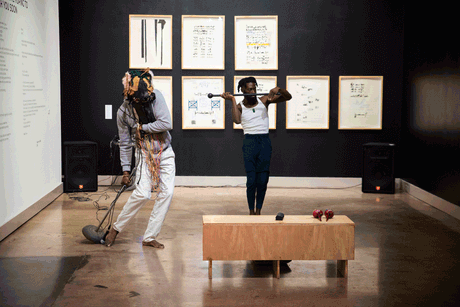
Amid an affordability crisis in art-world hubs such as New York, Los Angeles and Miami, regional art ecosystems are gaining importance all over the United States. A small but mighty force in this dynamic is the Alabama Contemporary Art Center (ACAC), a creative incubator and non-profit in Mobile, Alabama, that is preparing for a major renovation and adopting a transient, “movable feast” model for 2025.
“The most powerful thing we do as a museum is to support creative practice directly and facilitate new work that drives Alabama’s cultural identity forward,” says Elizabet Elliott, ACAC’s executive director and curator. “By partnering with other organisations, big and small, we can leverage what we are best at—seeding growth in the creative economy, being good stewards of risk and creating healthy spaces for dialogue—to extend and build on the mission of partner organisations.”
The centre’s multimillion-dollar overhaul, which will update its current space at 301 Conti Street and a connected building at 304 Government Street in Mobile’s downtown, is expected to take three to five years, requiring the institution to become nomadic in the interim. According to Elliott, letting go of ACAC’s 16,000 sq. ft gallery space involved its own grieving process for staff.
“We are a pure non-profit,” she says. “We are lucky to have a diverse set of support from individual foundations and performance contracts, but it is not a trust or endowment. It’s not the kind of support where we could close down our programming and expect to survive. We were in a position where we knew we really had to radically rethink what we did and what we cared about, what our values are and the programming.”
This radical rethink was especially important given ACAC’s contributions to the wider Mobile art community. Through its status as a regional regrantor with the Andy Warhol Foundation, the centre pumps around $300,000 into the area’s arts economy every year, providing a vital funding channel in a historically underserved community.
Preparing for the loss of ACAC’s home base has meant cultivating a renegade relationship to space. Elliott explains: “For one of the projects we’re doing in 2025, we had planned a pretty traditional exhibition with an artist working in social practice around foodways. She has a visual arts practice, but instead of the traditional model, we’re going to occupy a dead restaurant space. Our downtown landscape has a handful of dead restaurants that never reopened after Covid, so we’re going to take over one of those spaces and have a community dinner and talk about what the foodways relationship is to the lived experience of downtown.”
Nationally, Alabama, the US’s seventh-poorest state, is better known for its frequent role on the front lines of culture war issues than its contemporary art scene. On 1 October, a state bill will go into effect imposing the country’s most sweeping ban on diversity, equity and inclusion programmes in public colleges. Lawmakers are at present debating two separate library bills that would facilitate further book bans. And on 16 February, the Alabama Supreme Court ruled that embryos created through in vitro fertilisation should be considered children. Elliott is hoping ACAC can help change outsiders’ perceptions of the state.
“I’m from the South and I did the obligatory leaving thing and I came back. And the reason that I came back, and that we are here, is primarily because we see this place as soft ground to grow things,” she says. “Something really interesting happens when you’re on a margin, and my experience of larger arts ecosystems is that they’re often really cooked in an idea they have about themselves. There’s something that’s really refreshing and unique that happens when you don’t have a set idea about yourself. The South is much more diverse, intelligent and creative than anybody gives it credit for, and especially more intelligent and creative than it gives itself credit for.”
Creativity with social relevance
For Elliott, the lack of mainstream cultural attention is a boon to creative production in Mobile. “In Alabama, we tend to think that culture is something that happens elsewhere, especially in the arts. But what that means for the artists that are practising here is that they’re freed up from any sort of commercial art world parameter. The art world could not be less relevant to a place like this, so as a curator you cannot curate on the basis of fame or credentials because that doesn’t really mean anything to a Southern audience. What we find most impactful is curating from a place of social relevance.”
Over the past 12 months, ACAC has exhibited the photographer Allison Grant’s series on the chemical and fossil fuel industries in the state, the artist Molly Jae Vaughan’s labour-intensive textile elegy to the lives of murdered gender non-conforming and transgender citizens, and an archival dive into Mobile’s 1980s punk scene.
“Civil rights aren’t something that you can get away with ignoring in a place like this,” Elliott says. “There’s plenty of folks that have direct experiences, lived experiences every day regarding equity building, representation and democratic access to resources. These are really pertinent things to our community and there is a healthy—I’d even say rabid—appetite to delve into those conversations because they’re so present in our landscape.”