
Exoskeletons typically work by implementing motions programmed in advance and having the user call for them, making it difficult to use them for a wide range of motions in real-life environments.


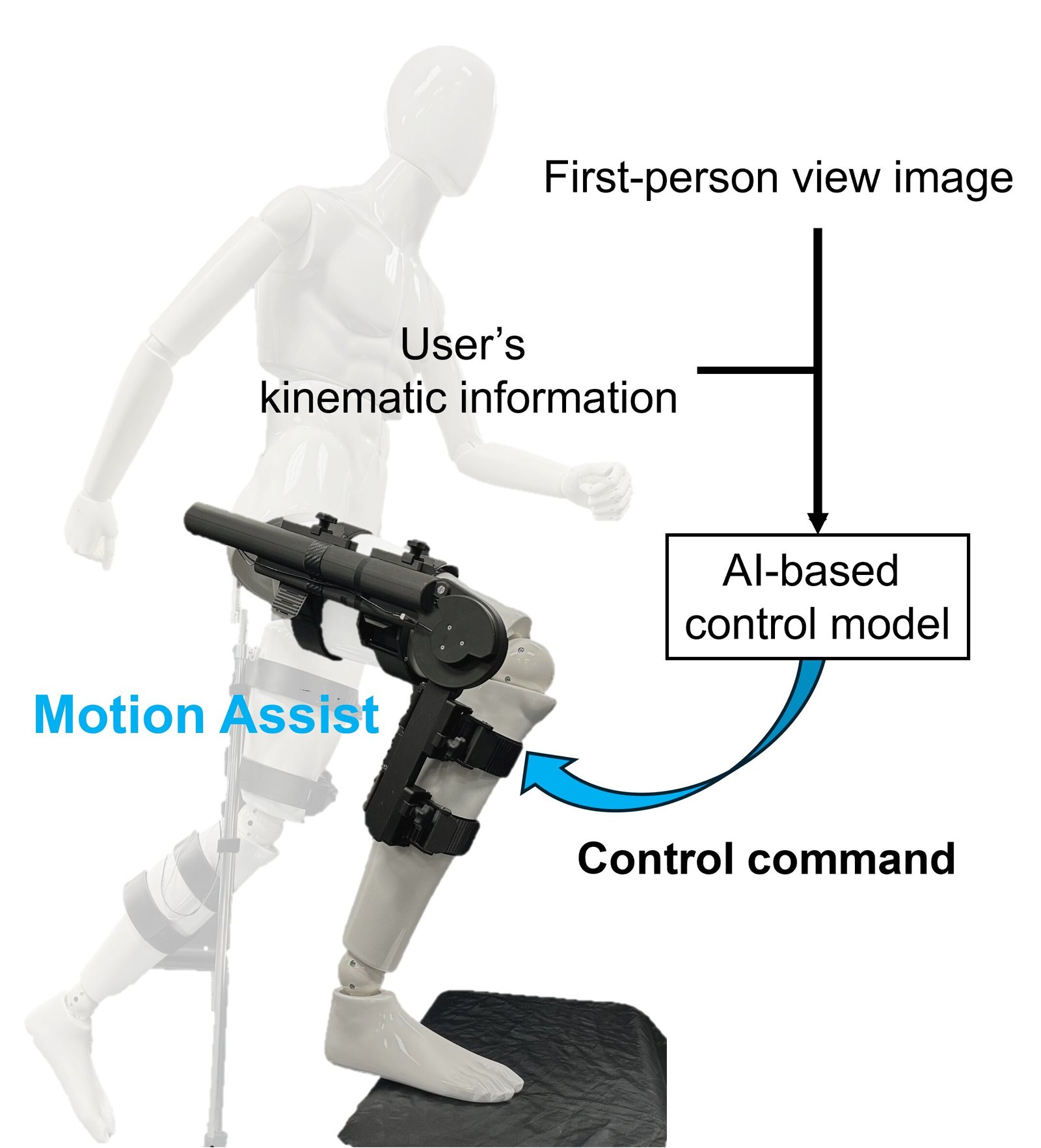
Now, in a notable example of wearable robotics, published in npj Robotics, researchers from the RIKEN Guardian Robot Project in Japan have used artificial intelligence to better assist users, by designing an exoskeleton that functions based on inputs regarding the user’s status as well as a view of the environment based on the user’s perspective.
Exoskeletons—robots that users wear to assist motions that are difficult due to weakness, for example—have attracted significant attention in our aging societies. To enable these robots to move according to the user’s intent, control approaches based on motion intention estimation are being studied and are expected to be applied to a wide range of motions in real-life scenarios.
Up until now, this has mainly been done by using techniques such as EMG—electromyography, which involves placing sensors on muscles that detect when the user is attempting to make a movement. Placing the sensors and calibrating them requires time and effort, however, making it difficult to apply in the field.
To address these limitations, the RIKEN team investigated whether AI, combined with a visual sensor, could be used to make the exoskeleton’s work more efficient.
They developed a system where an AI, in this case a transformer model, would receive inputs from a camera placed near the user’s eyes and kinematic sensors around the knees and torso, and would use this rich set of inputs to provide assistance for a series of tasks—in this case picking up an object and then climbing a step—representative of common daily activities that require different types of physical support.
The results were compelling. The AI-powered assistance system led to a measurable reduction in muscle activation during these movements, indicating that the exoskeleton was effectively supporting the user’s body.
Importantly, the assistive strategy developed from one user’s data could also be generalized to another user, suggesting that the model is capable of cross-user adaptability without retraining—a significant challenge in current exoskeleton technologies.
According to Jun-ichiro Furukawa, the corresponding author of the study, “These findings open new doors for future applications of wearable robots in areas such as health care, rehabilitation, and elderly care. With further development, such systems could offer personalized and adaptive assistance to individuals with mobility impairments or those recovering from injuries—enhancing their independence and quality of life.”
Jun Morimoto, who co-authored the paper, says, “This study represents an important step toward intelligent exoskeletons that can support a wide range of human activities in diverse environments. By using transformer-based AI, our system not only adapts to the current user’s physical state and surroundings but also shows potential for generalized assistance across different users.”
More information:
Jun-ichiro Furukawa et al, Transformer-based multitask assist control from first-person view image and user’s kinematic information for exoskeleton robots, npj Robotics (2025). DOI: 10.1038/s44182-025-00033-4
Citation:
Artificial intelligence enables exoskeletons to assist users more efficiently (2025, September 11)
retrieved 11 September 2025
from https://techxplore.com/news/2025-09-artificial-intelligence-enables-exoskeletons-users.html
This document is subject to copyright. Apart from any fair dealing for the purpose of private study or research, no
part may be reproduced without the written permission. The content is provided for information purposes only.