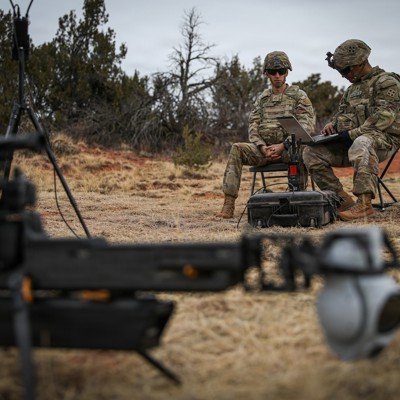
The 4th Infantry Division is working to scale testing of the Army’s next-generation command-and-control system from a battalion to division level by this summer, the division’s commander told reporters on Thursday.
The Colorado-based unit is coming off of more than two weeks in the field for its latest Ivy Sting exercise, Maj. Gen. Pat Ellis said, the fifth since the series began in September. This time, they increased from the ability to shoot from one networked artillery system to six, among other incremental advancements.
“So the joke I like to make is we are no longer fighting with the network. We are now fighting using the network,” Ellis said, alluding to previous iterations of Army command-and-control that kept data on multiple systems and devices that prevented commanders on the battlefield from seeing a full picture all at once.
With more than a dozen vendors involved in its development, led by Anduril and Palantir, NGC2 is one of the Army’s premier experiments within its Continuous Transformation approach to developing new technology: Rather than spend a decade building a program to completion, then sending it out to the field only to learn that it’s out of date or missing key components, the Army is building the prototype while soldiers are testing what it can already do in the field, then offering their feedback about what else they need it to do.
“So largely what is being operated out at Ivy Sting is based on commercial components, commercial software practices, or even straight commercial development,” Joe Welch, the Portfolio Acquisition Executive for C2 and Counter-C2, told reporters. “And we are adopting and adapting those based on the guidance and feedback…to ensure that those technologies are aligned to the way that Gen. Ellis and his division need to be prepared to fight.”
That mostly means that all of the sensors and weapons on the battlefield need to be able to feed what they’re seeing and doing into one system, so that commanders can make informed decisions about next moves.
“So it’s all in one place, and it’s there very, very quickly, so that the staffs can see it across their functional systems,” Ellis said, “You know, the fires person can see what the logistician sees, can see what the intel person sees.”
That’s allowed him to get the information he needs from the software system, rather than “have the hour-long staff meeting” to get updated on what each unit is dealing with.
That includes vehicles and equipment fitted with sensors that track fuel and ammunition levels, so that instead of logistics soldiers having to keep track and write reports, the information goes right into NGC2—and not only can the commander see it, but resupplies can be ordered.
“We’ve got a tank, a Bradley [fighting vehicle] and several strykers that are outfitted with this capability. We’re pulling it in,” Ellis said. “The goal for Sting 5 will be to run that at the battalion level.”
There are also similar sensors on each soldier, tracking their vitals and whether they’ve sustained a casualty. This serves two purposes: medics in the field can track conditions and record treatments that were given at the time of injury, then send that data to surgeons who will receive casualties at a field hospital; and commanders can know how many soldiers are still in the fight and send in the correct reinforcements.
Ivy Sting 4 also tested the soldiers on how to function if something goes wrong with NGC2, like a simulated electromagnetic jammer they had to find without a satellite feed and take out with mortars.
“So in other words, a denied, degraded, intermittent, and limited environment where we were essentially cut off from the division’s cloud, but we were still able to battle track and execute our tasks at the squadron level internally,” said Lt. Col. Shawn Scott, who commands 4th Squadron, 10th Cavalry Regiment, 3rd Brigade Combat Team. “And then, as we eliminated that simulated jamming threat, and we were able to reestablish connection back with division and brigade, we watched how our feeds fed back into division, and likewise, division back down to us seamlessly.”
The next step, for Ivy Mass in May, Scott said, is to bring out a red team from Army Training and Transformation Command to further attack the system and force 4th IDto diagnose and fix issues without warning.
The division will show off what they can do as a full division this summer at Project Convergence Capstone 6, Ellis said, then get right back to the next Ivy Sting.
“I can tell you that we already have on the calendar, about a month and change after PCC 6, we have Ivy Sting 7,” he said. “So we will continue the Sting series at the pace and volume that we’re doing now for Sting 8, Sting 9, Sting 10, as a lead up to what may happen in ‘27, is another opportunity for us to have the whole division fight.”