The proliferation of inexpensive, effective, and attractive Unmanned Aerial Vehicles (UAVs) on the modern battlefield has sparked a pressing debate. From the Nagorno-Karabakh conflict to the plains of Ukraine, loitering munitions and Unmanned Combat Aerial Vehicles (UCAVs) like the Bayraktar TB2 have challenged conventional forces, inflicting heavy losses on armour and logistics.
Drones have altered the dynamics of aerial warfare by targeting assets that once held clear advantages in mobility and firepower. Attack helicopters, prized for their ability to deliver precise strikes and support ground operations, now encounter risks from these inexpensive unmanned systems.
In multiple conflicts, drones have destroyed helicopters both on the ground and during flight, revealing weaknesses in rotorcraft defences. For African militaries, which often deploy helicopters in counter-insurgency and border patrols against groups using off-the-shelf drones, these events provide direct guidance on adjusting strategies to protect vital air support.
In Ukraine, where the conflict has driven rapid advancements in drone tactics, Russian forces have lost several helicopters since the start of the conflict in 2022. Ukrainian drones and air defences have compelled Russia to reposition its rotorcraft farther from front lines and relocate bases deep into its territory to evade strikes. This adjustment has lowered the helicopter loss rate over the past year, but it has also shaped requirements for future designs like the PAK AA, which seeks greater range and speed than current models such as the Kamov Ka-52 and Mil Mi-28N. Those helicopters achieve maximum speeds of about 300 kilometres per hour and combat radii of roughly 200-250 kilometres on internal fuel. Operations now occur at distances of several hundred kilometres, limiting immediate responsiveness but preserving assets.
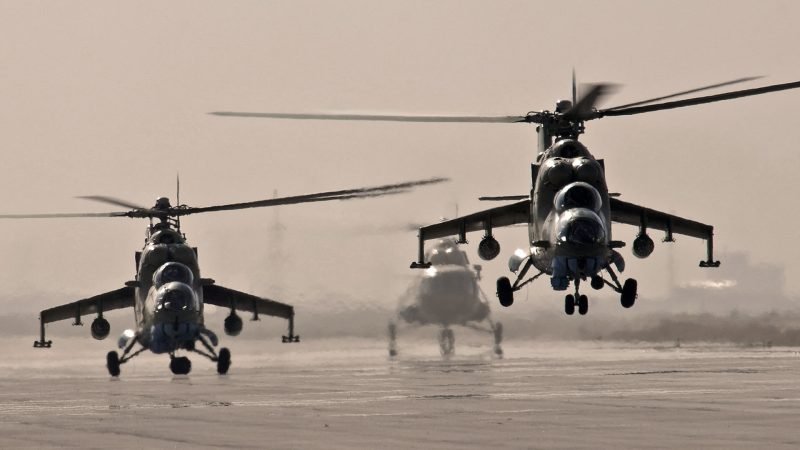
This new reality has cast a shadow over one of the Cold War’s apex predators: the attack helicopter. The war in Ukraine has provided a brutal testing ground. Russia’s advanced Ka-52 “Alligator” and Mi-28 “Havoc” helicopters, platforms designed to hunt tanks, have themselves been hunted. They have proven exceptionally vulnerable to Man-Portable Air-Defence Systems (MANPADS). Their operational profile—flying relatively low and slow to identify and engage targets—places them squarely in the kill zone of cheap, shoulder-fired missiles.
These substantial losses, combined with the high cost and irreplaceable loss of highly trained crews, have led analysts to question the platform’s future. When a $325,000-$2 million USD drone can neutralise a $50 million helicopter, the economic and tactical arguments for the traditional attack helicopter seem to weaken.
The Enduring Case: Payload and Presence
Despite these vulnerabilities, the attack helicopter is not obsolete; its role is undergoing a forced evolution. The platform retains several core capabilities that a drone-centric air force cannot replicate.
The most crucial difference is firepower, or “magazine depth.” An AH-64E Apache helicopter can carry a devastating load: typically 16 AGM-114 Hellfire missiles, 76 70mm rockets, and 1,200 rounds of 30mm cannon ammunition. In contrast, a Bayraktar TB2 carries a maximum of four small, laser-guided MAM-L missiles. For a “troops-in-contact” scenario where a ground unit is being overrun, the helicopter provides a volume of immediate, sustained, and varied fire that no current UCAV can match.
Furthermore, a helicopter provides a unique combination of speed, agility, and presence. While a Medium-Altitude Long-Endurance (MALE) drone offers persistence, it is slow. A helicopter can reposition across a theatre at 150 knots, escort transport aircraft, and insert Special Operations forces.
Perhaps most importantly, the crew provides unmatched situational awareness and judgment. The “Mark I Eyeball” of a pilot and gunner, augmented by advanced sensors, allows for a rapid, dynamic understanding of a complex battlefield. This is essential for the split-second decisions required in Close Air Support (CAS), especially in urban areas where distinguishing friend from foe is paramount and the rules of engagement are complex.
The Evolution: Manned-Unmanned Teaming
The future of the attack helicopter is not as a lone hunter, but as the networked “quarterback” of a robotic team. The doctrine of Manned-Unmanned Teaming (MUM-T) is now central to the platform’s survival and relevance.
Modern attack helicopters, such as the AH-64E Version 6 (v6), are now flying command posts. The crew no longer needs to fly into the teeth of enemy air defences. Instead, they “stand off,” using their datalinks to control multiple UAVs from the safety of their cockpit. The U.S. Army has defined this as a high Level of Interoperability (LOI), where the helicopter crew can view the drone’s sensor feed and control its flight path and payload directly.
In this new model, the helicopter stays low and masked, 10 to 20 kilometres from the fight, well outside the range of MANPADS. It then sends its unmanned “loyal wingmen” forward to find, fix, and identify the enemy.
This doctrine is fundamentally changing weapon-systems design. Instead of relying on direct line-of-sight Hellfires, crews can use the drone’s sensors to guide next-generation, non-line-of-sight (NLOS) missiles. Platforms are being integrated with weapons like the Rafael SPIKE NLOS, which allows a helicopter crew to fire a missile and guide it to a target 30 to 50 kilometres away using video feed from the missile’s own seeker. The drone finds the target, the helicopter services it from an invulnerable distance, and the crew remains safe.
This evolution was the entire basis for the U.S. Army’s Future Vertical Lift (FVL) program. While the Future Attack Reconnaissance Aircraft (FARA) program was cancelled, the core principle remains: future rotorcraft are being designed as “system of systems” hubs, built to launch and control a swarm of “Air-Launched Effects” (ALEs).
The era of the attack helicopter as a low-level brawler, akin to a World War II tank-hunter, may be ending. But its role as a lethal, responsive, and intelligent airborne command post for a team of unmanned systems is just beginning.