

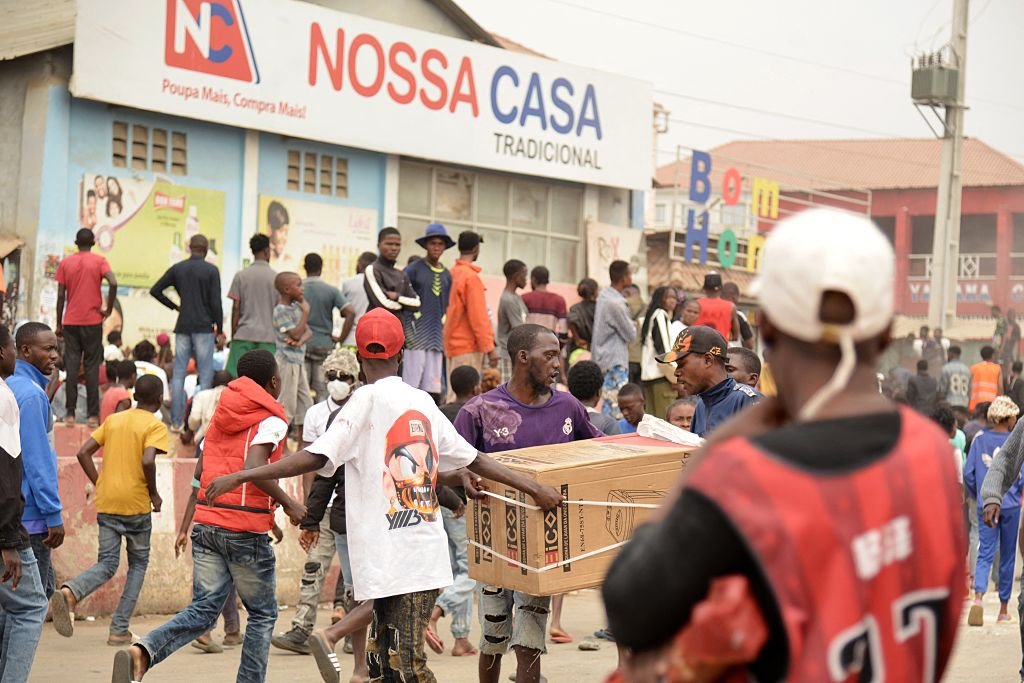
Public anger over a sharp rise in fuel prices in Angola triggered three days of violence, some of which was directed at the country’s large Chinese community. The violence destroyed shops, closed factories and caused thousands of Chinese residents to flee the country.
Based on reports, the rioting grew out of protests over the Angolan government’s decision to reduce subsidies on gasoline. The rioting preceded the government’s action in August to shut down 25 illegal Chinese cryptocurrency mining operations and expel 60 Chinese nationals involved in it.
Cryptocurrency mining is banned in Angola because of the burden it places on the country’s electrical grid. In the mining people use special computer hardware to solve complex mathematical puzzles that validate and record transactions on a blockchain in exchange for cryptocurrency rewards. The Chinese nationals arrested as part of the crackdown were given 24 hours to leave the country.
Recent video shared by BBC Zimbabwe and other news channels shows dozens of Chinese nationals flooding into Luanda’s international airport, many pushing wheeled bags. In the video, a man can be heard speaking to departing Chinese outside the airport in Portuguese and telling them in English “bye-bye.”
Angola is home to about 300,000 Chinese citizens, one of the largest Chinese communities on the continent. Chinese citizens own factories and mines in the country. They also play a large role in Angola’s construction industry and in its retail markets. Nearly 100 Chinese-owned shops in Luanda were vandalized when violence erupted in late July.
The sudden outburst of violence against Angola’s Chinese residents reflects a growing resentment toward the Chinese, whom many Angolans see as exploiting them and the country as a whole, according to analysts.
In 2024, Angolan authorities shut down two Chinese factories for breaking local laws. A metals processing facility was operating without a license and polluted a local river. A plastics factory was accused of keeping its 113 Angolan employees locked in and living in unsanitary conditions. Angolan artisanal fishermen also complain that Chinese trawlers are devastating the fish stocks they rely on for their livelihood.
Angola’s Chinese-fueled economic growth over the past two decades has led to corruption and sharp socioeconomic disparities across the country, with the upper 20% of society benefiting the most from deals with China and the lowest 20% seeing little of that largesse.
Angola has been Africa’s biggest beneficiary of China’s Belt and Road Initiative, which has provided the country with $68.6 billion in loans for crucial infrastructure between 2000 and 2021, according to AidData, a project that tracks Chinese Belt and Road investments around the world.
Among other things, Chinese loans built the new Dr. Antonio Agostinho Neto International Airport that opened in 2024. The new facility can serve 15 million passengers and 600,000 tons of cargo a year. It is the largest Chinese-financed airport outside China, according to AidData.
Angola agreed to repay its debt to China with oil exports. In recent years, however, because China has shifted its oil imports away from Africa and toward Russia and the Middle East, Angola has struggled to repay the billions of dollars it still owes.
Adding to Angolans’ resentments against China was the fact that, as in other African countries, much of the work on Angola’s Belt and Road projects was done by Chinese companies and Chinese workers. Angolans who were hired typically worked as manual laborers.
In some cases, the finished Chinese projects suffered setbacks. In 2010, for example, the $8 billion Chinese-built Luanda General Hospital was forced to close shortly after opening when cracks in the building raised the possibility that it might collapse. It reopened two years later after extensive repairs.
“Chinese investments did not fulfill the expectations of improving Angola’s technological capacity and infrastructure,” analyst Sumie Yoshikawa wrote earlier this year for the Eurasian Review. “In addition, many of the roads, houses, and buildings constructed by Chinese companies were of remarkably low quality.”


