

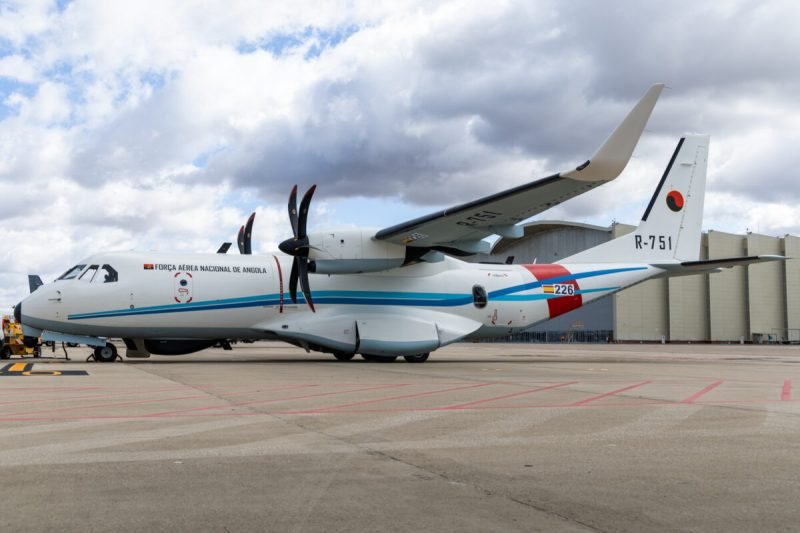
Airbus Defence and Space has completed a three-aircraft order for Angola, delivering two C-295 Maritime Surveillance Aircraft (MSA) on or around November 7, 2025. This delivery, which follows a transport-configured C-295W delivered in July 2024, provides the Angolan Air Force (Força Aérea Nacional de Angola, or FANA) with a modern, dedicated aerial surveillance capability that it has lacked for over three decades.
The acquisition restores a specialised maritime patrol function that was effectively lost in 1988 when the FANA’s lone Fokker F27-200MAR was transferred to the state airline. For decades, the air force has relied on ad-hoc solutions, including its fleet of ageing Soviet-era Antonov transports and a small number of light aircraft, such as a single CASA C-212 and a Cessna Citation, for limited surveillance duties. The first aircraft was ferried from the Airbus manufacturing facility in Seville, Spain, to Angola in July 2024. It (T-214) is in transport configuration.
This delivery marks a substantial leap from that ad-hoc posture to a purpose-built, 21st-century system. The aircraft will be central to Angola’s efforts to secure its 1,600-kilometre coastline, protect vital offshore oil and gas infrastructure, and combat illicit activities in the Gulf of Guinea.
The C-295 MSA
The Angolan aircraft are the C-295W variant, which is visually distinguished by its “winglets” or upward-curving wingtips. These are not merely aesthetic; they provide aerodynamic benefits, particularly in the “hot and high” conditions common in Southern Africa, while also reducing fuel burn by an estimated three to six per cent.
As a platform, the C-295 is a twin-turboprop, which presents a clear trade-off against jet-powered patrol aircraft. While it is slower, with a maximum cruise speed of approximately 260 knots, its primary advantage is endurance. The Pratt & Whitney Canada PW127G engines are highly efficient, enabling the C-295 MSA to conduct persistent surveillance missions lasting over 11 hours. This long loiter time is essential for the “dull, dirty, and dangerous” work of maritime patrol: searching vast swaths of ocean for small, non-cooperative targets.
The platform is also known for its Short Take-Off and Landing (STOL) capability, allowing it to operate from unpaved or short runways, a useful feature for deployment to forward operating bases along the coast. For the flight crew, the aircraft is equipped with a modern Collins Aerospace Pro Line Fusion avionics suite, a “glass cockpit” that reduces pilot workload and enhances situational awareness.
Airbus FITS
The true capability of the MSA variant resides in its mission bay, not the cockpit. The two new Angolan aircraft are the first C-295s in Africa to be equipped with the Airbus Fully Integrated Tactical System (FITS). FITS is the “central nervous system” of the aircraft, an open-architecture mission suite that integrates data from multiple sensors and presents it to the operators at two or more onboard consoles.
This system allows the crew to fuse information into a single, coherent tactical picture. The FITS suite on the C-295 MSA is built around a core set of sensors. While the full loadout can vary, the primary tools for the surface-surveillance role are a 360-degree, multi-mode search radar (capable of modes like Synthetic Aperture Radar (SAR) for imaging) and an Electro-Optical/Infrared (EO/IR) turret. The radar can detect targets at long range, and the EO/IR turret is then used to visually identify them as friendly, neutral, or suspicious, day or night.
The system also integrates an Automatic Identification System (AIS) receiver to track legitimate, transponder-equipped shipping, helping operators quickly spot “dark” vessels that are not broadcasting their identity. This entire data package can be shared in real-time with naval assets or command centres on the ground, turning the aircraft into a networked surveillance hub.
The Angolan Ministry of Defence, through its procurement company Simpotex, finalised the $196.7 million contract for all three aircraft in 2022, with the deal reportedly announced in 2018. The acquisition was financed by Spain’s Banco Bilbao Vizcaya Argentaria (BBVA), a common procurement model for large European defence sales.
The strategic imperative for this purchase is clear. Angola’s economy is heavily dependent on its offshore energy reserves, which require protection. Furthermore, its waters are a prime target for illegal, unreported, and unregulated (IUU) fishing, which costs Gulf of Guinea nations hundreds of millions of dollars annually. The C-295s will provide the aerial overwatch for Angola’s inter-agency maritime security efforts, vectoring its naval patrol vessels to intercept targets.
By selecting the C-295, Angola is also buying into a proven and popular platform. Airbus notes that 54 C-295s have been ordered by 11 African air forces, with Egypt and Ghana being other prominent operators. While Angola is the first to fly the dedicated FITS-equipped MSA version, its choice of the C-295 platform ensures a degree of regional commonality for a system that is rapidly becoming the continent’s standard medium-lift and surveillance aircraft.


