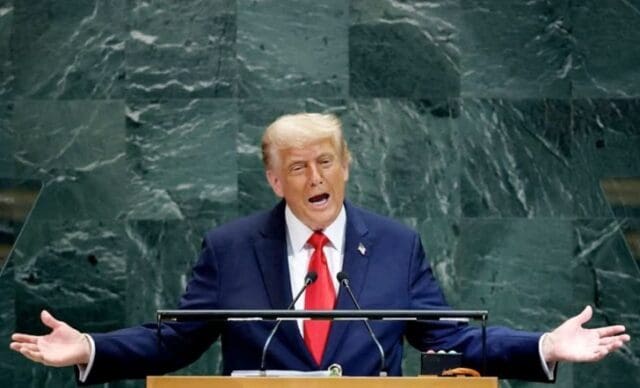
September 24, 2025 — UN, New York. President Donald Trump returned to the world stage this week with a fiery address at the United Nations General Assembly, making headlines for his defiant tone, controversial claims, and a noticeable teleprompter malfunction that set the tone for a chaotic but unmistakably Trumpian performance. This event has sparked extensive discussion on Trump’s UN Speech, analyzing its impact and implications.
Here are the key moments from his speech:
– Advertisement –
1. A Rough Start: Teleprompter Trouble
Trump’s speech began awkwardly, as the teleprompter appeared to malfunction during his opening remarks. Pausing mid-sentence and visibly frustrated, Trump improvised for several minutes.
“You know, sometimes technology doesn’t work, but I always do,” he quipped, prompting an uneasy chuckle from the audience. While some parts of the speech eventually returned to script, much of it bore the hallmark of Trump’s freewheeling rally style.
2. “I Ended Seven Wars” — A Bold and Unverified Claim
In one of the more striking moments, Trump claimed credit for achieving what he described as “an unmatched era of peace.”
– Advertisement –
“During my presidency, I ended seven wars. Seven. You won’t hear that from the fake news,” Trump declared.
He did not specify which conflicts he was referring to, leaving analysts scrambling to interpret the statement. Trump’s UN Speech: Analyzing these claims requires sifting through complex geopolitical realities. While his administration pursued troop drawdowns in Afghanistan, Iraq, and Syria, none were officially declared as “ended” during his tenure, and several conflicts persisted beyond his presidency.
3. Sharp Criticism for UN Inaction on Global Crises
Trump took direct aim at the United Nations itself, accusing the body of offering “empty words” while failing to address mounting global challenges. Trump’s UN Speech: Analyzing the criticism shows an attempt to redefine international accountability.
“While nations burn and borders collapse, the UN offers only statements, not solutions,” Trump said. “People are tired of speeches — they want action.”
He singled out ongoing conflicts in Ukraine, the Middle East, and Africa as areas where he believes the UN has been “asleep at the wheel.”
4. Pushback Against Recognition of a Palestinian State
In one of the most charged moments, Trump rebuked recent moves by European and Latin American nations to formally recognize a Palestinian state, calling it “a betrayal of peace.”
“You do not make peace by rewarding terror,” Trump said. “Recognizing a state born out of violence sends the wrong message to both sides.” Analyzing Trump’s UN Speech with regard to the Middle East indicates a renewed emphasis on unilateral peace strategies.
This marked a clear departure from current U.S. policy under President Biden, who has supported a two-state solution while calling for de-escalation in the region.
5. A Call for Europe to “Step It Up” on Russia
Echoing themes from his earlier presidency, Trump criticized NATO allies for not contributing enough to defense efforts, particularly in the face of continued Russian aggression in Ukraine.
“Europe needs to step it up. The U.S. can’t do all the heavy lifting,” Trump said. “It’s time they meet their obligations — or face the consequences.”
The comment was met with mixed reactions in the chamber, with some delegates appearing visibly uncomfortable. Trump’s transactional view of alliances has long been a point of contention with traditional U.S. partners.
6. “You’re Going to Hell” — Trump’s Rant on Migration
In one of the most jarring moments of the speech, Trump lambasted countries for their immigration policies and accused them of enabling chaos. Trump’s UN Speech: Analyzing this aspect reveals a clear pivot back to domestic campaign issues.
“You’re going to hell. That’s where your countries are headed if you don’t fix the migration disaster,” he said bluntly.
He blamed what he called “open-border insanity” for rising crime, economic instability, and the erosion of national identity — rhetoric that mirrored his domestic campaign themes.
7. Climate Change: “The Greatest Con Job Ever”
Trump once again rejected the scientific consensus on climate change, denouncing international climate efforts as a scam.
“Climate change is the greatest con job ever perpetrated on the world,” he declared. “They want to control your lives, your energy, your freedom — all in the name of a hoax.”
The comment triggered audible murmurs and some boos from the chamber, particularly from EU and island nation representatives, many of whom have experienced direct climate impacts in recent years.
8. U.S.–Brazil Tensions on Display
The sharpest geopolitical contrast came not from Trump’s speech alone, but in the back-to-back address by Brazilian President Luiza Carvalho. While Trump railed against migration, climate policy, and “globalist elites,” Carvalho called for unity on environmental protection, humane migration strategies, and defense of democratic norms.
“We will not be bullied into abandoning science, compassion, or sovereignty,” Carvalho said — a not-so-subtle rebuke of Trump’s tone.
Relations between the U.S. and Brazil have cooled significantly in recent months, and the two speeches underscored a widening divide in worldview and diplomacy.
Conclusion: A Familiar Voice, a Sharpened Edge
Trump’s UN speech was vintage Trump — combative, unpredictable, and aimed squarely at his base. While the teleprompter glitch may have rattled the delivery, it did little to soften the speech’s sharp rhetoric or undermine its political purpose. Trump’s UN Speech: Analyzing the consequences suggests a continual influence on global diplomacy.
With the 2024 U.S. presidential election still casting a long shadow over international diplomacy, Trump’s address served both as a reminder of his enduring influence and a preview of the foreign policy approach he might bring should he return to office.