

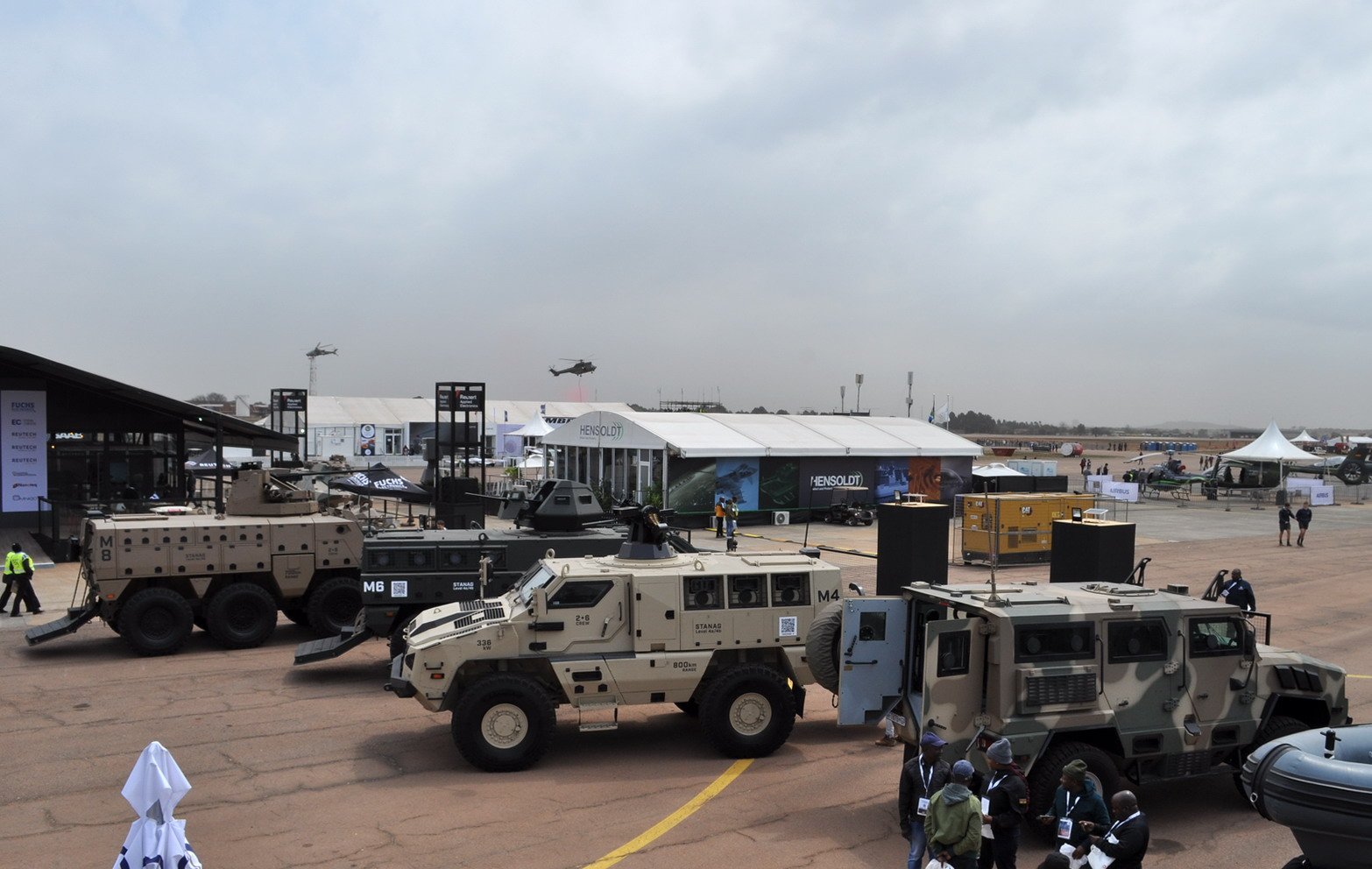
This year marks the silver jubilee for the Africa Aerospace and Defence (AAD) exhibition, which will see the 2026 iteration introduce a new project dedicated to collaborations between companies in the South African defence industry.
Evolving from the general practice of companies exhibiting only as stand-alone entities, the Aerospace, Maritime and Defence Industries Association (AMD) of South Africa identified the need to also provide a dedicated platform for local industry members to present collaborative projects to their target audience. The initiative will be showcased on the Defence Collaboration Stand in the AMD CLASSS Pavilion from 16 to 20 September at Air Force Base Waterkloof.
AMD Marketing Chairperson Colin Singarum told DefenceWeb a shortcoming identified in the traditional expo model is that having isolated companies exhibiting their products individually often makes it difficult for the target audience to recognise exactly how all the various systems, subsystems and components on offer can be integrated into the overall solutions they are looking for. The costs involved to build consolidated fully-functional technology demonstrators (TDs) and prototypes can be cost-prohibitive (particularly for smaller companies), posing a large financial risk should the message communicated on the show fail to translate into tangible orders. Consequently, Project CLASSS envisages the same benefits for large, medium and small entities across the local defence landscape, by pooling resources and expertise together in order to “Hunt as a Pack”.
Project CLASSS is made up of six sectoral pillars, namely Cyber; Land; Air; Sea; Space and Security (predominantly dedicated to border security). AMD will facilitate the partnering of members to collaborate on featured technology demonstrators in these respective categories.
The value of MPDs
Singarum points to collaboration between Original Equipment Manufacturers (OEMs) and related system/sub system providers to create Marketing Product Demonstrators (MPDs), spreading the cost burden and risk. He envisages several companies (typically 5 or 6) each contributing their own speciality to the envisaged end-product/s. If structured correctly, this can also provide Enterprise Supplier Development (ESD) points for AMD members, which will add up to incentives from government: for example, if companies spend on partners for their MPD when a contract is in place, they will probably meet the 3% spend to gain ESD; even the 1% spend for Corporate Social Investment (CSI), making the achievement towards Broad-Based Black Economic Empowerment (B-BBEE) credits part of the collaboration and not a burden or a challenge later.
Examples of collaborative MPDs
To illustrate the value of MPDs in reputational terms, Singarum notes that “Denel Aerostructures was involved in the Airbus A400M heavy-lifter transport aircraft programme by designing and manufacturing the wing-to-fuselage fairing and top shelf section. This collaboration allowed the South African flag to be displayed on the completed aircraft as a strategic partner as the aircraft rolled out on the global stage. From a marketing perspective, this visibly elevated us into an esteemed aviation circle on a large project that couldn’t have been undertaken alone. Likewise with Paramount’s collaboration with Airbus in the AS550 light utility helicopter modification…that involved 20 different companies from OEMs to SME.”

Multiple companies collaborated to provide subsystems onto the helicopter, including a helmet-mounted display, electro-optical turret, mission display, GPS receiver, air data, attitude and heading reference system (ADAHRS), mission computer, computers and weapons, including 12.7 mm gun pods and 70 mm unguided rockets. The AS550 was widely displayed, including at Africa Aerospace and Defence shows, resulting in firm orders, notably from the Middle East.
A wide range of products right across the industry spectrum could be supplied by local companies for a Marketing Product Demonstrator: “For land applications the needs are broad and opportunities abundant. The Department of Defence (DoD) has around 500 Ratels that serve as a proven battle-tested platform, which can be modified with new equipment to serve various roles on the modern battlefield, since they are sturdy enough to mount 30 mm cannons along with all the high-tech systems to support it. Ratels are also found in nine other African countries including Ghana, Rwanda and Zambia, that can easily be repurposed or modernised. For typical light-skin applications, agile offroad SUVs like Toyota Land Cruisers (which are widespread and serviced by an extensive network of dealerships) can act as the base platform, with 12.7 mm machine guns mounted on them as part of an anti-drone package.
“For maritime patrol South Africa can manufacture fast patrol boats with coastal radar tracking systems to work in conjunction with Unmanned Underwater Vehicles (UUVs) – or even be developed into AI-driven Unmanned Surface Vessels (USVs). For border security, many types of locally developed drones can be equipped with Forward-Looking Infra-Red (FLIR) pods, again with the option of AI integration… The list of applications providing opportunities for local collaborations are only limited by industry’s imagination when it comes to providing solutions to problems faced around the world today,” he added.
Thongwane Namane, Director: Commercial at the SCS Aerospace Group and the Vice Chairperson of the AMD Space Committee, echoed his sentiments regarding how the project ties into space applications as follows: “South Africa has rapidly evolved into a regional leader in space science, shifting from a focus on pure research to the application of space-based data for socio-economic and security needs. Three critical pillars of this strategy are increasing agricultural yields for food security, Maritime Domain Awareness (MDA) in regard to special economic zones in the Blue Economy and Critical Infrastructure Monitoring, all of which are central to the nation’s security and economic stability.”
South Africa’s Exclusive Economic Zone (EEZ) covers a vast area of approximately 1.5 million square kilometres. Monitoring such a massive area for illegal fishing, piracy and oil spills is possible via satellites equipped with high-resolution sensors to detect “dark targets” (vessels that have turned off their Automatic Identification Systems [AIS] to avoid detection). The MDASat Constellation developed by the Cape Peninsula University of Technology (CPUT) with Astrofica Technologies and the FleetSAR Constellation developed by the SCS Aerospace Group are being developed to provide data, as close as possible to real-time, to collect AIS, VHF Data Exchange Service (VDES) signals and satellite imagery to significantly improve the state’s ability to track maritime traffic and improve national security in South Africa’s territorial waters.
For Critical Infrastructure Monitoring, space applications are increasingly used to safeguard South Africa’s land-based assets, including power grids, water pipelines, and transport networks. Recent initiatives have seen the integration of space data into “Digital Twin” platforms where these platforms provide a real-time, holistic view of infrastructure performance, allowing for proactive maintenance and anomaly detection before a failure occurs.
While satellites can serve as eyes in the sky, Project CLASSS can function as the “brain,” linking satellite data to ground-level operations. This ensures effective monitoring and protection of South Africa’s vast maritime and land resources. By developing tactical sovereign capabilities through local aerospace and defence expertise, the project can reduce reliance on foreign-controlled data for national security.
This illustrates the broad scope of the initiative, with ample room to incorporate many different skillsets across the local industry spectrum. All companies involved will benefit from a shortened lead time and lower cost, while getting to be seen together with industry leaders, adding credibility for smaller players and allowing bigger players to focus on their core function.
“Showing the collective strength of our AMD members when working as a united industry under the motto ‘Build it and They Will Come’ aims to attract international market representatives, demonstrating that by building real, practical solutions, we attract attention, customers and investment by embracing innovation, resulting in transformative, exportable solutions,” Singarum said.
How AMD facilitates collaboration
AMD’s Marketing Committee sent out partnership applications to all AMD members on Thursday 19 March. In cases where several local companies supply similar products, the one that best suits the criteria, is most readily available to be delivered within the necessary timeframe and has a broad spectrum of local subsystems suppliers, will be the preferred MPD partner – however, since multiple projects within the six categories are envisaged, AMD’s aim is to involve as many companies as possible in some form or another. Companies with dual-use products may also be involved in more than one collaborative project – the goal is to develop potential wherever it exists and create a catalyst to reach the market more quickly and close deals.


