A year and a half after announcing its intention to acquire iRobot, Amazon’s deal is officially dead. All parties involved anticipated some level of regulatory scrutiny, but after a few decades of tech company consolidation, few expected this much friction. The deal had already passed through select international regulatory bodies, including the U.K. Ultimately, however the European Union’s recent clamping down on perceived anti-competitive M&As proved to be the final nail in the coffin. This morning’s news also finds iRobot laying off 350 people – amounting the nearly one-third of its total headcount — as long-time CEO Colin Angle steps down.
“iRobot is an innovation pioneer with a clear vision to make consumer robots a reality,” Angle said in a release. “The termination of the agreement with Amazon is disappointing, but iRobot now turns toward the future with a focus and commitment to continue building thoughtful robots and intelligent home innovations that make life better, and that our customers around the world love.”
The deal has already taken some toll on the firm, including two rounds of layoffs. Last July, Amazon lowered its purchase price 15%, from $1.7 billion to $1.4 billion. The news came as iRobot announced that it was raising $200 million to continue operations after the initial deal was expected to close.
“iRobot is taking on new financing that we believe is sufficient to support our operations in a hyper competitive environment and meet our liquidity needs as well as pay off iRobot’s existing debt,” Angle said at the time.
The phrase “hyper competitive environment” is a telling one. It effectively does two things. It explains the need for fresh cash, in the midst of financial struggles that pre-dated the acquisition announcement. It also speak to the broader regulatory scrutiny around the deal. When it was first announced, there were two key sticking points among critics.
The first and less discussed was privacy. Roombas have mapping capabilities and Amazon has often faced criticism over its decisions to offer Ring cam security footage to law enforcement. The idea of letting the company into private residences in this way has understandable given many advocates pause.
The second and ultimately larger sticking point is competition. Amazon has the biggest retail billboard on the internet. The company could have, in theory, promoted Roombas in way that shut out the “hyper” competition.
There’s no question, of course, that the environment is dramatically more competitive than the one iRobot entered into 20 years ago. When iRobot finally found its groove in the robot vacuum space after years of false starts (including baby dolls and lunar rovers, to name a few), the company finally hit upon what – to date – remains the only successful home robot on a meaningful scale. Angle likes to say that he finally found success as a roboticist after becoming a vacuum salesman. It’s a cute line that gets to the heart an industry that requires the identification of needs in other fields in which most roboticists are not well-versed.
After two decades, the robot vacuums exist on their own island. That’s certainly not for lack of trying on the part of iRobot or the competition. It seems like every year another “companion” robot comes and goes. Neither can the issue be blamed on lack of demand. Above all, it’s a technology problem. There are currently a lot of constraints on the functionality of hardware automation that is acceptably priced for consumers – and this likely won’t be changing any time soon.
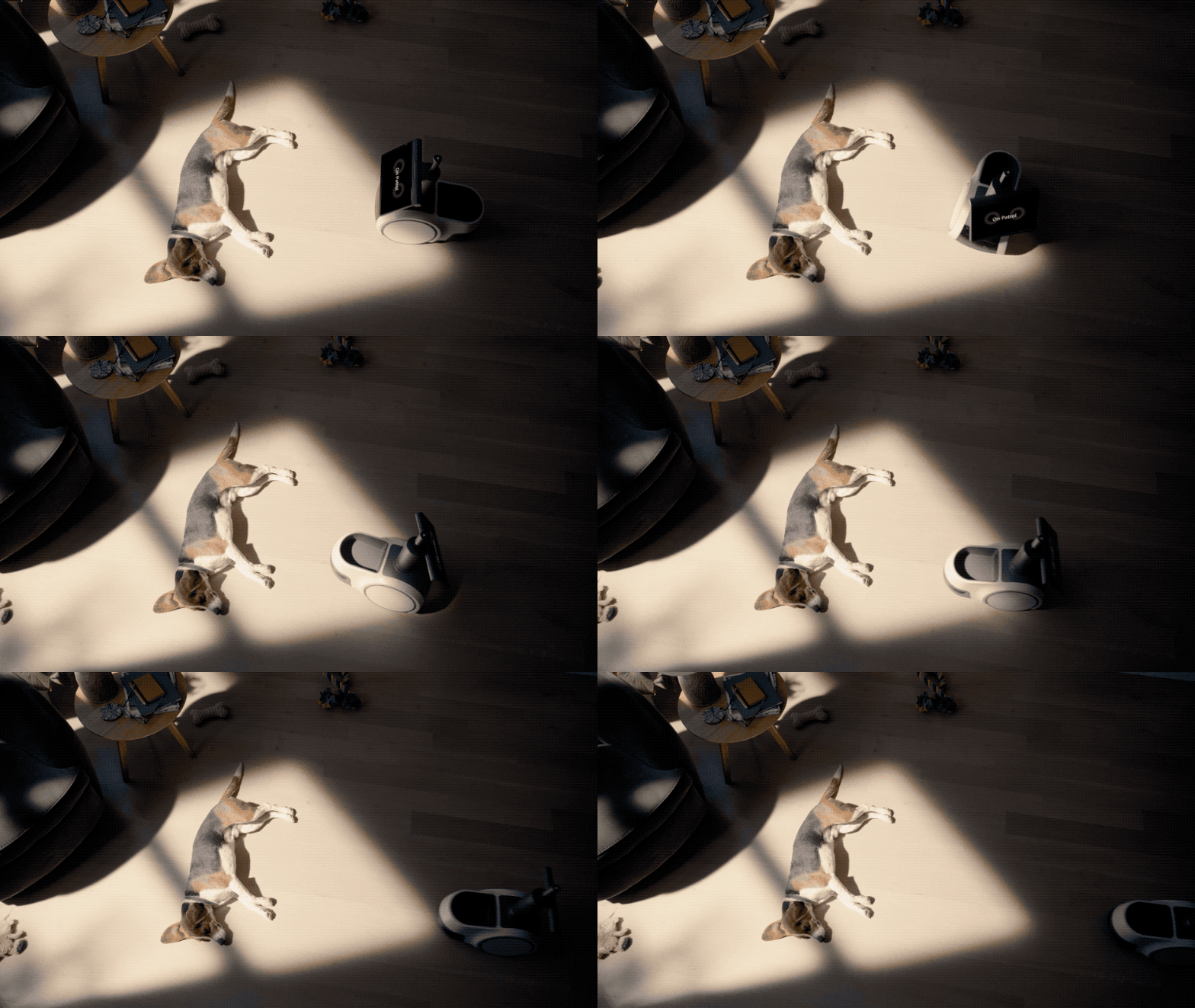
Image Credits: Amazon
Look at Amazon’s Astro robot. It’s cute, it’s compelling, it does some interesting things (the periscope security camera is a genuinely clever innovation that gets around the Roomba’s limited vantage point). But it didn’t exactly set the world on fire. At this point, it’s probably best classified as an interesting experiment. That’s not to say that Amazon is done with it or other home robots (it’s not), but presently it feels like a bit of an evolutionary dead end. I would, however, love to be proved wrong here.


Meanwhile, the are now dozens of robot vacuums. Some come from bigger names like Samsung and Dyson, while far cheaper models have flooded the market. Search for “cheap robot vacuum” on Amazon and you’ll find a ton of options under $100. iRobot’s focus, on the other hand, has been pushing the state of the art, resulting in robots that top out around 10x that amount when you factor in things like the self-cleaning bin.
iRobot has certainly felt the pinch of the category it created. Remember the gutter-cleaning Looj or pool cleaning Verro? Over the years, the company has looked to apply the Roomba’s successes to different parts of the house to an uneven record of success. The lawn mowing Terra, meanwhile, was hit hard by Covid and supply chain constraints. It was indefinitely put on ice nearly four years ago, and this morning’s news doesn’t bode well for the project’s future.
That decision, of course, will ultimately fall on the person who steps in as the second CEO in iRobot’s 34-year history. Currently, executive vice president Glen Weinstein is stepping into the interim role.
Layoffs should always be mourned for the toll they take on individuals, who are too often singled out arbitrarily. That absolutely applies to the multiple rounds iRobot has undergone in recent years. Since its founding in 1990, the company has been one of the pillars of greater-Boston’s thriving robotics ecosystem. A year or two after I started, TechCrunch held a private dinner for Boston robotics luminaries, and it seemed as though nearly every guest had been involved with iRobot one way or another over the years.
Boston robotics will ultimately be okay. Those extremely talented individuals who are no longer with the company will form the next generation of world changing robotics startups. This is sad, hard news, but I’m not too worried about those smart and capable individuals at the end of the day. They will do great things. Nor am I particularly worried about the future of the home robot. It’s had a slow start that may stretch out even longer, but soon enough we’ll be seeing key breakthroughs in AI, navigation and mobile manipulation that will engender a new crop of capable home robots.
Hopefully, in spite of its struggles, iRobot will continue to play a key role in that world.