


Deep learning models, such as convolutional neural networks (CNNs) and recurrent neural networks (RNNs) are designed to partly emulate the functioning and structure of biological neural networks. As a result, in addition to tackling various real-world computational problems, they could help neuroscientists and psychologists to better understand the underpinnings of specific sensory or cognitive processes.
Researchers at Osnabrück University, Freie Universität Berlin and other institutes recently developed a new class of artificial neural networks (ANNs) that could mimic the human visual system better than CNNs and other existing deep learning algorithms. Their newly proposed, visual system-inspired computational techniques, dubbed all-topographic neural networks (All-TNNs), are introduced in a paper published in Nature Human Behaviour.
“Previously, the most powerful models for understanding how the brain processes visual information were derived off of AI vision models,” Dr. Tim Kietzmann, senior author of the paper, told Tech Xplore.
“These are often convolutional in nature—a machine learning hack that allows the corresponding neural networks to search for the exact same feature everywhere in the visual input. This approach is very powerful: what you learn in one location of space can be transferred to all others. However, this is something the brain cannot do (the brain cannot ‘copy’ and ‘paste’ information from one location of the cortex to another).”
In addition to performing some actions that the primate brain is incapable of performing, CNNs also organize information differently from biological neural networks. In contrast with CNNs, the brain is retinotopically organized, which means that visual signals travel from the retina to the visual cortex (a region of the brain’s outer layer known to process visual information).
“The brain also exhibits a systematic relationship between the types of features it is responding to and the location at which it is searching for them,” said Kietzmann.
“This interrelation of space and feature along the cortical surface is an essential aspect of visual processing, but, as stated above, this feature is not considered in machine learning. To solve this shortcoming, we developed a biologically more realistic model class ‘All topographic neural networks,’ in which feature selectivity is spatially organized across a ‘cortical sheet,’ i.e., a 2D surface in which neighboring features are bound to be similar, but vary across larger distances).”
Most computational approaches commonly used to model how the human visual system processes natural images rely on deep neural networks (DNNs), such as CNNs. These are powerful models that can be trained to classify visual data, such as brain imaging scans, or to identify specific objects in images.
“The problem with these models is that they are often quite far removed from biology, and newer ML models, despite being more powerful, also stopped being better models of visual processing in the brain (a relationship that held true in the past),” explained Kietzmann.
“Across a series of papers, my lab demonstrates ways in which we can change the ML models to be better models of biology. For example, by training on better image datasets, by including recurrent connectivity in the network architecture, by considering what task the models should be trained for, and most recently, by considering that the brain has feature detectors aligned across the cortical surface.”
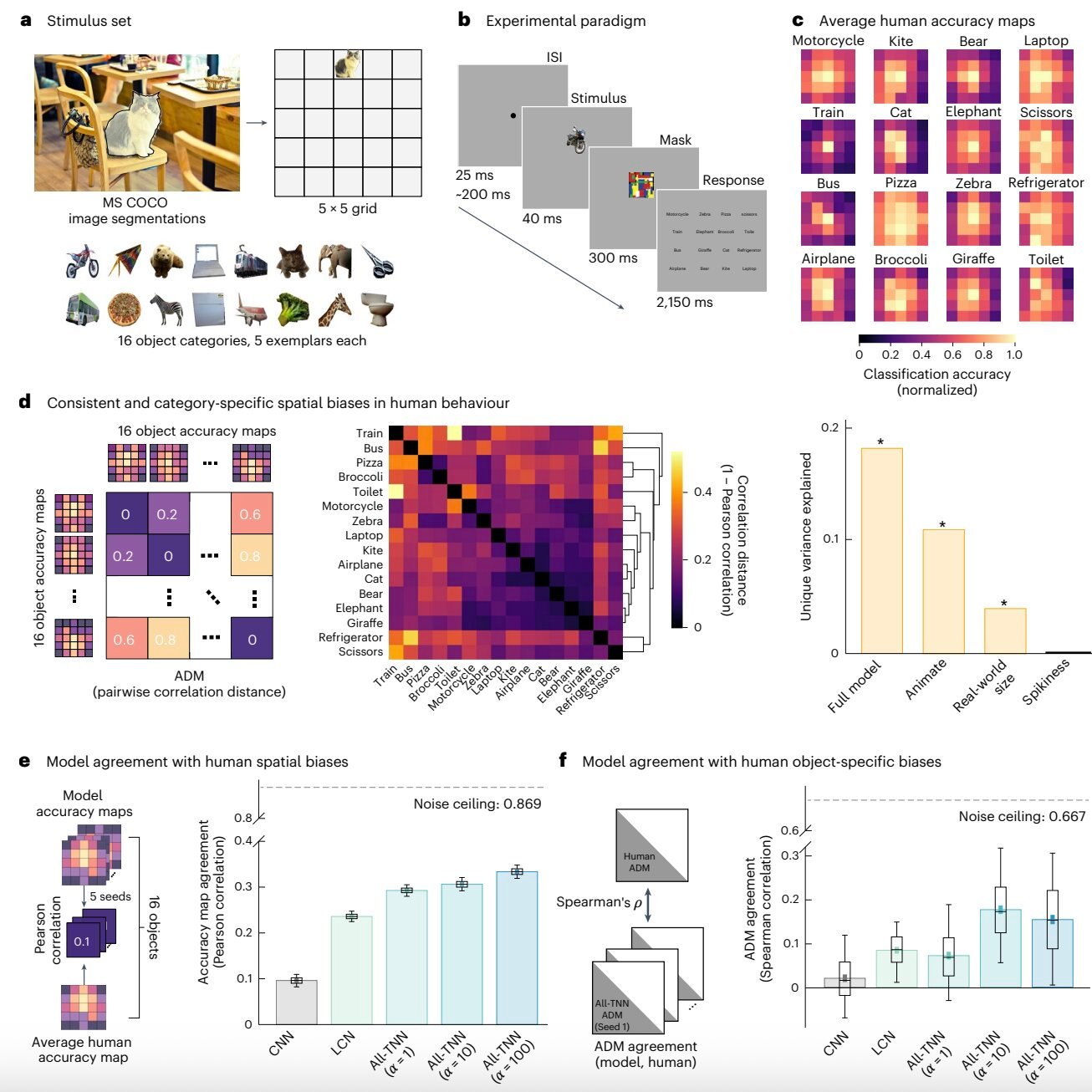
Kietzmann and his colleagues demonstrated that the new models they developed, based on (All-TNNs), mirror the human visual system more closely than CNNs and other DNNs. This is because they do not only replicate the principles underpinning the organization of the visual cortex, but they also capture human behavioral patterns better than previously developed models.
In the future, All-TNNs could be used to carry out neuroscience and psychology studies, potentially shedding new light on the neural underpinnings of the human visual system. For instance, they could help to better understand how the arrangement of feature selectivity across the cortex, also known as topography, influences human perception and behavior.
“We are currently trying to improve training to be more efficient in terms of task performance, as topographic networks are parameter rich, compared to their convolutional counterparts,” added Kietzmann.
“In addition, we currently need to steer the models towards smooth feature selectivity across space—a key feature of cortical topography. However, biology has likely developed implicit mechanisms that make the cortical selectivity smooth. Finding out which aspects allow for this to happen is a main area of research that we hope to be able to contribute to.”
Written for you by our author Ingrid Fadelli,
edited by Robert Egan
—this article is the result of careful human work. We rely on readers like you to keep independent science journalism alive.
If this reporting matters to you,
please consider a donation (especially monthly).
You’ll get an ad-free account as a thank-you.
More information:
Zejin Lu et al, End-to-end topographic networks as models of cortical map formation and human visual behaviour, Nature Human Behaviour (2025). DOI: 10.1038/s41562-025-02220-7.
© 2025 Science X Network
Citation:
All-topographic neural networks more closely mimic the human visual system (2025, June 20)
retrieved 20 June 2025
from https://techxplore.com/news/2025-06-topographic-neural-networks-mimic-human.html
This document is subject to copyright. Apart from any fair dealing for the purpose of private study or research, no
part may be reproduced without the written permission. The content is provided for information purposes only.


