

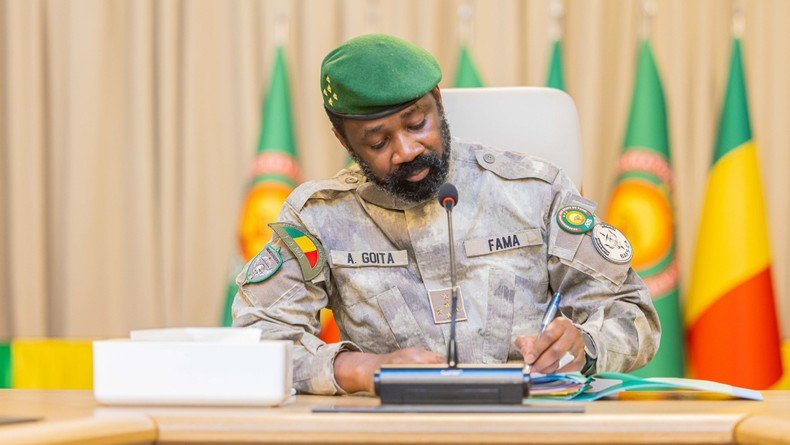
The declaration came as Niger’s President, Abdourahamane Tchiani, arrived in Algiers for high-level discussions, generally viewed as the clearest indication that the two nations’ diplomatic tensions are lessening after an intense standoff.
“We agreed to launch the project to complete the trans-Saharan gas pipeline through Nigerien territory after the holy month of Ramadan,” the Algerian president relayed to the media at a joint press conference in Algiers.
The state energy company Sonatrach “will take the lead and will begin laying the pipeline that passes through Niger,” the president added.
As seen in Anadolu Agency, the Algerian leader further highlighted the relevance of Tchiani’s visit, confirming that both countries are interested in ending hostilities between them and moving forward with collaborations in security, energy, and education.
“With this visit, we are ending an abnormal period characterized by coldness between the two countries, even though the two brotherly peoples continued to communicate with each other,” Alegria’s president said.
“We will preserve the friendship that has united us with Niger for generations,” he added.
Algeria’s rift with Niger
The dispute between the two countries that share nearly 950 kilometers (590 miles) of border began in April of last year, following an accusation by Mali, an ally of Niger and Burkina Faso, that Algeria had shot down one of its drones.
Algeria claimed that the aircraft breached its airspace on an aggressive course, marking the third such infringement.
However, Mali disputed this, claiming that the drone wreckage was discovered 9.5 kilometers south of the Algerian border after being shot down between March 31 and April 1.
In reaction to the event, Niger, Mali, and Burkina Faso, members of the Alliance of Sahel States, recalled their ambassadors from Algeria.
On the Algerian side, the country’s Foreign Ministry declared that radar data proved a 1.6-kilometer breach of its airspace, justifying the flight restriction based on Mali’s frequent infractions.
Algeria denied any responsibility in the drone incident and accused Mali of trying to divert attention away from its domestic concerns.
Mali’s transport and infrastructure ministry, in turn, announced the closing of its airspace to Algerian planes, accusing Algeria of “persisting in sponsoring international terrorism,” but offering no particular examples or proof to back up the charge.
Following the event, Mali, Burkina Faso, and Niger recalled their ambassadors from Algeria. Algeria replied by recalling its diplomats from Niger and Mali and delaying the arrival of its new envoy in Burkina Faso.



