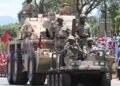
On July 10, 2025, the paramilitary Rapid Support Forces (RSF) in Sudan announced that they had shot down a Turkish-made Akinci drone belonging to the Sudanese Armed Forces (SAF) over El Fasher, the capital of North Darfur.
According to RSF spokesperson Al-Fateh Qarashi, the drone was brought down last Thursday after carrying out a series of airstrikes that the RSF claims indiscriminately targeted civilian areas. The statement detailed how the bombings struck residential zones, hospitals, schools, and camps for internally displaced persons (IDPs) in Zamzam, Kuma, and Mellit, painting a grim picture of the toll these operations have taken on the local population.
This event is the latest development in a brutal conflict between the SAF and the RSF that has ravaged Sudan since mid-2023, with both sides vying for control in a war that has already claimed at least 150,000 lives and displaced millions. The Akinci drone, a product of Baykar, Turkey’s largest defence contractor, represents a leap forward in unmanned aerial technology. Known as a high-altitude long-endurance (HALE) unmanned combat aerial vehicle (UCAV), it is built for versatility, capable of executing air-to-ground and air-to-air combat missions. With a payload capacity exceeding 1,350 kg, the Akinci can carry an array of weapons, including laser-guided smart munitions, missiles like the SOM cruise missile, and air-to-air missiles.
Its advanced systems include a multi-role active electronically scanned array (AESA) radar, a SAR/GMTI radar, a wide-area surveillance system, electronic warfare capabilities, and satellite communication tools, making it well-suited for reconnaissance, surveillance, and precision strikes. For the SAF, its sophisticated drone fleet has been a vital tool in maintaining control over contested regions, particularly in Darfur, where the RSF has been pressing its campaign to seize El Fasher, a city under siege since mid-May 2024.
The RSF’s push to capture El Fasher carries both strategic and symbolic weight. Having already secured four of Darfur’s five states, the paramilitary group views the city as a critical prize in its broader effort to dominate the region. The SAF, in response, has leaned heavily on its aerial arsenal, deploying drones like the Akinci to strike RSF supply lines, artillery units, and strongholds in areas such as Nyala, Al-Fashir, Geneina, and Kordofan. The downing of this particular drone could signal a shift in the conflict’s dynamics, especially if the RSF proves capable of consistently countering the SAF’s air superiority. This incident also lays bare the intricate web of international involvement fueling the war.
In March 2025, a Washington Post report, citing leaked documents, messages, and financial records, exposed how Baykar had secretly supplied $120 million worth of drones and warheads to the Sudanese military in 2023. The deal included at least eight TB2 drones and 600 warheads, with shipments routed through intermediaries to skirt U.S. and European Union arms embargoes banning military sales to Sudan’s warring factions. Baykar, co-owned by the son-in-law of Turkish President Recep Tayyip Erdoğan, has not publicly addressed these allegations, even as Turkey positions itself as a mediator in the conflict.
The report also suggested that Sudanese officials may have enticed Turkish companies with access to gold and copper mines in exchange for military support, adding another layer of complexity to the transactions. The RSF, meanwhile, has its foreign backers. In 2023, the U.S. Department of the Treasury’s Office of Foreign Assets Control (OFAC) revealed that the Wagner Group, a Russian private military contractor, had been supplying surface-to-air missiles to the RSF to challenge the SAF’s air dominance. Though the exact type of missile system remains unspecified, possibilities include man-portable air defence systems (MANPADS) or short-range air defence units. This assistance has bolstered the RSF’s ability to confront SAF drones and helicopters, as demonstrated by their success against the Akinci.
Earlier in the conflict, the RSF relied on anti-aircraft guns of 23 mm and 14.5 mm calibres, along with MANPADS like the SAM-7 and FN-6, but the addition of Wagner-supplied systems appears to have elevated their defensive capabilities. The SAF’s drone program has not been limited to Turkish support. In October 2024, Egypt delivered Bayraktar TB2 drones to the Sudanese military, a move facilitated by improving relations between Egypt and Turkey. These drones, operational primarily in Khartoum state, have been used to attack RSF supply convoys and artillery units in el-Gezira State, including an assault on the Baka Bridge near Wad Madani. By late 2024, they joined the SAF’s efforts to reclaim parts of the capital region.
Additionally, two Turkish Air Force A400M Atlas aircraft landed in Port Sudan in April 2025, likely linked to further drone deliveries from Baykar, underscoring the ongoing flow of military hardware into Sudan despite international sanctions. The RSF has actively sought to disrupt the SAF’s drone operations. In early May 2025, RSF drone attacks on Port Sudan targeted Turkish experts training SAF personnel to operate the Akinci UCAVs. Some of these experts were injured and evacuated to Turkey, though the SAF’s Akinci drones continued to function, striking RSF positions across multiple regions. The United Arab Emirates has also reportedly collaborated with the RSF over the past two months to neutralise the SAF’s Akinci fleet, though these efforts had been unsuccessful until the recent downing over El Fasher. The SAF’s struggles to maintain its aerial edge reflect the evolving nature of the conflict. While the military has benefited from drone deliveries from Turkey and Egypt, the RSF’s growing air defence capabilities pose a formidable challenge.
The U.S. and the U.K has imposed sanctions on entities like the Wagner Group and Sudan’s Defence Industries System, which allegedly contracted with Baykar, as well as individuals such as Ivan Alexandrovich Maslov, the Wagner Group’s leader in Mali, for destabilising African nations. Yet, arms from Iran, Russia, and other suppliers continue to pour into Sudan, deepening a humanitarian crisis that shows no signs of abating.
The downing of the Akinci drone on July 10, 2025, stands as a stark illustration of the war’s toll and the pivotal role of advanced weaponry in shaping its course. For the RSF, it is a triumph that could embolden their campaign, while for the SAF, it is a setback that may force a reassessment of their reliance on air power.