

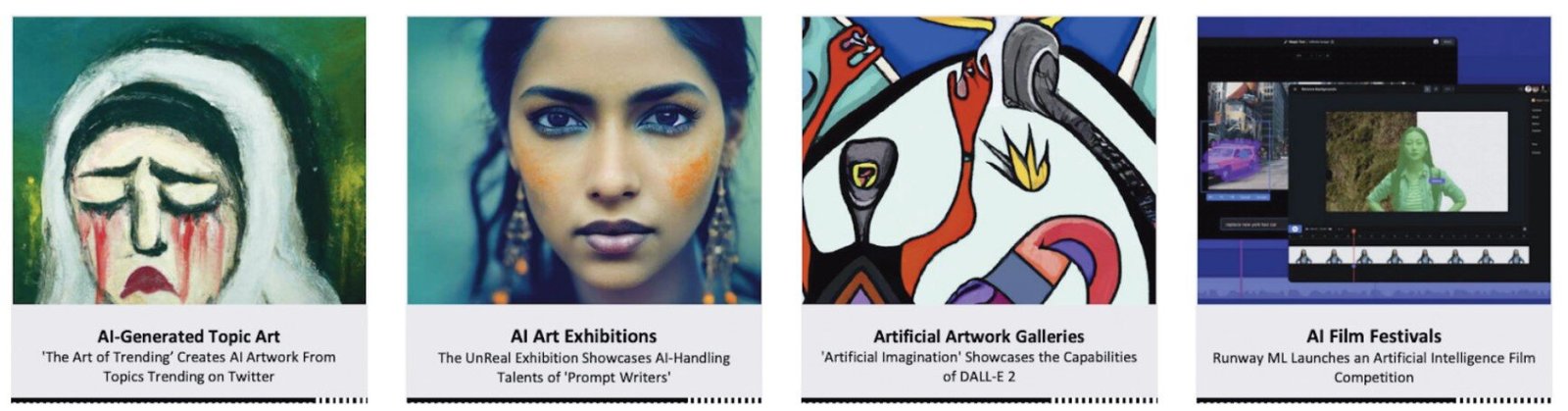

Artificial intelligence is transforming the creative process. AI can not only generate complex texts, high-quality images, and videos in just a few minutes. It can also support creative thinking and act as a research tool in the stages prior to artistic production. However, its adoption also raises ethical concerns around issues such as originality, authorship, ownership, and potential job displacement.


This subject, and the factors driving and restricting the adoption of AI, are covered in depth in the article “Acceptance of Generative Artificial Intelligence in the Creative Industry,” by Dominika Weglarz, published in the journal Retos.
“Among many other things, generative artificial intelligence can help create ideas and foster participation in brainstorming sessions. By increasing the speed and quantity of ideas generated, it enables us to spend more time on critical thinking, evaluating and selecting the most robust and relevant approaches. In short, AI does not replace human creativity, but it can significantly enhance it,” said Weglarz.
The impact of generative AI on creative industries
Generative AI could automate up to 26% of tasks in the arts, design, entertainment, media, and sports sectors, according to the latest research. Furthermore, other articles point out that 75% of creative professionals find AI useful for tasks including image editing and searches, highlighting its role as an enabler rather than a creator. The launch of AI models such as the large language model used by ChatGPT has led to use of this technology becoming more popular, but in fact, it has been carving a niche in the art world for some time.
The launch in 2016 of The Next Rembrandt, an AI project capable of producing a three-dimensional printed painting after analyzing 168,263 fragments of the 346 surviving paintings by the Dutch Baroque painter, and the installation of exhibitions including The UnReal Exhibition in Amsterdam and World of AI·Imagination—ARTECHOUSE in New York, which display a vast amount of works involving generative AI in their creative process, are good examples of how this technology has been used in the sector.
“In the long term, AI will significantly transform processes and the way people work in the creative industries. Less time is likely to be spent on technical execution, and more time on strategic thinking and conception. Creatives will not necessarily have to master traditional tools, but they will have to learn how to handle new platforms based on artificial intelligence,” Weglarz said.
“The key skills in this new environment will be critical thinking, managing ideas, and the ability to collaborate with intelligent systems. That doesn’t mean the end of creative talent, but rather an evolution towards a more strategic and conceptual role.”
What are the factors driving the adoption of generative AI?
After examining a wide range of factors which influence whether generative artificial intelligence is adopted at some point in the creative process, Dominika Weglarz’s study concludes that there are three factors above all that lead to its adoption:
- Performance expectancy. This is the most important factor, and means that tools which help perform a specific task more effectively are the ones that are most readily adopted.
- Support. This refers to all the resources that help us learn and understand how to use a particular tool. In other words, when AI tools provide user support services to deal with queries or have videos with practical demonstrations, it is much easier to adopt them.
- Brand trust. According to the study, tools that have built a strong brand, and are consequently trusted by users, will be adopted more easily.
What are the factors holding back AI in the creative industries?
Dominika Weglarz focused her thesis on the adoption of generative artificial intelligence in the creative industries, and compared samples from Spain and the United States. She pointed out that there are also factors restricting the adoption of AI in the creative industries, although it is difficult to establish universal barriers, as these vary depending on the context, professional profile, and level of digitalization in each organization.
However, she believes that the main factors are fear of change and cultural resistance, financial constraints and the need for almost constant training and reskilling. “Many professionals feel paralyzed by the speed with which this technology is evolving, which makes them reject or distrust it. Some people believe that AI is a threat to the value of human labor, and even jobs,” she explained.
“Additionally, many of the most advanced AI tools, and especially those designed specifically for creative industries, are subject to payment and require ongoing investment. This can be a significant barrier, especially for freelancers, small agencies and independent studios with limited funds. The same applies to the need to fund continuing education,” Weglarz concluded.
More information:
Dominika Weglarz et al, Acceptance of Generative AI in the Creative Industry: Examining the role of Brand Recognition and Trust in the AI adoption, Retos (2025). DOI: 10.17163/ret.n29.2025.01
Open University of Catalonia
Citation:
AI could automate up to 26% of tasks in art, design, entertainment and the media (2025, September 30)
retrieved 30 September 2025
from https://techxplore.com/news/2025-09-ai-automate-tasks-art-media.html
This document is subject to copyright. Apart from any fair dealing for the purpose of private study or research, no
part may be reproduced without the written permission. The content is provided for information purposes only.


