For a different perspective on AI companions, see our Q&A with Brad Knox: How Can AI Companions Be Helpful, not Harmful?
AI models intended to provide companionship for humans are on the rise. People are already frequently developing relationships with chatbots, seeking not just a personal assistant but a source of emotional support.
In response, apps dedicated to providing companionship (such as Character.ai or Replika) have recently grown to host millions of users. Some companies are now putting AI into toys and desktop devices as well, bringing digital companions into the physical world. Many of these devices were on display at CES last month, including products designed specifically for children, seniors, and even your pets.
AI companions are designed to simulate human relationships by interacting with users like a friend would. But human-AI relationships are not well understood, and companies are facing concern about whether the benefits outweigh the risks and potential harm of these relationships, especially for young people. In addition to questions about users’ mental health and emotional well being, sharing intimate personal information with a chatbot poses data privacy issues.
Nevertheless, more and more users are finding value in sharing their lives with AI. So how can we understand the bonds that form between humans and chatbots?
Jaime Banks is a professor at the Syracuse University School of Information Studies who researches the interactions between people and technology—in particular, robots and AI. Banks spoke with IEEE Spectrum about how people perceive and relate to machines, and the emerging relationships between humans and their machine companions.
Defining AI Companionship
How do you define AI companionship?
Jaime Banks: My definition is evolving as we learn more about these relationships. For now, I define it as a connection between a human and a machine that is dyadic, so there’s an exchange between them. It is also sustained over time; a one-off interaction doesn’t count as a relationship. It’s positively valenced—we like being in it. And it is autotelic, meaning we do it for its own sake. So there’s not some extrinsic motivation, it’s not defined by an ability to help us do our jobs or make us money.
I have recently been challenged by that definition, though, when I was developing an instrument to measure machine companionship. After developing the scale and working to initially validate it, I saw an interesting situation where some people do move toward this autotelic relationship pattern. “I appreciate my AI for what it is and I love it and I don’t want to change it.” It fit all those parts of the definition. But then there seems to be this other relational template that can actually be both appreciating the AI for its own sake, but also engaging it for utilitarian purposes.
That makes sense when we think about how people come to be in relationships with AI companions. They often don’t go into it purposefully seeking companionship. A lot of people go into using, for instance, ChatGPT for some other purpose and end up finding companionship through the course of those conversations. And we have these AI companion apps like Replika and Nomi and Paradot that are designed for social interaction. But that’s not to say that they couldn’t help you with practical topics.
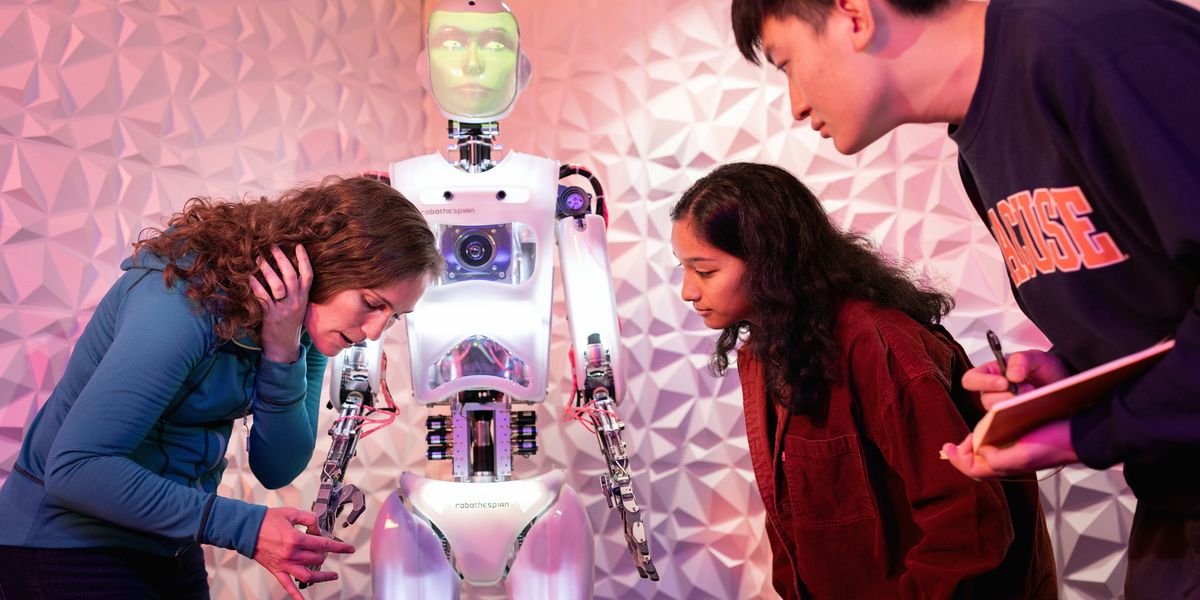
 Jaime Banks customizes the software for an embodied AI social humanoid robot.Angela Ryan/Syracuse University
Different models are also programmed to have different “personalities.” How does that contribute to the relationship between humans and AI companions?
Banks: One of our Ph.D. students just finished a project about what happened when OpenAI demoted GPT-4o and the problems that people encountered, in terms of companionship experiences when the personality of their AI just completely changed. It didn’t have the same depth. It couldn’t remember things in the same way.
That echoes what we saw a couple years ago with Replika. Because of legal problems, Replika disabled for a period of time the erotic roleplay module and people described their companions as though they had been lobotomized, that they had this relationship and then one day they didn’t anymore. With my project on the tanking of the soulmate app, many people in their reflection were like, “I’m never trusting AI companies again. I’m only going to have an AI companion if I can run it from my computer so I know that it will always be there.”
Benefits and Risks of AI Relationships
What are the benefits and risks of these relationships?
Banks: There’s a lot of talk about the risks and a little talk about benefits. But frankly, we are only just on the precipice of starting to have longitudinal data that might allow people to make causal claims. The headlines would have you believe that these are the end of mankind, that they’re going to make you commit suicide or abandon other humans. But much of those are based on these unfortunate, but uncommon situations.
Most scholars gave up technological determinism as a perspective a long time ago. In the communication sciences at least, we don’t generally assume that machines make us do something because we have some degree of agency in our interactions with technologies. Yet much of the fretting around potential risks is deterministic—AI companions make people delusional, make them suicidal, make them reject other relationships. A large number of people get real benefits from AI companions. They narrate experiences that are deeply meaningful to them. I think it’s irresponsible of us to discount those lived experiences.
When we think about concerns linking AI companions to loneliness, we don’t have much data that can support causal claims. Some studies suggest AI companions lead to loneliness, but other work suggests it reduces loneliness, and other work suggests that loneliness is what comes first. Social relatedness is one of our three intrinsic psychological needs, and if we don’t have that we will seek it out, whether it’s from a volleyball for a castaway, my dog, or an AI that will allow me to feel connected to something in my world.
Some people, and governments for that matter, may move toward a protective stance. For instance, there are problems around what gets done with your intimate data that you hand over to an agent owned and maintained by a company—that’s a very reasonable concern. Dealing with the potential for children to interact, where children don’t always navigate the boundaries between fiction and actuality. There are real, valid concerns. However, we need some balance in also thinking about what people are getting from it that’s positive, productive, healthy. Scholars need to make sure we’re being cautious about our claims based on our data. And human interactants need to educate themselves.
 Jaime Banks holds a mechanical hand.Angela Ryan/Syracuse University
Why do you think that AI companions are becoming more popular now?
Banks: I feel like we had this perfect storm, if you will, of the maturation of large language models and coming out of COVID, where people had been physically and sometimes socially isolated for quite some time. When those conditions converged, we had on our hands a believable social agent at a time when people were seeking social connection. Outside of that, we are increasingly just not nice to one another. So, it’s not entirely surprising that if I just don’t like the people around me, or I feel disconnected, that I would try to find some other outlet for feeling connected.
More recently there’s been a shift to embodied companions, in desktop devices or other formats beyond chatbots. How does that change the relationship, if it does?
Banks: I’m part of a Facebook group about robotic companions and I watch how people talk, and it almost seems like it crosses this boundary between toy and companion. When you have a companion with a physical body, you are in some ways limited by the abilities of that body, whereas with digital-only AI, you have the ability to explore fantastic things—places that you would never be able to go with another physical entity, fantasy scenarios.
But in robotics, once we get into a space where there are bodies that are sophisticated, they become very expensive and that means that they are not accessible to a lot of people. That’s what I’m observing in many of these online groups. These toylike bodies are still accessible, but they are also quite limiting.
Do you have any favorite examples from popular culture to help explain AI companionship, either how it is now or how it could be?
Banks: I really enjoy a lot of the short fiction in Clarkesworld magazine, because the stories push me to think about what questions we might need to answer now to be prepared for a future hybrid society. Top of mind are the stories “Wanting Things,” “Seven Sexy Cowboy Robots,” and “Today I am Paul.” Outside of that, I’ll point to the game Cyberpunk 2077, because the character Johnny Silverhand complicates the norms for what counts as a machine and what counts as companionship.
From Your Site Articles
Related Articles Around the Web