
• Business
  • Markets
  • Politics
  • Crypto
  • Finance
  • Intelligence
    • Policy Intelligence
    • Security Intelligence
    • Economic Intelligence
    • Fashion Intelligence
  • Energy
  • Technology
  • Taxes
  • Creator Economy
  • Wealth Management
  • LBNN Blueprints
  • Business
  • Markets
  • Politics
  • Crypto
  • Finance
  • Intelligence
    • Policy Intelligence
    • Security Intelligence
    • Economic Intelligence
    • Fashion Intelligence
  • Energy
  • Technology
  • Taxes
  • Creator Economy
  • Wealth Management
  • LBNN Blueprints

AI can help cut down on waste, improve quality in dyed fabrics

Simon Osuji by Simon Osuji
June 4, 2025
in Artificial Intelligence
0
AI can help cut down on waste, improve quality in dyed fabrics
0
SHARES
0
VIEWS
Share on FacebookShare on Twitter


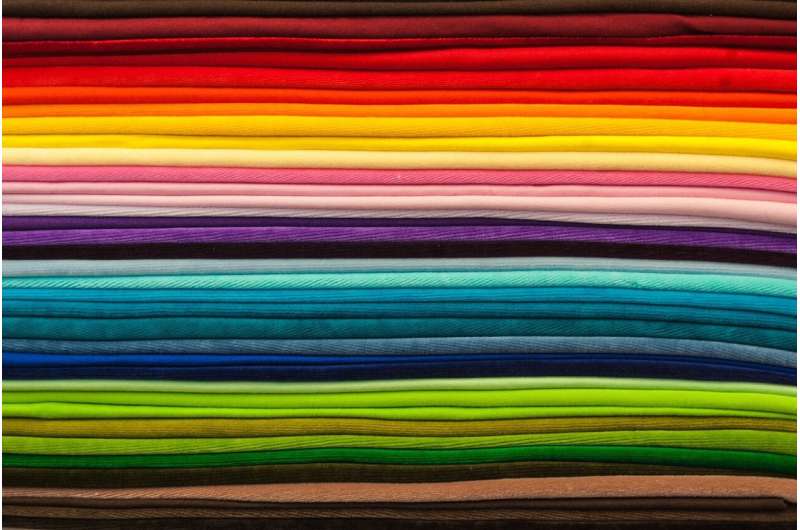
colorful fabric
Credit: Pixabay/CC0 Public Domain

A new study finds that machine learning can help reduce textile manufacturing waste by more accurately mapping how colors will change during the dyeing process.


Related posts

12 Athletes to Watch at the 2026 Winter Olympics

12 Athletes to Watch at the 2026 Winter Olympics

February 4, 2026
‘Fallout’ Producer Jonathan Nolan on AI: ‘We’re in Such a Frothy Moment’

‘Fallout’ Producer Jonathan Nolan on AI: ‘We’re in Such a Frothy Moment’

February 4, 2026

Fabrics are typically dyed while wet, and their colors change as they dry. This can make it difficult to know what a piece of fabric will end up looking like in its finished state, said Warren Jasper, professor in the Wilson College of Textiles and author of a paper on the study published in the journal Fibers.

“The fabric is dyed while wet, but the target shade is when it’s dry and wearable. That means that, if you have an error in coloration, you aren’t going to know until the fabric is dry,” he said. “While you wait for that drying to happen, more fabric is being dyed the entire time. That leads to a lot of waste, because you just can’t catch the error until late in the process.”

The amount of color change from wet to dry states is not uniform between different colors. This non-linear relationship means that the amount of color change between wet and dry is unique to each color, and data from one color sample cannot be easily transferred to another.

To tackle this problem, Jasper developed five machine learning models, including a neural network designed specifically to map this type of non-linear relationship. He then trained the models by inputting visual data from 763 fabric samples of various colors, both wet and dry. Each dyeing took several hours to complete, Jasper said, which made collecting data a significant undertaking.

While all of these models outperformed non-machine learning models in terms of accuracy, the neural network stood out as significantly more accurate than any other option. The neural network showed an error as low as .01 and a median error of 0.7 using CIEDE2000, a standardized color difference formula. The other machine learning models showed CIEDE2000 error ranges of anywhere between 1.1 to 1.6, while the baseline went as high as 13.8. In the textile industry, CIEDE2000 values exceeding 0.8 to 1.0 are generally considered outside of acceptable limits.

This neural network has the potential to cut down significantly on waste caused by color errors, as it would allow fabric manufacturers to better predict the end result of the dyeing process before large amounts of fabric has been incorrectly dyed. Jasper said that he hopes to see similar machine learning tools adapted more broadly in the textile industry.

“We’re a bit behind the curve in textiles. The industry has started to move more toward machine learning models, but it’s been very slow,” he said. “These types of models can offer powerful tools in cutting down on waste and improving productivity in continuous dyeing, which accounts for over 60% of dyed fabrics.”

More information:
Warren J. Jasper et al, A Controlled Study on Machine Learning Applications to Predict Dry Fabric Color from Wet Samples: Influences of Dye Concentration and Squeeze Pressure, Fibers (2025). DOI: 10.3390/fib13040047

Provided by
North Carolina State University

Citation:
AI can help cut down on waste, improve quality in dyed fabrics (2025, June 4)
retrieved 4 June 2025
from https://techxplore.com/news/2025-06-ai-quality-dyed-fabrics.html

This document is subject to copyright. Apart from any fair dealing for the purpose of private study or research, no
part may be reproduced without the written permission. The content is provided for information purposes only.


Source link

Previous Post

Govt dismisses claims linking Mokwa flood to dam failure – EnviroNews

Next Post

Rosebud lands $6M to scale its interactive AI journaling app

Next Post
Rosebud lands $6M to scale its interactive AI journaling app

Rosebud lands $6M to scale its interactive AI journaling app

Leave a Reply Cancel reply

Your email address will not be published. Required fields are marked *

RECOMMENDED NEWS

Top 10 Easiest European Countries to Secure a Work Visa

Top 10 Easiest European Countries to Secure a Work Visa

10 months ago
UAE fintech market to reach $6.43bn by 2030

UAE fintech market to reach $6.43bn by 2030

10 months ago
Dubai Duty Free’s 11-month sales hit $1.94bln

Dubai Duty Free’s 11-month sales hit $1.94bln

1 year ago
Soft Space First In The World To Deploy Live MPoC-Certified Solution

Soft Space First In The World To Deploy Live MPoC-Certified Solution

2 years ago

POPULAR NEWS

  • Ghana to build three oil refineries, five petrochemical plants in energy sector overhaul

    Ghana to build three oil refineries, five petrochemical plants in energy sector overhaul

    0 shares
    Share 0 Tweet 0
  • The world’s top 10 most valuable car brands in 2025

    0 shares
    Share 0 Tweet 0
  • Top 10 African countries with the highest GDP per capita in 2025

    0 shares
    Share 0 Tweet 0
  • Global ranking of Top 5 smartphone brands in Q3, 2024

    0 shares
    Share 0 Tweet 0
  • When Will SHIB Reach $1? Here’s What ChatGPT Says

    0 shares
    Share 0 Tweet 0

Get strategic intelligence you won’t find anywhere else. Subscribe to the Limitless Beliefs Newsletter for monthly insights on overlooked business opportunities across Africa.

Subscription Form

© 2026 LBNN – All rights reserved.

Privacy Policy | About Us | Contact

Tiktok Youtube Telegram Instagram Linkedin X-twitter
No Result
View All Result
  • Home
  • Business
  • Politics
  • Markets
  • Crypto
  • Economics
    • Manufacturing
    • Real Estate
    • Infrastructure
  • Finance
  • Energy
  • Creator Economy
  • Wealth Management
  • Taxes
  • Telecoms
  • Military & Defense
  • Careers
  • Technology
  • Artificial Intelligence
  • Investigative journalism
  • Art & Culture
  • LBNN Blueprints
  • Quizzes
    • Enneagram quiz
  • Fashion Intelligence

© 2023 LBNN - All rights reserved.