


By John Kourkoutas
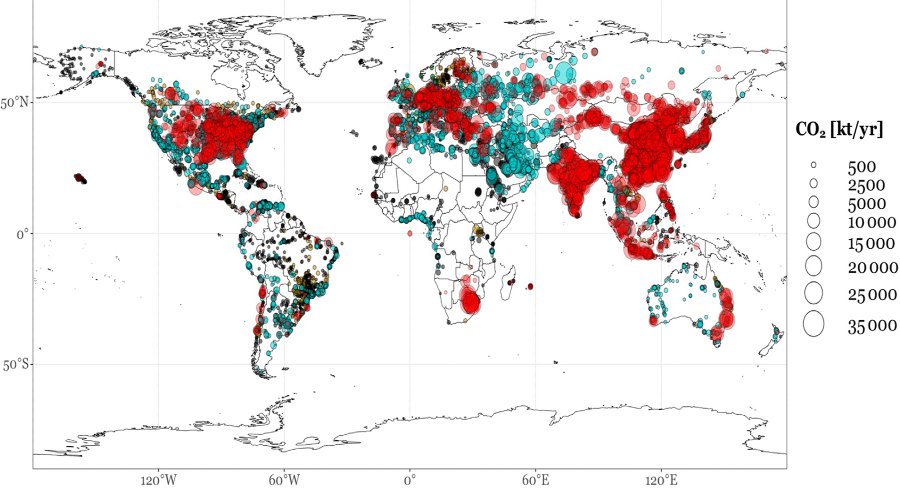
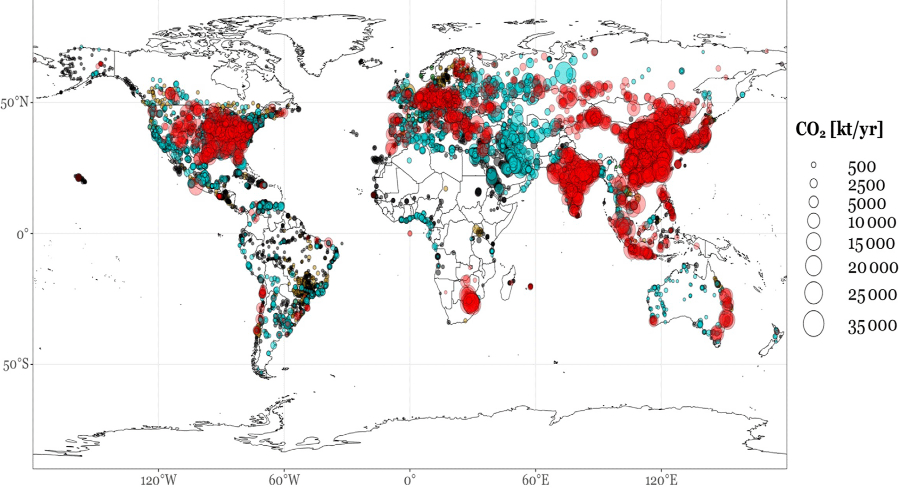
Look up the global map of greenhouse gas emissions below. Filter by source, by location, by scale. Zoom out until you can see every continent at once. Now find Africa.
Take your time.
You will not find much. North America is blanketed in dense clusters of red and cyan markers. Europe, similarly saturated. China, India, and Russia display enormous emission concentrations.
Southeast Asia and the Middle East register heavy industrial signatures. Sub-Saharan Africa, by contrast, is nearly empty – a few scattered data points along the South African coastline, a modest cluster around Nigeria’s petroleum infrastructure, and then, for thousands of miles in every direction, very little at all.
That map tells a story. It is not the story most climate discussions choose to tell.
Africa contributes less than 4 percent of global emissions – yet absorbs some of the world’s most severe climate consequences. That is not a footnote. It is an indictment.
The Numbers Are Unambiguous
Africa accounts for less than 4 percent of global greenhouse gas emissions. Yet it absorbs some of the most severe consequences of a crisis it did not create.
Prolonged droughts are hollowing out the Sahel. Catastrophic flooding has displaced hundreds of thousands in Mozambique. Crop failures are escalating across Zambia and neighboring states. Lake Chad – once one of Africa’s great inland seas – has contracted by roughly 90 percent since the 1960s, a collapse driven in significant part by shifting rainfall patterns linked to global warming.
Entire agricultural zones, upon which rural economies and food security depend, are becoming climatically unviable.
This is not a peripheral concern or a future risk. It is a present emergency, and it is falling disproportionately on the people least responsible for causing it.
Licensed under the Creative Commons Attribution 4.0 International license.
What the Crisis Looks Like From the Ground
Having worked across Sub-Saharan Africa for over a decade, I have witnessed these dynamics not as data points, but as lived realities. I have stood at the banks of the Kafue River in Zambia as water levels dropped to the point that the country’s hydroelectric generation – its primary source of electricity – teetered on the edge of failure.
I have walked through maize fields that should have been green and were instead cracked and dry, because the rainy season had shifted six weeks from where it had reliably arrived for generations.
I have spoken with farmers who have never heard the term “carbon credit,” who do not know what a parts-per-million measurement of atmospheric CO₂ means, who could not locate the Kyoto Protocol on a map – and who have nonetheless lost their livelihoods, their harvests, and in some cases their communities, because of decisions made in boardrooms and legislatures on other continents.
There is something morally clarifying about watching that happen. It strips away the abstraction.
Victim or Partner? The World Must Choose
The most persistent failure in global climate discourse is not scientific. It is not financial. It is conceptual.
When Africa enters the conversation – and it enters far less often than it should – it is almost invariably cast as a victim. Occasionally, it is framed as a beneficiary of climate aid.
Almost never is it treated as a solution provider. Almost never as a business partner. Almost never as a strategic actor with assets the world urgently needs.
That framing is not only condescending. It is strategically incoherent.
Return to the emissions map. Africa’s near-absence from it is not merely a tragedy to be mourned. It is, from one angle, a competitive advantage to be leveraged.
The Congo Basin contains the world’s second-largest tropical rainforest, a carbon sink of global significance. The continent possesses some of the most abundant untapped solar and wind resources on Earth.
Vast tracts of land capable of sustainable agricultural development remain underutilized. Carbon credit markets, still nascent on the continent, represent a frontier of significant economic potential.
Africa is not the problem. It is a substantial part of the solution – but only if the world abandons the charity model and replaces it with an investment framework worthy of the stakes.
The green transition will not succeed without Africa. And Africa should not be expected to participate in it for free.
What Genuine Partnership Requires
Genuine climate partnership with Africa requires three things that the current international architecture largely fails to deliver.
First, it requires financing that functions as investment, not aid. Climate funds directed toward Africa must be structured to build durable economic capacity – renewable energy infrastructure, agricultural resilience systems, carbon market institutions – not simply to offset immediate suffering.
The distinction matters. Aid creates dependency. Investment creates leverage.
Second, it requires meaningful African representation in the institutions and negotiations that shape global climate policy. Decisions about carbon markets, climate finance architecture, and emissions accounting directly affect African economies and ecosystems.
The continent must have a seat at the table proportional to its stake in the outcome – which is to say, an enormous one.
Third, it requires the world to accept that Africa’s cooperation in the green transition has a price – a fair one – and that paying it is not generosity. It is an obligation incurred by those who created the problem in the first place.
The Ledger Is Not Balanced
The global climate ledger is grotesquely imbalanced. The industrialized world spent two centuries emitting carbon freely, building prosperity on a resource it treated as limitless, externalizing the costs onto ecosystems and populations that would bear them decades later.
Africa is among the foremost bearers of those costs today.
That history does not make the problem unsolvable. But it does make certain conclusions unavoidable.
The continent that contributed least to the crisis cannot be expected to shoulder its consequences in silence, participate in its resolution for free, or wait patiently while the world’s wealthiest nations negotiate the terms of a transition that will reshape its economies regardless of whether Africa has a voice in the process.
The green transition will not be won without Africa. Its forests, its land, its solar potential, its capacity for sustainable growth – these are not optional inputs.
They are essential ones. And Africa should not participate for free. That is not a negotiating position. It is a moral fact.
John Kourkoutas is business development expert that specializes in helping companies, export teams, and business leaders succeed in Africa’s dynamic and emerging markets.