In 2026, the story of economic power in Africa is not the singular rise of one dominant state or region. Instead, it is a patchwork of national stories all happening at once. Some are recovering from periods of much worse turmoil, others are exploiting natural resources, and some are generating reform driven change. Together, they make up the heart of what analysts are now dubbing the Africa’s is due to produce this year.
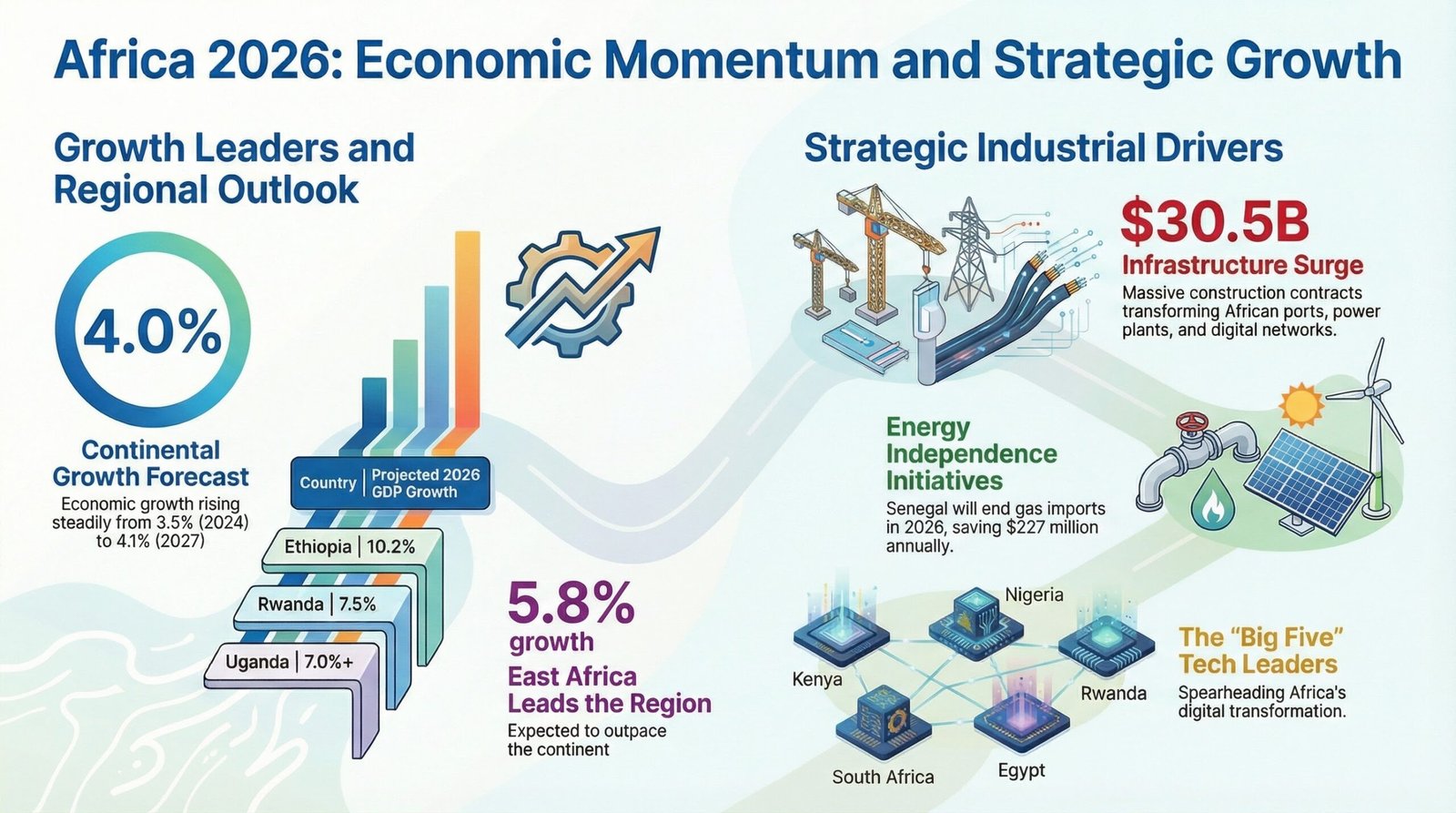
Projections drawn from the International Monetary Fund, African Development Bank and United Nations Economic Commission for Africa estimate that the continent could grow by about 4 percent in 2026, while the global average may be closer to around 2.7 percent. Performance is strongest in East Africa, with forecast growth at around 5.8 percent.
But averages obscure the true story. The deeper story is about ten countries whose growth trajectories shine in sharp contrast.
Fastest Growing Economies Africa: South Sudan and the Mathematics of Rebound
Projected growth: Rebound peak – Between 5-7%
It is not essential destruction, but a recovery dynamic that places South Sudan at the pinnacle of the Fastest growing economies Africa list. A series of pipeline outages and regional insecurity throttled the country’s main source of revenue, oil exports. GDP numbers have rebounded quite sharply as infrastructure work to restore capacity is reviving output and exports are becoming more consistent.
This kind of growth is mathematical as well as physical. When a country has suffered deep contraction, even partial normalization can produce dramatic percentage increases. Government revenue and foreign exchange earnings largely come from oil and gas, while reconstruction spending is providing short term stimulus across a wider economy.
However, sustainability remains uncertain. Policy makers recognize that South Sudan’s economy is highly dependent on hydrocarbons and therefore highly sensitive to global price movements and political shocks. Long term sustainability depends on whether oil revenues are reinvested into education, infrastructure, agricultural productivity and institutional capacity.
Growth in 2026 would represent recovery for South Sudan. Whether it represents structural transformation remains uncertain.
Fastest Growing Economies Africa: Ethiopia’s Energy Agriculture and Reform
Projected growth: 10.2%
Ethiopia’s place among the Fastest growing economies Africa reflects scale, reform and infrastructure ambition. Ethiopia, with a population of more than 120 million, is one of the largest markets on the continent. The Grand Ethiopian Renaissance Dam remains central as it reshapes the country’s energy landscape, with electricity generation expected to expand and reduce costs for industry while raising export revenue.
Agriculture continues to be the mainstay of employment and export earnings, while modernization activities focus on improving productivity and resilience. Infrastructure investment linking industrial parks to ports and export corridors supports manufacturing and foreign direct investment.
Technology is becoming an additional growth pillar. Liberalization of telecom services and expansion of fintech are changing financial access and private sector innovation.
Macroeconomic pressures remain a challenge. Inflation and foreign exchange constraints have weighed on households and businesses. International partners are backing reform programs designed to stabilize the currency and strengthen fiscal discipline.
Ethiopia’s growth demonstrates that large economies can combine structural reform with state driven infrastructure development to achieve strong output expansion.
Read Also: Ethiopia’s GERD and Sovereignty: Why the Nile Dispute Remains a Defining Test of National Autonomy
Fastest Growing Economies Africa: Guinea’s Mining Strength
Projected growth: Above 10%
Guinea’s inclusion reflects global commodity demand that continues to influence the Fastest growing economies Africa rankings. The country is one of the world’s leading bauxite producers, a critical ingredient in aluminum production. Increased demand for energy transition materials has boosted export revenue and driven port modernization and railway expansion.
Investment in mining has injected capital into construction and logistics. Infrastructure development facilitates not only mineral exports but also broader trade.
However, Guinea’s dependence on extractive industries is volatile. Global commodity prices fluctuate, and reliance on external export demand increases exposure to shocks.
Political stability also plays a critical role. Investor confidence depends on regulatory certainty, contract stability and governance transparency.
Guinea’s growth story illustrates both the opportunity and risk of resource driven expansion. The long term question remains whether mineral wealth can catalyze industrial diversification beyond extraction.

Fastest Growing Economies Africa: Senegal’s Energy Expansion
Projected growth: Above 7%
Senegal’s position among the Fastest growing economies Africa is closely tied to offshore energy development combined with infrastructure modernization. Projects including Sangomar and Greater Tortue Ahmeyim are positioning Senegal as a hydrocarbon producer in West Africa.
Energy revenues are expected to expand fiscal capacity that may finance social programs and infrastructure. Dakar’s port modernization enhances logistics competitiveness regionally.
Senegal’s growth model is not solely extractive. Urban services, telecommunications and infrastructure expansion are broadening the economic base. Construction and financial services are emerging sectors that support diversification.
Relative political stability strengthens investor confidence. Managing resource wealth responsibly while promoting non energy sectors remains critical for long term sustainability.
Senegal’s 2026 outlook represents both opportunity and responsibility as the country transitions into energy production.
Fastest Growing Economies Africa: Uganda’s Oil and Regional Connectivity
Projected growth: Above 7 %
Uganda has strengthened traditional export sectors such as coffee and gold while developing oil infrastructure and regional connectivity projects that have boosted its growth prospects. The East African Crude Oil Pipeline and related investments are expected to significantly expand fiscal space once production scales.
Transport corridors connecting Uganda with regional markets are being enhanced by improved infrastructure. Improved connectivity supports expanded trade and private sector activity.
Oil introduces fiscal complexity. How revenue volatility is managed and whether governance remains transparent will determine whether energy enhances long term resilience or deepens dependency.
Agriculture remains a major employer, and improving rural productivity is essential for inclusive growth. Financial services and telecommunications are expanding, raising hopes for broader economic diversification.
Uganda’s 2026 projection reflects optimism tied to energy development balanced with responsible macroeconomic management.
| Country | Subregion | Projected Real GDP Growth (%) | Projected Inflation Rate (%) | Key Economic Drivers | Major Export Commodities | Economic Challenges |
|---|---|---|---|---|---|---|
| Ethiopia | East Africa | 10.2 | Not in source | Agriculture productivity, manufacturing (textiles), construction, and hydroelectric energy (GERD) | Coffee, gold, and manufactured goods | Debt default (Eurobond), foreign exchange distortions, and regional security concerns |
| Guinea | West Africa | 10.0 | Not in source | Bauxite mining and iron ore projects | Bauxite | Structural risks and dependence on extractive industries |
| Rwanda | East Africa | 7.5 | 4.7 | Services (tourism, ICT, finance), agriculture, and infrastructure investment | Ores, slag, ash, coffee, tea, and spices | Debt levels (83.5% of GDP), widening current account deficit, and regional tensions |
| Benin | West Africa | 6.7 | Not in source | Oil production restart (Sèmè field), cotton exports, and manufacturing (GDIZ) | Cotton and crude oil | Institutional management of oil revenue and historical fiscal instability |
| Kenya | East Africa | 5.8 | Not in source | Fintech (M-Pesa), agritech, renewable energy, and logistics | Not in source | Exposure to global trade tensions and expiration of AGOA |
| South Africa | Southern Africa | 2.0 | Not in source | Mining, manufacturing, financial services, and AI/tech hubs | Not in source | High unemployment, energy shortages, and structural constraints |
| Senegal | West Africa | Not in source | Not in source | Offshore oil and gas production (Sangomar and GTA projects) and infrastructure | Energy exports | Fiscal impact of electricity subsidies and transition from gas imports |
| Nigeria | West Africa | Not in source | Not in source | Oil, e-commerce, healthtech, and financial services | Oil | Infrastructure deficits (power), regulatory challenges, and high debt servicing |
| Egypt | North Africa | Not in source | Not in source | Logistics (Suez Canal), tourism, and fintech | Not in source | Currency pressures and debt sustainability |
| South Sudan | East Africa | Not in source | Not in source | Resumed oil production and post-conflict reconstruction | Oil | Governance issues and security challenges |
Read Also:Rwanda-DRC Washington Accords: Can They Bring Lasting Peace?
Fastest Growing Economies Africa: Rwanda’s Technology Led Growth Model
Projected growth: 7.5%
Rwanda stands out among the Fastest growing economies Africa for its governance led development approach. The country has prioritized services, tourism, infrastructure and information technology over large scale extractive industries.
Kigali markets itself as a conference destination and technology hub. The Made in Rwanda program encourages local industry and value addition. Investment in digital infrastructure has expanded financial inclusion and strengthened innovation ecosystems.
Construction supports urban expansion, while service exports stabilize revenues.
Rwanda’s model emphasizes institutional capacity and long term planning. Unlike commodity dependent economies, its growth is rooted in human capital, regulatory efficiency and private sector development.
Maintaining competitiveness will require continued investment in education and digital skills.
Fastest Growing Economies Africa: Niger’s Energy and Irrigation Drive
Projected growth: Around 7%
Niger’s place among the Fastest growing economies Africa reflects expansion in oil production and public investment in agriculture. Energy related projects are expected to increase export revenues, while irrigation investment seeks to protect agricultural output against climate variability.
Livelihoods remain centered on agriculture, making irrigation infrastructure critical for resilience. Security risks and political instability pose ongoing challenges.
Fiscal outcomes will also be influenced by external financing conditions and commodity price movements.
Niger’s long term growth depends on balancing energy revenues with agricultural modernization and governance stability.
Fastest Growing Economies Africa: Djibouti’s Strategic Gateway Role
Projected growth: High performance – Between 5-7%
Djibouti’s economic growth is driven by geography. Located at the gateway to the Red Sea, it functions as a logistics hub linking Ethiopia to global markets.
Output is led by port services, trade corridors and infrastructure investment. The services sector is the main engine of growth, supported by transit trade and regional demand.
Djibouti benefits indirectly from economic expansion in neighboring countries, particularly Ethiopia. Competitive positioning is supported by continued infrastructure investment and efficient port operations.
Diversification beyond logistics may strengthen resilience, but geographic advantage remains its primary asset.
Fastest Growing Economies Africa: Benin’s Reform Driven Momentum
Projected growth: 6.7 percent
Benin’s growth has progressed steadily, supported by enhanced agricultural productivity, trade modernization and revival of energy sectors. Upgraded trade routes promote regional integration, while public reforms strengthen private sector performance.
Unlike resource rich economies that experience windfalls, Benin’s path has been reform oriented and gradual.
Policy consistency and increased value addition in agriculture will determine long term competitiveness.
Fastest Growing Economies Africa: Côte d’Ivoire’s Diversified Expansion
Projected growth: 6.4%
Côte d’Ivoire combines agricultural strength with growing manufacturing and financial services. Cocoa remains the backbone, but improvements in infrastructure and industrial growth broaden the economic base.
The expansion of Abidjan’s financial district strengthens its position as a regional banking center.
While diversification enhances resilience, exposure to global commodity cycles remains.
Côte d’Ivoire demonstrates how agricultural legacy can coexist with industrial ambition.