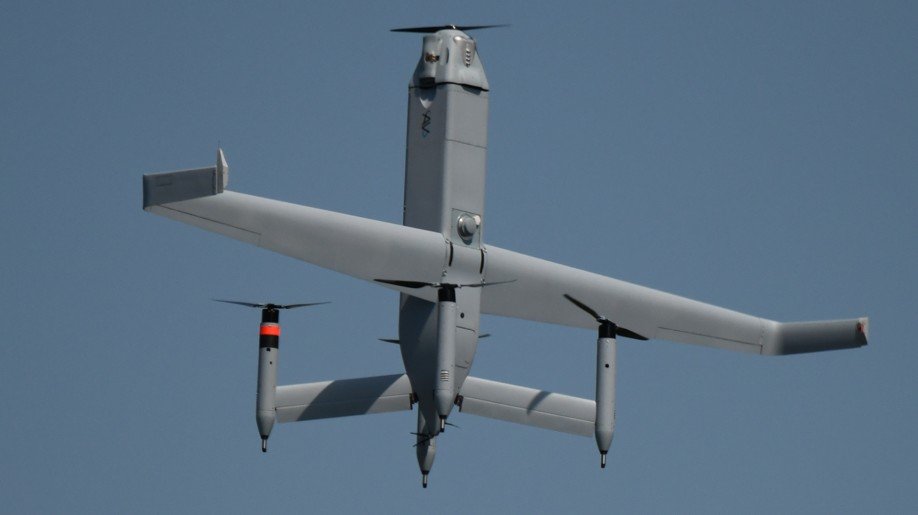

AeroVironment’s Wildcat uncrewed aircraft system (UAS) has reached key development milestones under DARPA’s Early Vertical Take-off and Landing (VTOL) Aircraft Demonstration (EVADE) program.
The UAS has completed vertical take-off to forward flight transitions and validated its propulsion and flight control systems.
Wildcat is a tail-sitting VTOL platform designed for deployment from ship decks in contested maritime environments.
It features autonomous launch and recovery capabilities, with a compact structure and stable flight capabilities, allowing for deployments in coastal areas with limited infrastructure.
“In a matter of weeks, we’ve gone from system integration to full forward flight transitions, all while validating key subsystems. This is what innovation at operational speed looks like,” said Chris Fisher, AeroVironment VP of MacCready Works Novel Systems.
Wildcat’s Enhancements
Ahead of the testing program, AeroVironment introduced several technical upgrades to its Wildcat UAS to align with DARPA’s EVADE requirements.
These include a new Visual Precision Landing System, integration of government-furnished software, and testing of a modular autopilot and onboard artificial intelligence processing unit.
AeroVironment is currently equipping Wildcat with modular payloads to support intelligence, surveillance, reconnaissance, communications, and other tactical functions.
Upcoming trials will simulate maritime operations, with the aircraft transitioning between hover and forward flight while executing payload-driven tasks in various scenarios.
DARPA Programs
The EVADE program is part of DARPA’s broader AdvaNced airCraft Infrastructure-Less Launch And RecoverY (ANCILLARY) initiative.
The goal is to develop lightweight VTOL drones that can be deployed in large numbers from ships or remote locations, turning a single platform into a launch hub for uncrewed systems.
Test flights for ANCILLARY Phase 2 are scheduled for 2026, with a focus on early integration of autonomy and mission payloads.