

Written by Pauline Soy



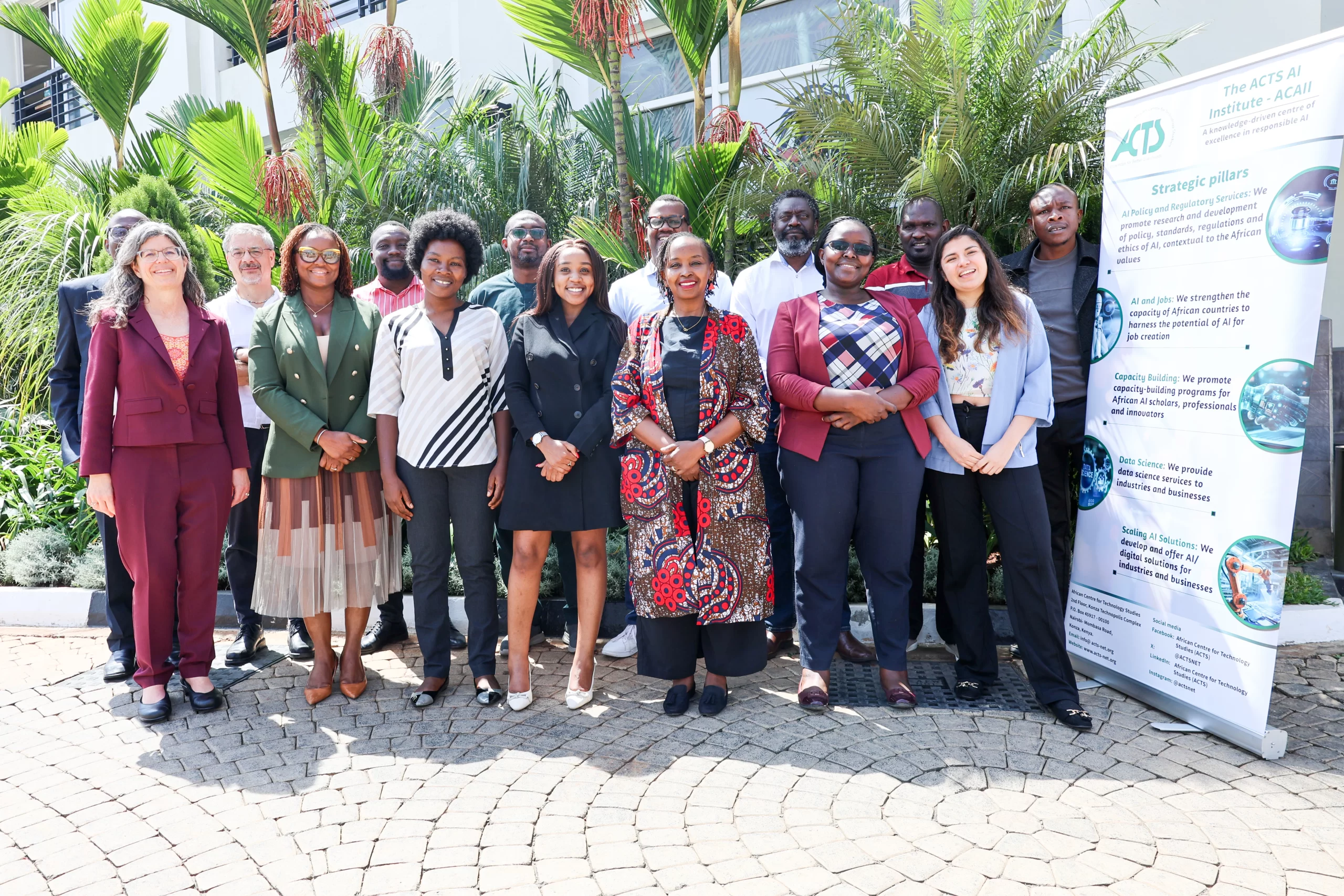
Photo: Lacuna Fund Steering Committee, Innovation hubs, development partners and staff of the ACTS AI Institute during the committee meeting in Nairobi Kenya.
The rapid evolution of artificial intelligence (AI) has positioned it as a key driver of socio-economic transformation globally. However, for many regions in the Global South, particularly across Africa, the promise of AI is often hampered by critical data gap. While data is generated daily by governments and private entities, much of it is not AI-ready, lacking the quality, structure, and accessibility required for machine learning. Addressing this challenge requires a robust framework for data governance and a commitment to creating high-quality datasets and ethical standards that reflect local contexts.
On the 27th and 28th of January 2026, the ACTS AI Institute of the African Centre for Technology Studies – ACTS, as the Lacuna Fund secretariat, hosted the Fund’s steering committee members, innovations hubs across Africa and Latin America, and development partners, to chart the path for the next phase of its development, as the end of the Fund’s current strategy approaches.
The Lacuna Fund was established to address the lack of representative and accessible datasets for training machine learning models in Low- and Middle-Income Countries. Historically, AI models have been trained on data predominantly sourced from the Global North, leading to biases and inaccuracies when applied to African or Asian contexts.
Empowering localized innovation
To strengthen the African AI landscape, there needs to be proper investment in human capital. The Lacuna Fund provides critical resources for data scientists and researchers to create datasets that are relevant to their own communities. This helps researchers to generate quality, machine-learning-ready datasets, and empower local innovators to develop solutions that add real value to their specific socio-economic challenges. The Dataset Impact Assessment Report by Datawise reveals that several projects supported by Lacuna Fund demonstrate that when data is representative and accessible, AI becomes a powerful tool for social good, tailored to the unique needs of the region.
In Kenya, researchers are developing language tools based on existing Lacuna datasets to move beyond data collection toward actual tool development for broader use. In Cameroon, a language tool is being developed specifically for marginalized tribes within the pygmy community to assist in agriculture.
In Healthcare, AI is being leveraged to identify the most effective HIV therapies in rural Uganda by analysing patient data across 11 different clinics. Similarly in Rwanda, a tool is under development to help primary school teachers identify autism symptoms in students at an early stage.Still on health, a project in Senegal utilizes skin images to detect cancer specifically on black skin, filling a dangerous gap left by models trained on white or brown skin tones, addressing the bias in global health models.
Focusing on the economy, AI is being applied to improve the efficiency of diamond sorting in mines through image analysis in Botswana, while Nigeria is using AI for predictive maintenance in oil and gas extraction equipment.
The imperative need for standardization and quality
As data collection efforts scale, the need for rigorous data governance becomes paramount. Data governance involves managing the availability, usability, integrity, and security of data. In the Global South, this includes navigating diverse national standards and overcoming the traditional siloed approach to data management.
A recurring challenge in data is the tension between standardization and innovation. While computer scientists and engineers often prefer the freedom to experiment without the constraints of rigid standards, some level of uniformity is essential for interoperability and large-scale data utilization. The current recommendation is to move toward shared guidelines rather than restrictive mandates. This includes standardizing metadata, so that different research teams can easily understand and use each other’s work. Proper standardization includes a clear description of the dataset and consistent metadata formats. Without these, even the most valuable datasets risk remaining unused because potential users cannot verify their origin or understand their structure.
Data governance is crucial, especially when it comes tohuman-centric data, especially in healthcare. This introduces significant ethical responsibilities. When you think about the ethics of accessibility, in many cases, full open access is not feasible due to the sensitive nature of the data. Strategies such as tiered access is more are crucial, where a portion of the dataset is made public, while more sensitive components are restricted to verified researchers who have obtained specific permissions.
For sustainability, the AI landscape must move beyond training and awareness toward practical, long-term implementation. Capacity building needs to move beyond just about teaching people how to code toward creating a structure that supports the entire data lifecycle. This includes investing in the expertise required to maintain datasets, update tools, and manage long-term hosting. There is also a need for communities of practice, where Lacuna Fund grantees and researchers can share lessons learned and collaborate on joint proposals in order to foster a self-sustaining ecosystem.
To justify continued investment, it is crucial to track the return on investment of data initiatives. This involves answering key questions such as, to what extent is the data being used? Who is using it? What is the ultimate impact on the economy or public health?
For more information about the Lacuna Fund, please contact: ACAII [@] acts-net.org.


