

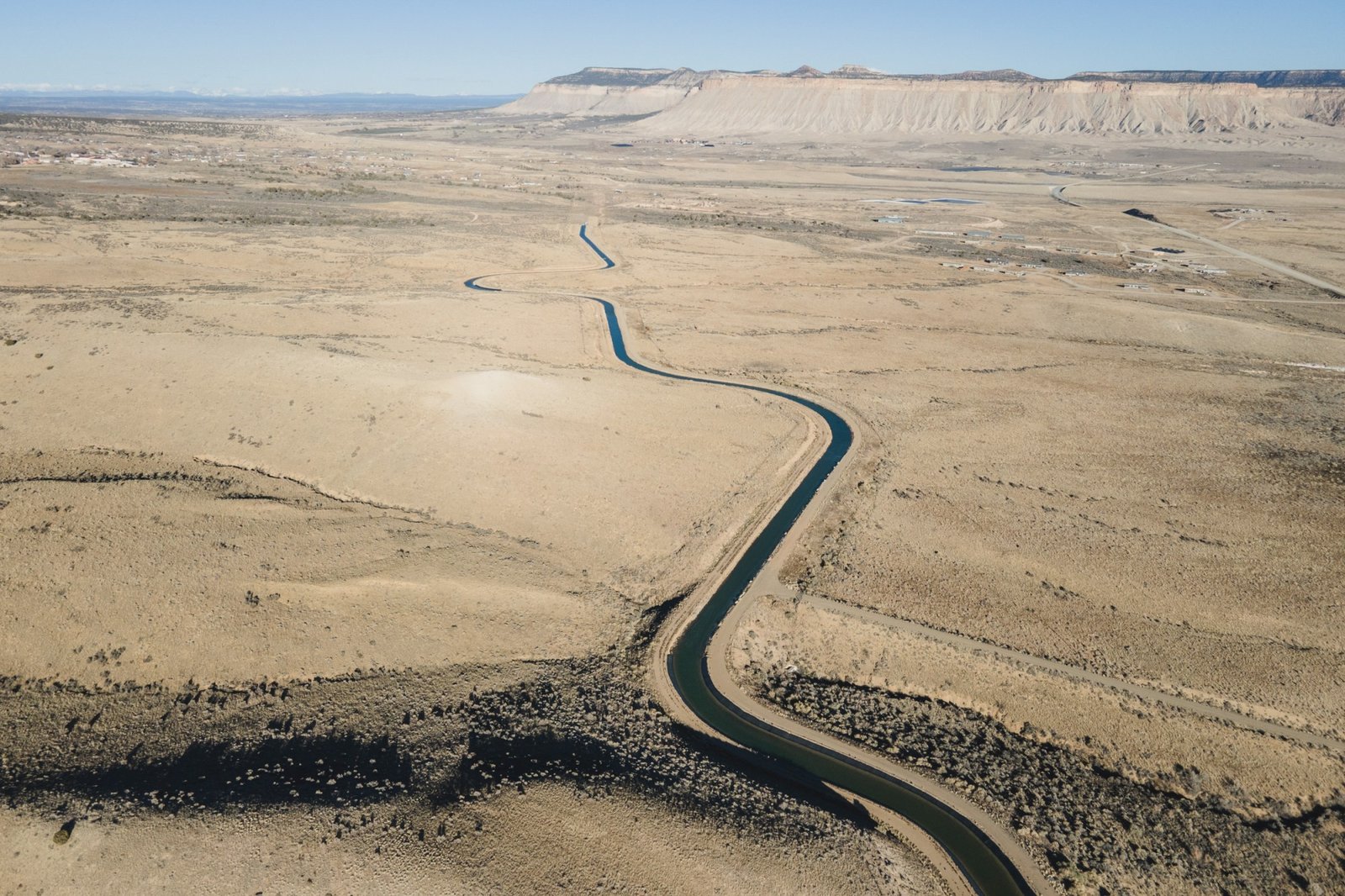
For a century, the Colorado River has been managed in pieces. Legally and politically, it’s divided into two basins, with each state and community focused on securing its respective water supply. But that is not how a river functions. The Colorado River is an interconnected system, sustained by Rocky Mountain snowpack, rainfall and groundwater.
It is fragile, and under increasing stress. Two and a half decades into this century, the river that built the modern West has 20% less water flowing through it than it did on average in the last century. As heat and drought intensify, so do the stakes: Failure to recognize the severity of changing conditions, managing the river in parts without considering needs of the whole and inadequate planning for long-term shortages put the future of all the basin at risk.
For the last five years, I have documented how the Colorado River Basin’s farmers are navigating water shortages and uncertainty amid deep political divisions about the river’s future. This project, called American Adaptation, examines three agricultural communities whose survival is threatened by a shrinking river, examining what happens to people when policies and water management struggle to keep pace with a changing climate.


In one of the river’s northern watersheds, the Ute Mountain Farm and Ranch Enterprise is adapting its management as the water it relies on becomes less dependable. In central Arizona, farmers have returned to well water after becoming the first communities to have their supply cut off completely due to the basin-wide shortage. And in California’s Imperial Valley, the farms that receive the river’s largest water allocation are under growing pressure to share the burden of shortage.
Together, their stories illustrate the stakes — and rising tensions — of the current negotiations over the river’s future management. States, tribal nations and the federal government are reckoning with 100 years of developing water infrastructure based on assumptions of continuing abundance and expansion. These ideas — and the legal frameworks built around them — are colliding with the reality of a river with much less water than expected, raising complex questions about what the Colorado can sustain, how its water should be used and who will shoulder the necessary cuts.

When Water is Uncertain
𖡡 Towaoc, Colorado, at the foot of Sleeping Ute Mountain

On 7,600 acres painstakingly carved out of desert brush, the Ute Mountain Farm and Ranch, a tribally run enterprise of the Ute Mountain Ute nation, produces cattle, alfalfa, corn and wheat. Its operations are led by Simon Martinez, Eric Whyte and Michael Vicente, who have deep personal connections to the enterprise. Martinez helped build the dam for the reservoir that provides the farm’s water, while Whyte cleared desert brush and mapped where the fields would go. Vicente, as the lead irrigator, can account for every drop of water that’s used.
In good years, the farm’s circular fields flourish in brilliant green bursts. But the past decade has brought increasingly erratic access to water. Each spring, the local irrigation district announces potential cuts after assessing snowpack runoff and the available water stored in nearby McPhee Reservoir. In 2021, the farm received just 10% of its water allocation and was forced to leave 6,000 acres unplanted. In 2022, 30% of the water came in, and last year, 34%, which the farm was able to increase to 50% after leasing shares from other water users.
To survive, they adapted. Every year, the farm’s leadership creates numerous plans for different water scenarios. They have applied for grants, implemented low-flow nozzles in the irrigation system, installed small-scale hydropower generators. They joined a Land Institute pilot program to test crops that use less water.

in Towaoc. Credit: Caitlin Ochs
“We still haven’t thrown the towel in.”


“We still haven’t thrown the towel in,” said Simon Martinez. “Nobody ever thought, when the reservoir was built, that there wouldn’t be enough water to supply the farms that have been put out here. It’s not only us; it’s happening all through southwestern Colorado.”
Low-water years leave their mark. Brush and scrub quickly reclaim unplanted fields. Employees laid off during dry years are hard to replace. During consecutive years of heat and drought, farms that rely on the basin’s many smaller reservoirs become even more vulnerable. As the number of dry years grows, it is increasingly uncertain how much shortage the Ute Mountain Farm and Ranch Enterprise can sustain in the long term, despite the farmers’ determination to adapt.


When Water Disappears
𖡡 Pinal County, Arizona, in the Sonoran Desert

Hundreds of miles south, Will Clemens manages his uncle’s 2,100-acre farm, cultivating cotton, alfalfa and Bermuda grass. Farmers in this region operate with a year-round growing season punctuated by dust storms and summer monsoons.
In this intense environment, wells were the only water source before Colorado River water became available. Until the 1980s, farmers drew their water from deep underground, contributing to fissures, land subsidence and drying wells. The completion of the Central Arizona Project alleviated the pressure, delivering farmers cheap imported river water that was classified as lower priority and the first to be cut during shortages. Deliveries continued until 2022, when low water levels at Lake Mead triggered federal cuts, and central Arizona farms lost access. In response, Clemens’ local irrigation district drilled a dozen new wells.


“I’ve been asking myself, does America really need to be in the agriculture industry?”
Without the river, Clemens and his neighbors have seen the canals’ water drop. At times, their irrigation district will cut off water before a field is fully irrigated, or struggle to keep up with the farmers’ water orders. More pressure on groundwater raises questions about what is sustainable in the future. Large parts of Arizona have no legal limits on pumping water from the ground. Even areas with legally protected groundwater have failed to meet a safe yield goal set in the 1980s to balance groundwater taken each year with naturally replenished water by 2025.

Some central Arizona farmers are selling or leasing their farmland to solar developers, as water dwindles and energy demands grow. Miles up the road from where Clemens farms, sleek black grids of solar panels gleam next to green alfalfa. For years, Arnold Burruel, Clemens’ uncle, has been in talks with a solar developer about selling the land.
“I’ve been asking myself: Does America really need to be in the agriculture industry?” Burruel said. “America is not totally enamored with agriculture when it comes to pesticides, herbicides, groundwater, GMOs — all of the above. We are at a crossroads. Are we going to continue to farm the way we are farming and heavily subsidize growers that can’t make ends meet? Society has to come up with an answer.”


When Water is Abundant
𖡡 Imperial Valley, California, just north of the Mexican border

From above, the All American Canal forms a stark blue line, slicing through the Algodones Dunes. One of the world’s largest canals, it is fed by the Imperial Dam, which diverts up to 6.8 million gallons of water each minute from the Colorado River.
This is the only water source for 500,000 acres of Imperial Valley farmland. Farms here are protected by senior rights at low risk of cuts and receive regular releases from Lake Mead, the largest reservoir in the United States. During summer months, the sun looms over the valley’s dusty, flat horizon, and temperatures often climb above 100 degrees. Despite decades of drought and growing water shortage, water has flowed uninterrupted to the Imperial Valley.
“I have a responsibility for the people who work here to make sure we survive.”


Fourth-generation family farmer Jack Vessey, who oversees a 10,000-acre produce operation, knows the canal system well. Growing up, he searched for places to swim on hot summer days.

“We take water seriously,” said Vessey, who added sprinkler systems, which are more efficient than flood irrigation. In recent years, the Imperial Irrigation District joined other communities throughout the basin in voluntarily cutting water through 2026 in exchange for federal funds. The district’s compensation was several hundred dollars more per acre-foot than other participants. But as funding set aside for Western water by the Biden administration is drawn down, it is unclear how much will be available to pay for future voluntary cuts.
Vessey is aware of the growing pressure on the river and the valley’s farms, but he emphasizes that the community has helped with shortages and is protective of its water.

“I have a responsibility for the people who work here to make sure we survive,” he said. “I have to be a little selfish at some point and say, ‘Keep giving us the water we need.’ I know we’ve got to do our part, but I can look in the mirror and say we are not wasting water, we are growing food people need.
“If it wasn’t for that canal coming off the Colorado River, this would just turn to desert.”

This project was supported by the National Geographic Society’s World Freshwater Initiative.
We welcome reader letters. Email High Country News at editor@hcn.org or submit a letter to the editor. See our letters to the editor policy.
This article appeared in the March 2026 print edition of the magazine with the headline “The Shrinking River.”



