Several African countries are experiencing economic growth rates ranging between 3% and 6% despite currency woes and major inflationary pressure.
However, the challenge facing policymakers in the short term is the need to narrow fiscal deficits. At present, this is set to be achieved under a new wave of International Monetary Fund (IMF) programmes. SA, however, is one of less than a handful of countries on the continent that has not called on the IMF.
ADVERTISEMENT
CONTINUE READING BELOW
Citigroup dubbed the new wave the “new age of fiscal austerity” in its latest Global Perspectives & Solutions report called Africa, a New Growth Model. Unlike in the late 1980s and early 1990s, the new wave of IMF programmes is not based on cutting spending. Spending on health and education will be preserved.
Raising revenue
“Instead, fiscal consolidation is largely driven by raising revenue. A key element of this will be taxing the informal sector. Coupled with this is the challenge to formulate new exchange rate policies in an era of higher global interest rates,” the report noted.
David Cowan, senior Citigroup economist covering Africa, said during a media briefing on Friday that countries like Nigeria raise less than 10% of their gross domestic product (GDP) through tax revenue. Ghana raises about 14%, Kenya around 18%, Zambia around 20%, and Mauritius 23%, while South Africa, Botswana, and Namibia raise on average around 28%.
Read: New global tax rules may see African countries losing out, again
The battle for most African countries in the next couple of years will be to catch up with the likes of SA.
However, SA is still trying to figure out how to stabilise its debt levels and consolidate its fiscal position, says Citigroup SA economist Gina Schoeman.
This can be done by finding the means to grow the economy, which will naturally generate revenue, or by cutting expenditure very hard. This then becomes a credibility problem.
Cutting expenditure
Finance Minister Enoch Godongwana, in the medium-term budget policy statement, suggested non-interest expenditure cuts of R85 billion over the next two years.
When this fiscal year started, expenditure growth was estimated to be 1.5%. Up until August, year-to-date expenditure growth was running just over 9%, notes Schoeman.
Read: Government misses revenue target by R57bn
“So, you can ask yourself whether you think National Treasury will actually be able to achieve the expenditure cuts that they set out for the year. Knowing that there is a particularly sensitive budget coming up in February, that strategy might change.”
Schoeman says she is not discrediting Treasury. “They can only do what they can do, but for the first time in our democratic history, we are facing an election that is going to potentially impact our public finances.”
Schoeman says Citigroup is not arguing that South Africa needs the IMF right now. However, the country is going to need markets that will be able to absorb all its borrowing. As a percentage of GDP, the country’s loan debt is set to rise from 74.7% in the current fiscal year to 77.7% in 2025-26 before stabilising in 2026-27 at 77.5%.
Being stuck
ADVERTISEMENT
CONTINUE READING BELOW
“Fundamentally, the fiscal problem is a growth problem,” says Schoeman. SA is trying to fix the things that are broken, whereas other African countries are trying to use new technologies, new ways of mining, and looking at new trade relations across the world.
Listen/read: Green hydrogen: An ‘opportunity to completely reindustrialise SA’
“SA just seems to be stuck in the mode of fixing the broken. It is not that we are not making any progress; we are. We are getting in more private and public sector involvement with regards to the broken things, but the growth problem remains our Achilles’ heel,” says Schoeman.
In Africa, there is a big move from old commodities such as oil and gas to so-called new green commodities such as copper, cobalt, and lithium.
This move will be coupled with the untold story of how Africa is going to feed the world, says Cowan.
He says products from SA, Kenya, Tanzania, Senegal, Zambia, Côte d’Ivoire and Ghana will find their way to Europe, the Middle East and China.
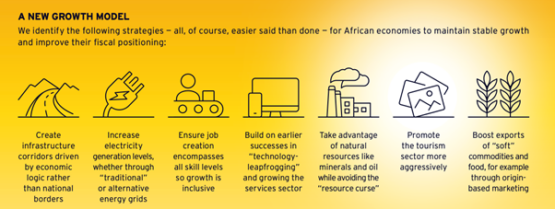
However, for a “new growth model” to emerge, African governments and the private sector must work together to take advantage of the continent’s favourable demographics, technological developments, and a changing world economy.
“At the same time, it is critical to avoid getting caught up in a new hype and forgetting the importance of developing foundational infrastructure.”
Source: Citigroup Global Perspectives & Solutions report
Spanner in the wheel


He adds that politics can constrain development, but more African governments will simply have to get serious about economic growth and development as their central political and policy concerns.
Schoeman adds that in SA, we will have to look at how the ANC government feels about its future when the election polls start coming out in January.
Read: Tax administrations need to adapt to a changed business environment