With more than two decades of steady growth and a deepening global footprint, Galvion has become known for its focus on the evolving needs of the modern Warfighter.
 Now, with the appointment of Pat Zajac as Senior Vice President for Global Strategy and Business Development, the company is doubling down on innovation, integration, and customer engagement.
We spoke with Zajac three months into his new role to get his perspective on Galvion’s priorities, from next-gen helmet systems to strategic investments and what it takes to stay ahead in a rapidly changing defense landscape.
You’re three months into your new role at Galvion. What is your most immediate impression?
What’s struck me most in these first few months is just how deeply committed Galvion is to serving the Warfighter.
That commitment runs through every level of the organization — it’s not just a mission statement, it’s part of the culture. From the leadership team to the frontline employees, there’s a shared sense of purpose and pride in what we do.
You also see it in Galvion’s long-term investments — in people, in resources, in technology, in innovation — all grounded in a legacy that’s both proud and ongoing.
It’s a powerful foundation to be stepping into. When I did my own due diligence prior to accepting this role, I was struck by the fact that Galvion has enjoyed growth, year-on-year in 21 of the 23 years they’ve been operating. Also, with multiple long-term contracts in place, such as NSPA, there is an immensely secure foundation on which to build and continue that growth.
From a product perspective, what has impressed you most?
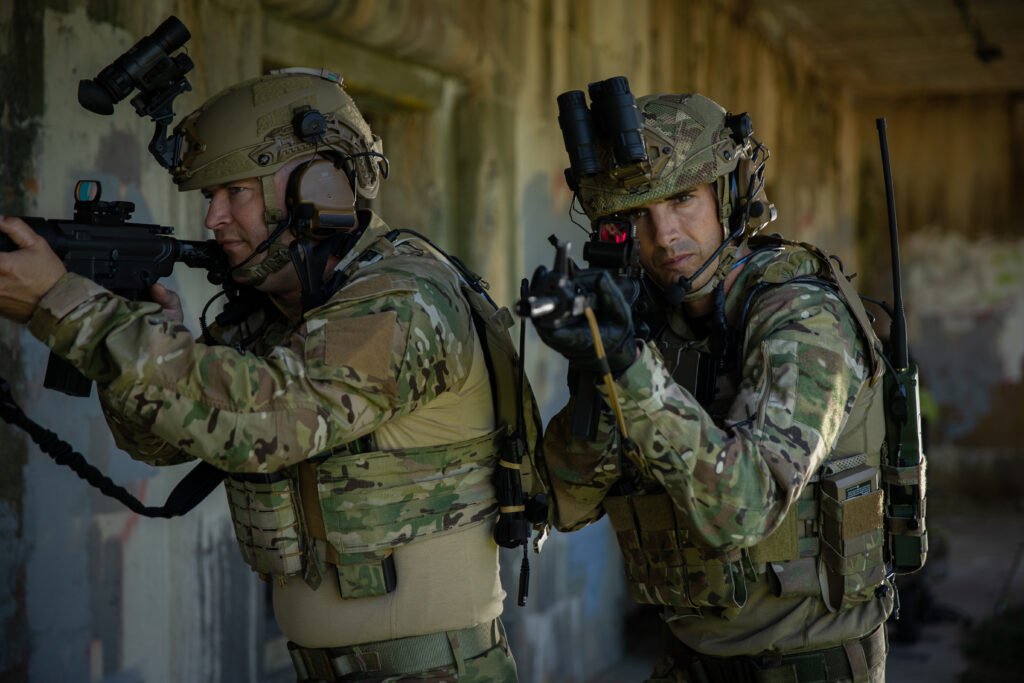
Amongst many, one of the standout innovations for me is our Advanced Integrated Head Systems, recently introduced as our CORTEX category.
What’s most remarkable about it, is the shift in mindset it represents — the recognition that the helmet is no longer just a piece of protective gear. It’s a platform in its own right, much like an armored vehicle or a rotary-wing aircraft.
Historically, the headborne system was focused on survivability. Now, with evolving mission demands, that platform needs to deliver far more capability.
CORTEX is the output from our initiative to drive that shift. It draws on deep human factors expertise from both the tactical head systems and the power and data sides of our business.
We’re developing a headborne platform that integrates sensors, power, and data management in a way that’s intelligent, efficient, and above all, designed around the Warfighter. Size, weight, power, interoperability, survivability, fatigue, and lethality — these are not afterthoughts; they’re core design pillars.
It’s a true system-of-systems approach, built with a clear understanding of operational realities and then refined in our ground-breaking Warfighter Lab.

Onto strategy, where will you be taking your new team in the next 12 months with regards to the Business Development and Marketing strategy?
A top priority for us is significantly deepening customer intimacy. That means continuing to go beyond traditional engagement and embedding ourselves, even more, in the evolving needs of the Warfighter.
We want to understand not just where the requirements are today, but where they’re going tomorrow — and ensure we’re out in front with solutions that anticipate and address those next-generation challenges.
Business Development and Marketing play a critical role in that. It’s about being more connected, more informed, and more proactive in how we listen and respond. Our goal is to be a true partner to our customers, shaping capabilities that make a real difference on the battlefield and in other environments where there are a similar capability needs, such as law enforcement.
How do you see your team evolving to deliver that strategy?
To execute on our strategy, the team itself needs to evolve — and that’s already underway.
We’re able to attract the very best talent, both from an operational user standpoint and within the defense industry more broadly. That mix is critical to understanding our customers on a deeper level and translating that insight into action.
We’re also looking to add some horsepower through targeted recruitment. That means identifying talent who can enhance our reach into key customer areas and bring fresh energy and perspective to how we engage.
It’s about further developing a high-performing, agile team that’s equipped to lead in a rapidly changing landscape. That team then creates the most solid foundations for growth and ongoing resilience.
Investment-wise, Galvion has made some bold and large-scale moves in recent years. Can you explain how that helps the business?
Every major investment that Galvion has made has been grounded in a single guiding principle: how do we better serve the Warfighter? That focus drives everything. If we’re truly aligned with the Warfighter’s evolving needs — and committed to delivering the capabilities that matter most — the business success will naturally follow.
These investments are about building a stronger, future-proofed platform. We’re not just thinking about today’s requirements but ensuring we’re positioned to meet tomorrow’s challenges as well.
Part of that includes a strong international focus — developing in-country capabilities, forging meaningful partnerships, and putting real resources on the ground.
Our new factory in Poland is a great example. It’s not only a major strategic investment but also a clear signal of our commitment to supporting NATO allies with local manufacturing, local expertise, and rapid responsiveness.

Then, how does that investment help you and your team to deliver on the strategy you’ve described above?
It ties directly to what I mentioned earlier — but even more importantly, these investments signal both a cultural and financial commitment from our leadership to put the Warfighter first and to further develop that solid foundation. That alignment empowers our Business Development team in a very real way.
When our team engages with customers, they’re walking in the door backed by a company that’s visibly and credibly investing in solutions that matter. That builds trust. It means we’re not just another vendor — we’re seen as a committed, long-term partner.
The bottom line is, it makes our job more efficient. The relationships are warmer, the conversations are more focused, and the value we bring is already recognized before we start discussing a single solution. That’s a strong position to be in.
Finally, what are the main challenges you face, and how do you see Galvion navigating those?
One of the biggest challenges right now is the broader economic landscape — and the potential impact it can have on cost, schedule, and overall program risk. It’s a reality across the industry, and it requires constant vigilance and adaptability.
What gives us a real advantage, though, is our global footprint. Unlike organizations that are more regionally concentrated, we’re able to draw on resources, talent, and capabilities from across multiple geographies.
That not only helps us mitigate economic and supply chain pressures, spreading and mitigating against risk, but also positions us to remain agile and responsive to customer needs around the world. In a climate like this, resilience is key — and we’re structured and positioned to deliver it.
I’m delighted to have joined the Galvion team and to now be a part of an exceedingly exciting journey.