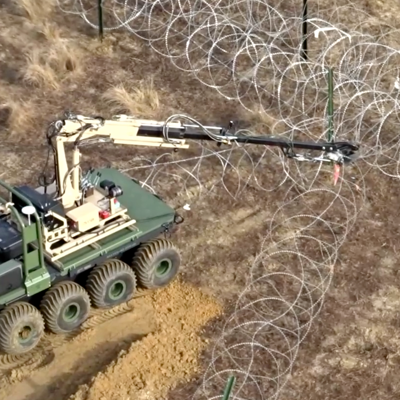
Faced with a thicket of mines, tank traps, and bunkers, future U.S. Army engineers might not rush to the front. Instead, they may reach for a remote control to choose from a menu of drones and tracked robots to sweep away the problem.
Among the several units experimenting with new tech is the 18th Airborne at Camp Liberty, N.C., where engineers from the 20th Engineer Brigade ran a multi-day experiment in mid-December to test various options for breaching barbed wire, dragon’s teeth tank barriers, and deep ditches.


Some of the greatest progress so far has come from drones, which the Army uses to map out the positions of enemy mines, said Maj. Scott Rayburn, who helped lead the experiments as operations officer for the 20th Engineer Brigade.
The Army tested drone platforms such as the SkyRaider and small Anafi quadcopter, Rayburn said. The small, commercially available drones are not fielded in large numbers across the Army, but are approved for military use under the Defense Department’s Blue UAS program.
The engineers then hung a variety of sensors on the drones, including LiDAR, to map the locations of possible mines.
Using multiple types of sensors to identify mines is critical, Rayburn said. “No one camera is going to deliver everything that you need.”
Additionally, the more sensors on a single drone, the faster an engineer can assess the scope of an enemy minefield. By contrast, drones with only one type of sensor force soldiers to hand-create a composite view made up of multiple drone flights, Rayburn said.
However, the larger drones capable of carrying the weight of such sensors, are a bigger target, and easier to shoot down. “There’s always a trade-off,” he said.
Software can help identify mines once the data is captured, Rayburn said, highlighting the Office of Naval Research’s SORIDs system as “one of the more promising” tools.
Such systems, through machine learning, can even identify what types of mines are present, he said. “For a growing number of specific mine types, we are able to identify with some systems what they actually are.”
To then destroy these barriers, Rayburn and other engineers turned to commercially available items or things already in the Army inventory. “That was our charge: What can we do with what’s available right now?”
Among the machines tested were the Army’s S-MET, a golf-cart-sized wheeled robot, and the EMAV, a roughly car-sized tracked robot. The S-MET proved its ability to destroy barbed wire, Rayburn said. Engineers also successfully adapted the EMAV to fire the Army’s MICLIC, a rocket-launched line laden with explosives that can clear minefields in an instant.
“We’re pretty happy where we got with those two,” he said.
Still, soldiers will need more time to get comfortable operating the vehicles, which have not been introduced across the Army. “The limiting factor is mostly our stick time and our experience with the systems to make appropriate modifications,” Rayburn said. His unit will get several of the S-MET vehicles this year.
Alongside the military robots, one Caterpillar bull-dozer worked to fill in a trench remotely. The bulldozer, originally created to make it safer to operate in dangerous mining conditions, is an example of how the 18th Airborne is using commercial tech to fill gaps that otherwise might require lengthy, government-driven procurement processes.
Caterpillar already manufactures remote-controlled bulldozers for use in
Rayburn’s unit will deploy to the Joint Readiness Training Center this spring, and will do a second iteration of the experiment there. The main goal is to get soldiers more familiar with operating the same set of vehicles, he said.
The Army has laid increasing importance on the value of using robots as it modernizes its forces.
The “moral responsibility is to not trade blood for first contact with the enemy,” Gen. James Rainey, commander of Army Future’s Command, said at an event hosted by AUSA in early December. “We still have soldiers driving up [with MICLICs]—we’ve lost our mind.”
The 18th Airborne began planning for the experiment in October, shortly after the Ukrainian army’s counter-offensive slowed to a halt while attempting to breach Russia’s dense minefields. Those defenses included mine fields of 500 meters—longer than the MICLIC’s range—as well as double-layered mines to destroy mine-clearing vehicles.