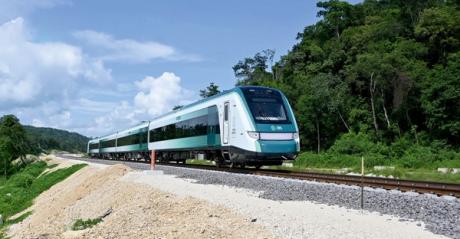
Several organised activist movements continue to oppose the new Maya Train, despite the controversial project’s imminent public opening, in sections, starting in December. The 1,525km-long high-speed rail line will connect tourist destinations on the Yucatán Peninsula, with around 20 stations from Palenque to Cancún.
Many archaeologists, environmentalists and activists in Mexico and around the world argue that the train has and will continue to do irreparable damage to the environment, the local Maya population and archaeological sites on the Yucatán—including six Unesco World Heritage sites and several discoveries made during the railway’s construction.
The total cost of the Maya Train, a pharaonic project spearheaded by the Mexican president, Andrés Manuel López Obrador, was projected at around $8.3bn in 2020, a figure that has since skyrocketed to $28bn. The Mexican government argues that the benefits of the Maya Train will offset the costs, and Obrador’s administration estimates that the project will reduce poverty in the region by a minimum of 15% through the creation of more than one million jobs in the tourism sector and related to the construction, management and maintenance of the train. Yet, for the past three years, the Mexican government has been accused of sidestepping environmental and archaeological regulations in order to complete the Maya Train before the end of Obrador’s term in September 2024.
Over the course of the project’s development, archaeologists working for the National Institute of Anthropology and History (INAH)—one of two federal agencies overseeing the Maya Train—have published papers on significant findings along the route. According to a report released last year, they have registered around 25,000 new archaeological sites, including the ancient metropolis of Xiol near Mérida. In addition, they have identified 800 natural features with an “archaeological context”, such as caverns and cenotes—underground freshwater channels that were sacred to the ancient Maya, who regarded them as portals to the underworld.
Many fear that these discoveries will be at risk, somewhat ironically due to the project that led to their uncovering in the first place. People who live along the route could also be affected.
Organised crime and environmental devastation
The Maya Train will provide easier access to once-rural regions on the Yucatán, but this may inadvertently expose local Maya communities—a population that numbers more than 8 million citizens, direct descendants of the Maya remaining at the time of the Spanish conquest—to cartels involved in the trafficking of people, narcotics and pre-Hispanic antiquities. “With the creation of Cancún [in the 1960s] and the emergence of new tourist centres such as Playa del Carmen and Cozumel, the hell of criminality also made its way into the Mayan territory,” wrote Angel Sulub, a Mayan delegate to the Congreso Nacional Indígena de México, in April in the digital magazine Debates Indígenas. Sulub fears that expanding tourism in the region may lead to even more crime.
While increased tourism will have an immeasurable social and cultural impact on the region, most of the economic benefits of the Maya Train are expected to reach not regular people but transnational organisations with investments in real estate, agriculture and energy. More tourism will surely strengthen local economies, but, as Sulub wrote, it is the “dependence on the tourism sector that enslaves” the Mayans who live there. “For the Mayan people, tourism represented the violent transition from self-sufficiency to dependence on service sector labour.”
On the environmental front, in August, a cartographic analysis based on satellite data revealed that nearly 16,500 acres have been deforested since the project began, with an estimated 87% of that land cleared in violation of federal regulations, according to the Mexican environmental organisation CartoCrítica. Other organisations, like Sélvame del Tren—a group formed specifically in opposition to the Maya Train—estimate that around 10 million trees have been cut down since 2020, despite Obrador’s campaign promise that not “a single tree” would be felled. (These studies were swiftly countered by Mexico’s environmental cabinet, which claims that the figures are much lower—just 8,000 acres and 3.5 million trees—and that CartoCrítica’s numbers are inflated to include privately owned developments.)
Sélvame del Tren sent a letter to Unesco in July 2022, urging the organisation to assist with the ethical and legal management of the Maya Train, specifically as it relates to the archaeological and environmental sustainability of the Yucatán’s cenotes. In a statement to The Art Newspaper, a Unesco spokesperson confirmed that the letter had been received and that Unesco has been in contact several times with Mexican authorities since the beginning of the project “to request that impact studies be carried out and that all useful documents be shared with its experts”. In September, the Unesco World Heritage Committee reiterated its request regarding the six World Heritage sites along the Maya Train route—Palenque, Calakmul, Campeche, Chichén Itzá, Uxmal and Sian Ka’an—giving Mexican authorities until February 2024 to comply.
The Maya Train’s potentially catastrophic effects on the region’s cenotes, which exist under fragile and easily collapsible terrain, is a common concern. According to environmentalists with Cenotes Urbanos (a non-profit dedicated to the exploration and conservation of caves), drilling and vibrations near cenotes could cause sea water to penetrate the sinkholes and salinise the water, contaminating aquifers used by Maya communities and existing urban and tourist centres in the region.
In several of the estimated 200 cenotes that have been impacted by the Maya Train, researchers have unearthed rare archaeological artefacts. In October 2021, a well-preserved ancient Mayan canoe dating between AD830 and AD950 was discovered in a cenote near Chichén Itzá—the first-ever intact canoe found in the Maya region. Archaeologists believe the canoe had a religious purpose, as the cenote also contained murals, a ceremonial knife and ceramic fragments from around 40 unique vessels that had been ritually shattered. INAH, in collaboration with Paris’s Sorbonne University, plans to create and exhibit a 3D model of the canoe, to be displayed in one of three new museums currently under construction on the Yucatán.
Museums to showcase unearthed artefacts
The archaeological finds uncovered as a result of the Maya Train’s construction are to be shown across three federally funded museums on the Yucatán, which will open within the next two years and collectively cost more than $22m. The 4,800 sq. m Puuc Archaeological Museum in the Kabah archaeological zone, near Uxmal, will house over 360 objects. There will be a new museum in Chichén Itzá (now 70% complete, according to INAH) with a renovated visitor centre—funds will also go towards the conservation of around 23 buildings across the archaeological site. And near Mérida, the former site of the Dzibilchaltún Site Museum will become a research centre and museum containing more than 200 artefacts. While these museums will serve an important educational purpose, their connection to the Maya Train project leaves a bitter taste for some regional observers.
While the Maya Train’s official website touts that it will “enhance archaeological jewels” and provide “new knowledge of the Mayan culture”, many people argue that the project will inadvertently destroy the very treasures it aims to promote.