
• Business
  • Markets
  • Politics
  • Crypto
  • Finance
  • Intelligence
    • Policy Intelligence
    • Security Intelligence
    • Economic Intelligence
    • Fashion Intelligence
  • Energy
  • Technology
  • Taxes
  • Creator Economy
  • Wealth Management
  • LBNN Blueprints
  • Business
  • Markets
  • Politics
  • Crypto
  • Finance
  • Intelligence
    • Policy Intelligence
    • Security Intelligence
    • Economic Intelligence
    • Fashion Intelligence
  • Energy
  • Technology
  • Taxes
  • Creator Economy
  • Wealth Management
  • LBNN Blueprints

An approach for unsupervised domain adaptation based on an integrated autoencoder

Simon Osuji by Simon Osuji
November 14, 2023
in Artificial Intelligence
0
An approach for unsupervised domain adaptation based on an integrated autoencoder
0
SHARES
2
VIEWS
Share on FacebookShare on Twitter


An approach for unsupervised domain adaptation based on integrated autoencoder
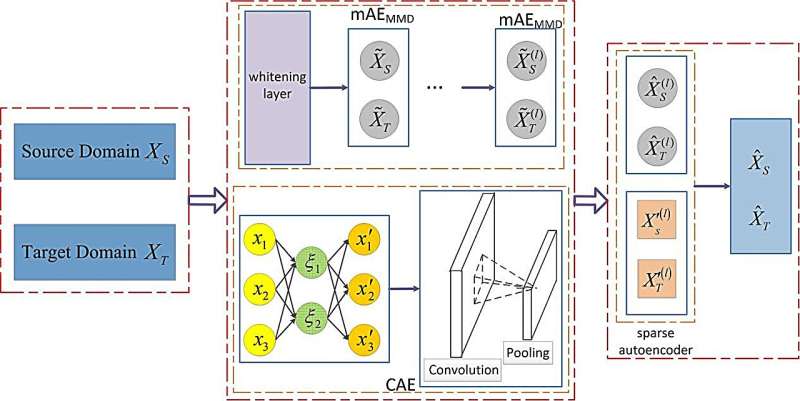
The processing flow of the proposed method. Credit: Frontiers of Computer Science (2023). DOI: 10.1007/s11704-022-1349-5

Unsupervised domain adaptation has garnered a great amount of attention and research in past decades. Among all the deep-based methods, the autoencoder-based approach has achieved sound performance for its fast convergence speed and a no-label requirement. The existing methods of autoencoders just serially connect the features generated by different autoencoders, which poses challenges for discriminative representation learning and which fails to find the real cross-domain features.

Related posts

OpenAI Announces Major Expansion of London Office

OpenAI Announces Major Expansion of London Office

February 26, 2026
The Best Headphones I’ve Tried (and Why I’d Buy Them All)

The Best Headphones I’ve Tried (and Why I’d Buy Them All)

February 26, 2026

To address these problems, a research team led by Zhu Yi published their research in Frontiers of Computer Science.

The team proposed a novel representation learning method based on an integrated autoencoder for unsupervised domain adaptation. A sparse autoencoder is introduced to combine the inter- and inner-domain features for minimizing deviations in different domains and improving the performance of unsupervised domain adaptation. Extensive experiments on three benchmark data sets clearly validate the effectiveness of the proposed method compared with several state-of-the-art baseline methods.

In the research, the researchers propose to obtain the inter- and inner-domain features with two different autoencoders. The higher-level and more abstract representations are extracted to capture different characteristics of original input data in source and target domains. A whitening layer is introduced for features processed in inter-domain representation learning. Then a sparse autoencoder is introduced to combine the inter- and inner-domain features to minimize deviations in different domains and improve the performance of unsupervised domain adaptation.

First, the marginalized AutoEncoder with Maximum Mean Discrepancy (mAEMMD) is introduced to map the original input data into the latent feature space for generating the inter-domain representations between source and target domains simultaneously.

Second, the Convolutional AutoEncoder (CAE) is utilized to obtain inner-domain representations and keep the relative location of features, which reserves spatial information of the input data in source and target domains.

Third, after higher-level features are obtained by these two different autoencoders, a sparse autoencoder is applied for the combination of these inter- and inner-domain representations, on which the new feature representations are utilized for minimizing deviations in different domains.

Future work should focus on learning representations of graph data, in which relationships are represented with an adjacent matrix, and exploring heterogeneous graph data relationships based on convolutional operation-based autoencoder networks.

More information:
Yi Zhu et al, Representation learning via an integrated autoencoder for unsupervised domain adaptation, Frontiers of Computer Science (2023). DOI: 10.1007/s11704-022-1349-5

Provided by
Frontiers Journals

Citation:
An approach for unsupervised domain adaptation based on an integrated autoencoder (2023, November 14)
retrieved 14 November 2023
from https://techxplore.com/news/2023-11-approach-unsupervised-domain-based-autoencoder.html

This document is subject to copyright. Apart from any fair dealing for the purpose of private study or research, no
part may be reproduced without the written permission. The content is provided for information purposes only.


Source link

Previous Post

Ukraine’s Soviet Air Defense System Adapted for American Missiles

Next Post

Biden’s Legacy Should Be Forever Haunted by Names of Gaza’s Dead

Next Post
Biden’s Legacy Should Be Forever Haunted by Names of Gaza’s Dead

Biden’s Legacy Should Be Forever Haunted by Names of Gaza’s Dead

Leave a Reply Cancel reply

Your email address will not be published. Required fields are marked *

RECOMMENDED NEWS

More armoured vehicles on SA roads

More armoured vehicles on SA roads

2 years ago
SeAH Wind brings in three contractors for Hornsea 3 work

SeAH Wind brings in three contractors for Hornsea 3 work

12 months ago
Simple approach enables direct publication of machine-readable scientific findings

Simple approach enables direct publication of machine-readable scientific findings

10 months ago
Bitcoin jumped and Coinbase’s app crashed, while Aptos eyes Hong Kong and Telegram rolls out rewards with TON

Bitcoin jumped and Coinbase’s app crashed, while Aptos eyes Hong Kong and Telegram rolls out rewards with TON

2 years ago

POPULAR NEWS

  • Ghana to build three oil refineries, five petrochemical plants in energy sector overhaul

    Ghana to build three oil refineries, five petrochemical plants in energy sector overhaul

    0 shares
    Share 0 Tweet 0
  • The world’s top 10 most valuable car brands in 2025

    0 shares
    Share 0 Tweet 0
  • Top 10 African countries with the highest GDP per capita in 2025

    0 shares
    Share 0 Tweet 0
  • Global ranking of Top 5 smartphone brands in Q3, 2024

    0 shares
    Share 0 Tweet 0
  • Mahama attends Liberia’s 178th independence anniversary

    0 shares
    Share 0 Tweet 0

Get strategic intelligence you won’t find anywhere else. Subscribe to the Limitless Beliefs Newsletter for monthly insights on overlooked business opportunities across Africa.

Subscription Form

© 2026 LBNN – All rights reserved.

Privacy Policy | About Us | Contact

Tiktok Youtube Telegram Instagram Linkedin X-twitter
No Result
View All Result
  • Home
  • Business
  • Politics
  • Markets
  • Crypto
  • Economics
    • Manufacturing
    • Real Estate
    • Infrastructure
  • Finance
  • Energy
  • Creator Economy
  • Wealth Management
  • Taxes
  • Telecoms
  • Military & Defense
  • Careers
  • Technology
  • Artificial Intelligence
  • Investigative journalism
  • Art & Culture
  • LBNN Blueprints
  • Quizzes
    • Enneagram quiz
  • Fashion Intelligence

© 2023 LBNN - All rights reserved.