Countless startups are trying to solve hard robotics problems in industry. But few are looking to bring the tech into homes.
Well, few except for Matic.
A relatively new venture founded by Navneet Dalal, an ex-Google research scientist, Matic, formerly known as Matician, is developing robots that can navigate homes to clean “more like a human,” as Dalal puts it.
Matic today revealed that it’s raised $29.5 million inclusive of a $24 million Series A led by a who’s who of tech luminaries, including GitHub co-founder Nat Friedman, Stripe co-founders John and Patrick Collison, Quora CEO Adam D’Angelo and Twitter co-founder and Block CEO Jack Dorsey.
Dalal co-founded Matic in 2017 with Mehul Nariyawala, previously a lead product manager at Nest, where he oversaw Nest’s security camera portfolio.
Dalal and Nariyawala met while working at Like.com, a computer vision startup that Google acquired in 2010, and ended up co-launching the webcam-based gesture recognition platform Flutter together. (Flutter also wound up being acquired by Google, coincidentally.)
Dalal and Nariyawala delved into the indoor robotics space after realizing that the field lacked 3D maps for precise navigation — at least from where they were standing.
“Just as autonomous vehicles need GPS and Google Street View Maps to navigate, fully autonomous indoor robots require precise understanding of their location on high-fidelity, Street View-like 3D maps of the constantly-changing indoor world,” Dalal told TechCrunch in an email interview. “We concluded that indoor robots needed on-device mapping capabilities to address privacy, latency and changing indoor environments.”
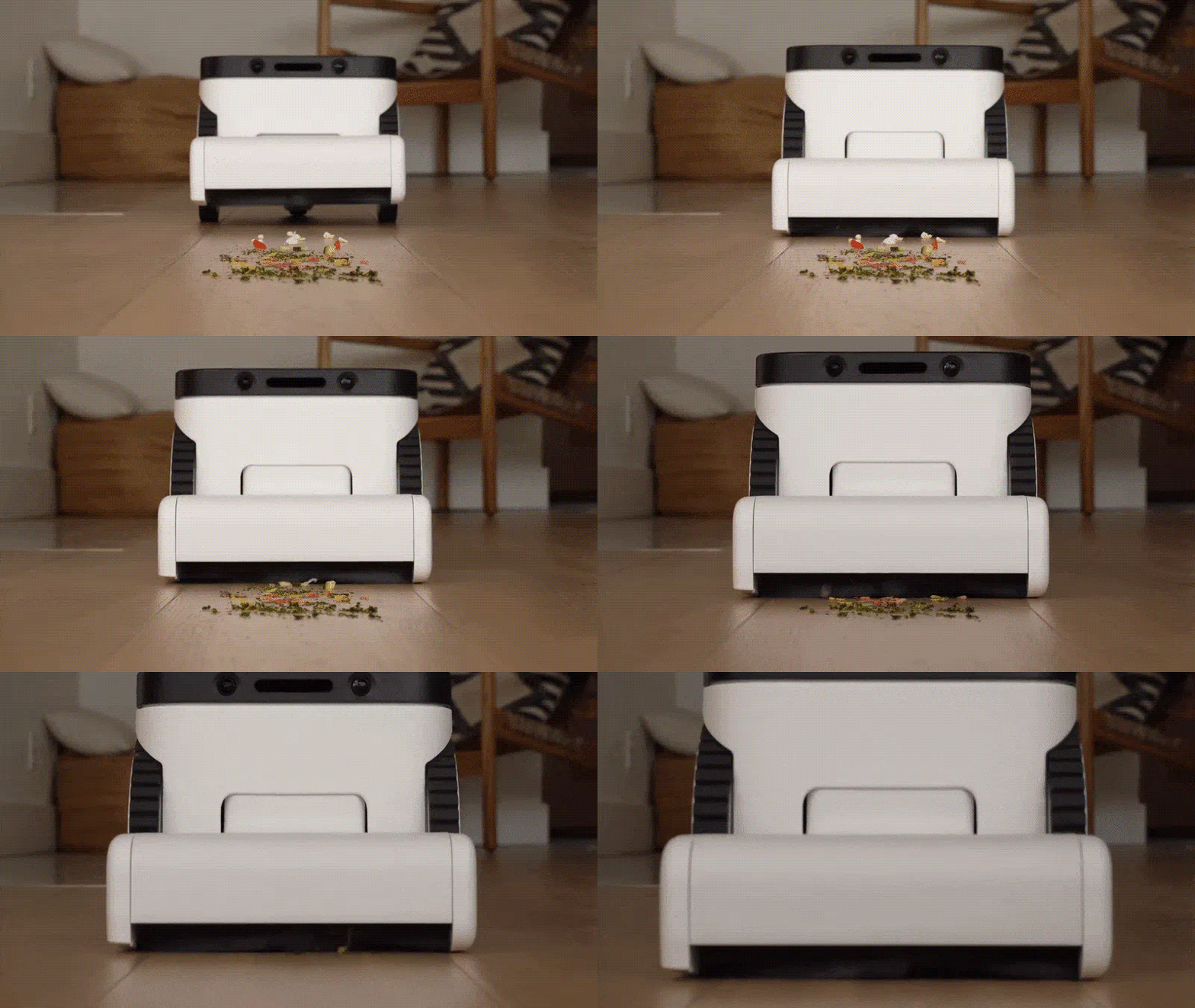
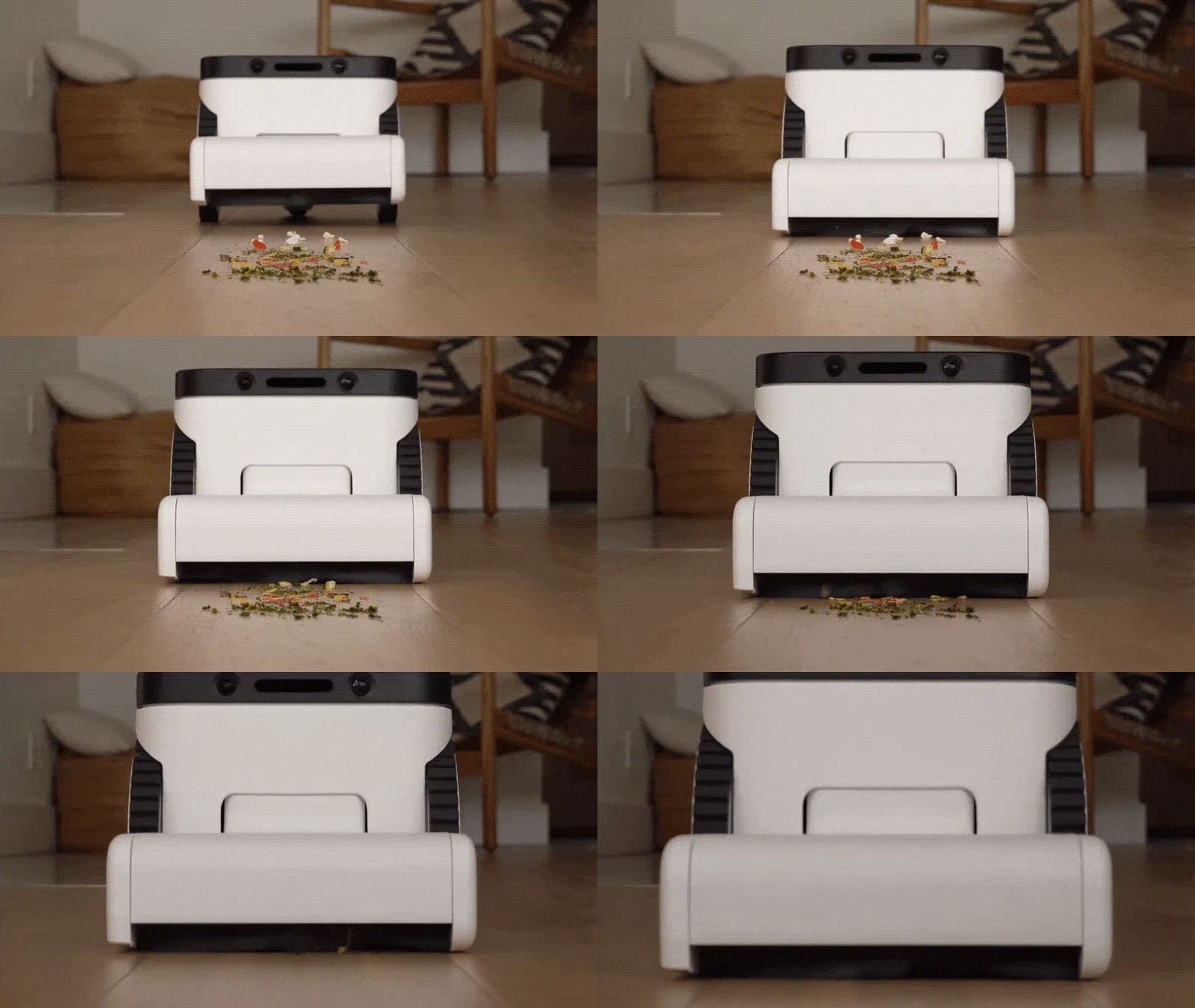
Mantic’s vacuum uses an array of cameras to map spaces — and understand where it is in them.
Early on, Matic focused on building robot vacuums — but not because Dalal, who serves as the company’s CEO, saw Matic competing with the iRobots and Evocavs of the world. Rather, floor-cleaning robots provided a convenient means to thoroughly map indoor spaces, he and Nariyawala believed.


“Robot vacuums became our initial focus due to their need to cover every inch of indoor surfaces, making them ideal for mapping,” Dalal said. “Moreover, the floor-cleaning robot market was ripe for innovation.”
Amazon’s $1.7 billion purchase of iRobot last year highlights just how valuable this indoor map data is perceived to be. iRobot, whose more recent robot vacuums capture detailed layouts of the homes they clean, reportedly once considered sharing mapping data with tech companies to develop more contextually aware smart home devices and AI assistants.
Ambitiously, Matic sought to design a “fully autonomous” robot that could patrol a home, automatically adjust how it cleaned based on different floor types and stains and “remember” which routes it took to continuously self-improve.
Years of R&D yielded the eponymous Matic vacuum, which relies on camera-based AI to map and navigate homes (ostensibly at 1.5-centimeter precision), recognize objects and switch between vacuuming and mopping based on what it observes.
Matic isn’t yet available for purchase. But Dalal and Nariyawala seeded it to friends and family beginning in April, and subsequently launched axf small number of customer field and beta trials.
“Matic was inspired by busy working parents who want to live in a tidy home, but don’t want to spend their limited free time cleaning,” Dalal said. “It’s the first fully autonomous floor cleaning robot that continuously learns and adapts to users’ cleaning preferences without ever compromising their privacy.”
There’s a lot of bold claims in that statement. But on the subject of privacy, Matic does indeed — or at least claims to — ensure data doesn’t leave a customer’s home.
All processing happens on the robot (on hardware “equivalent to an iPhone 6,” Dalal says), and mapping and telemetry data is saved locally, not in the cloud, unless users opt in to sharing. Matic doesn’t even require an internet connection to get up and running — only a smartphone paired over a local Wi-Fi network.
The Matic vacuum understands an array of voice commands and gestures for fine-grained control. And — unlike some robot vacuums in the market — it can pick up cleaning tasks where it left off in the event that it’s interrupted (say, by a wayward pet).
Dalal says that Matic can also prioritize areas to clean depending on factors like the time of day and nearby rooms and furniture.
“Like a human, fully autonomous floor-cleaning robot should remember which areas get dirty most frequently and clean there first,” Dalal said. “It should know that, after we cook and eat meals, the kitchen and dining areas are dirty — and clean those areas automatically when we finish eating. It should know that kids and dogs go in and out of the backyard all the time, so maybe clean near the backyard door five times a day but underneath the bed once a week is fine.”
Can all this navigational lifting be accomplished with cameras alone? Dalal insists that it can, despite the fact that many of the more capable robot vacuums on the market rely on lasers, lidar or both to simultaneously localize and map spaces.
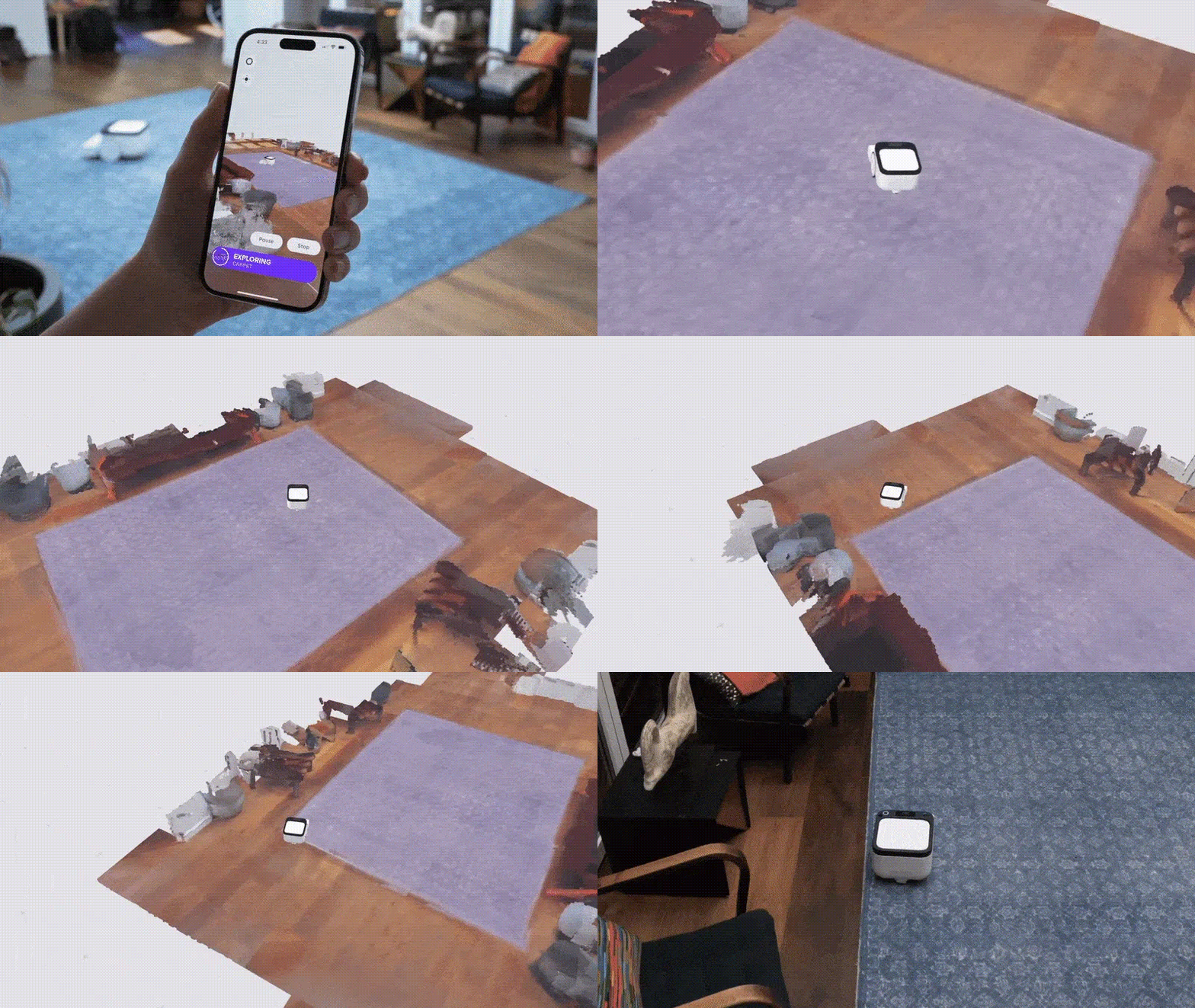
The Mantic vacuum’s progress can be visualized from the companion app for iOS.
“In order to run all the necessary algorithms, from 3D depth to semantics to … controls and navigation, on the robot, we had to vertically integrate and hyper-optimize the entire codebase,” Dalal said, “from the modifying kernel to building a first-of-its-kind iOS app with live 3D mapping. This enables us to deliver an affordable robot to our customers that solves a real problem with full autonomy.”
Whether the tech works as well as promised or not, Matic costs a pretty penny.
The robot starts at $1,795; it’ll be available at the discounted price of $1,495 for a limited time when preorders begin on November 2. And it every purchase requires a $75-per-month membership, which includes hardware upgrades, repairs and maintenance but can’t be canceled without forfeiting the vacuum to Mantic (pre-order customers get the first year free).
For comparison, iRobot’s most expensive vacuum is $1,399. The Roborock — a high-end rival — is $1,600. Neither have a membership fee — nor onerous cancelation terms attached to that fee.
To sweeten the deal somewhat, Matic’s throwing in a year’s supply of HEPA bags and “consumables refills” as well as an extended warranty. But even if the startups hits its shipping target of March 2024. there’s a lot of unknowns — and risks — involved in home robotics.
Just this year, robot vacuum startup Neato shut down after failing to reach its internal sales goals. Mayfield Robotics, which hoped to sell a home robot in partnership with Bosch, ceased operations before shipping a single unit to early customers. Meanwhile, Amazon’s struggled with Astro, its first robot-for-the-home attempt, which months after being unveiled still isn’t available to the general public.
Dalal and Nariyawala are attempting to keep overhead reasonable by maintaining a modest team — around 60 people (although Dalal says Matic’s headcount will probably land between 65 to 70 by year’s end). And, for what it’s worth, they’re confident enough in Matic’s ability to succeed that they’re already planning a “next set” of robotics products.
“In the short term, we’ll be competing with the first generation of ‘disc-robot’ makers,” Dalal said. “But our main competition is with anyone building fully autonomous indoor robots including humanoids … We’ve solved the bottlenecks to make fully autonomous indoor robots ubiquitous and built a software stack that can apply to any indoor robotics application.”
Time will tell whether that optimism was misguided or well-informed.