


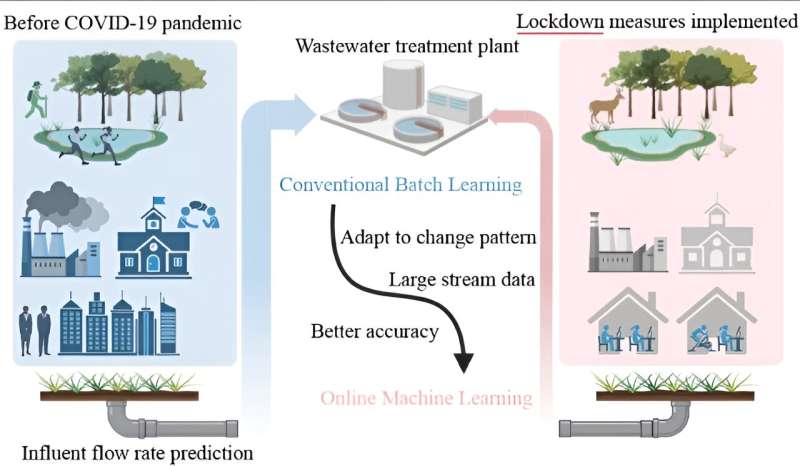
The accurate prediction of influent flow rates at wastewater treatment plants is important for the proper operation of treatment facilities. The influent flow refers to the untreated water coming into the plant. With the ability to accurately predict the influent flow rate, plant operators can plan for the efficient use of their resources.


Earlier studies that predicted influent flow rates proved that data-driven models are effective tools. But most of these earlier studies focused on batch learning, which has proven to be inadequate for wastewater prediction in the era of COVID-19 when the influent pattern changed significantly.
In batch learning or offline learning, the data is gathered over time with the machine learning model being trained from the data in batches. In online learning or streaming learning, the model is trained as new data arrives. While batch learning models typically work faster and require less computational resources, they tend to be not as flexible in handing large and changing datasets as online learning models.
The conventional batch learning prediction models are not suitable for prediction problems where there are changes in the input-output relationships. During the pandemic, the drawbacks of batch learning approaches became more evident as the lockdowns related to COVID-19 altered the input-output relationships. The team turned their attention to online learning models, to determine if they could overcome some of these limitations.
“We leveraged new machine learning techniques to enhance our ability to predict wastewater influent flow rates within the context of the COVID-19 lockdown situation,” said Pengxiao Zhou, a civil engineer at McMaster University. The potential application for this work is that the developed models can be integrated into commercial wastewater modeling software.
The online learning models developed by the team are called Adaptive Random Forest, Adaptive K-Nearest Neighbors, and Adaptive Multi-Layer Perception. They are based on the conventional batch learning models known as Random Forest, K-Nearest Neighbors, and Multi-Layer Perception.
The team used their newly developed online models to predict the changing influent flow rate that resulted because of COVID-19. The pandemic had a profound impact on people’s daily lives. The lockdowns that closed schools, non-essential services, and recreational facilities changed the behaviors and movements of billions of people. These changes impacted wastewater treatment plants. The research is published in the journal Frontiers of Environmental Science & Engineering.
The team developed the models using three to four years of hourly influent flow rate data and meteorological data, collected from two Canadian wastewater treatment plants. They compared the online learning models they developed to their respective conventional batch learning models to predict the influent flow rate at the two plants.
The team used two different scenarios. In one scenario, there was a 24-hour ahead prediction and in the other there was no lead-time prediction. Their online learning models produced accurate predictions under changing data patterns. They were efficient in dealing with continuous and large influent data streams. The team found the online learning models to be superior to batch learning models.
“The proposed new online learning models can provide more robust decision support to wastewater operators or managers for coping with changing influent patterns due to emergencies such as COVID-19,” said Zhou.
Looking ahead, the team’s future studies will include more case studies and consider more prediction scenarios to further validate the developed models. “The ultimate goal is to provide reliable tools for wastewater management and propel the development of wastewater intelligence,” said Zhou.
More information:
Pengxiao Zhou et al, Online machine learning for stream wastewater influent flow rate prediction under unprecedented emergencies, Frontiers of Environmental Science & Engineering (2023). DOI: 10.1007/s11783-023-1752-7
Provided by
Frontiers Journals
Citation:
Online machine learning models accurately predict wastewater influent flow rate (2023, October 23)
retrieved 23 October 2023
from https://techxplore.com/news/2023-10-online-machine-accurately-wastewater-influent.html
This document is subject to copyright. Apart from any fair dealing for the purpose of private study or research, no
part may be reproduced without the written permission. The content is provided for information purposes only.


