

![What is Amazon’s [redacted] ‘Project Nessie’ algorithm?](https://lbnntv.com/wp-content/uploads/2023/09/What-is-Amazons-redacted-Project-Nessie-algorithm.png)
The FTC’s lawsuit against Amazon alleging anti-competitive practices is largely full of things we already knew in a general sense: price hikes, pressure to use Amazon fulfillment and so on. But then we get to a sea of redactions and the mysterious “Project Nessie.” What is it, and could it possibly be as alarming as the unredacted sections make it sound?
The project, product or process is referred to more than a dozen times in the complaint filed by the FTC. And it’s one of those situations where the redactions probably make it sound scarier than it actually is.
Probably.
The first reference comes on page 6:
Amazon has also [redacted] through a [redacted] operation called “Project Nessie.” [redacted] Amazon’s Project Nessie has already extracted over [redacted] from American households.
What is it extracting? Money? Data? Something quantifiable, or else the document would not say “over.” Though I wouldn’t put it past Amazon, the context does not suggest anything physical or private, like video or biometrics.
An Amazon blog post from 2018 spotted by GeekWire describes Nessie as “a system used to monitor spikes or trends on Amazon.com.” Much of the timeline in the lawsuit takes place since then, however, so this definition (such as it is) may no longer be accurate, if it ever was.
Then, on page 11, among discussions of “anti-discounting” tactics, we have:
Amazon has deemed Project Nessie [redacted]: it has generated more than [redacted] in excess profit for Amazon.
In addition to overcharging its customers…
So Nessie does result in profit, but not necessarily directly, even though the last sentence implies it.
A bit of redaction sleuthing: An earlier sentence describes Nessie as a “[redacted] algorithm,” with the blackout text composed of no more than five or six characters (and note, “a” not “an”). Price? Profit? Sales? “Search” would just about fit too.
Last in Nessie references in the lawsuit is the whole section 7, which is four pages dedicated purely to Project Nessie.
Project Nessie is an algorithm [redacted]. Aware that this scheme belies its public claim that it “seek[s] to be Earth’s most customer-centric company,” [redacted].
How distressing. It later refers to “Part VI.A.3, above” in the middle of a redacted paragraph; the section is about how “Amazon maintains its monopolies by suppressing price competition with its first-party anti-discounting algorithm.”
Amazon recognizes the importance of maintaining the perception that it has lower prices than competitors. Behind closed doors, however, Amazon executives actively [redacted].
Instead, [redacted] “prices will go up.”
Unfortunately, the rest is almost entirely gone, as you can see:
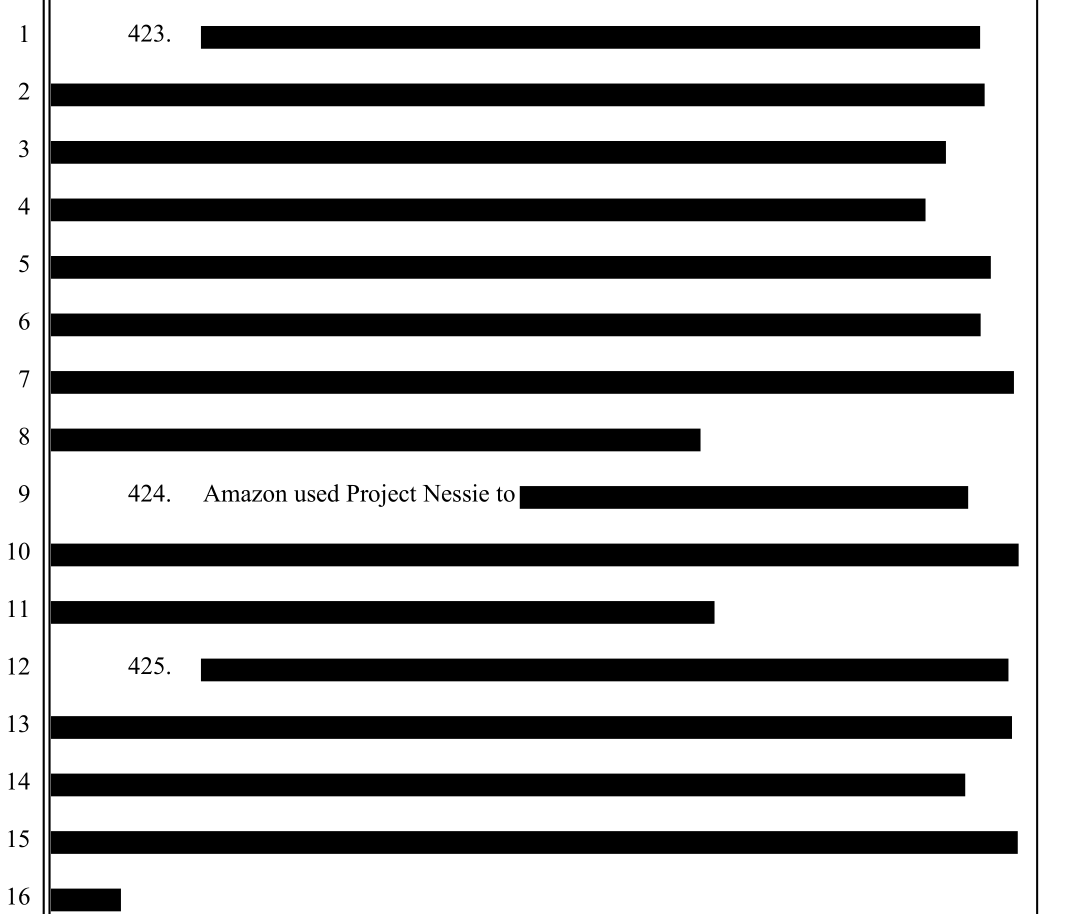
Image Credits: FTC
So what are we to make of this mysterious Project Nessie? It’s a highly secret internal algorithm and associated operation that makes them a lot of money, likely by manipulating price or search.


Are those small, seemingly arbitrary changes to price we see on items — up by a few cents today, down by a few tomorrow — Project Nessie in action, increasing or decreasing the price as needed based on the immense amount of sales data they have access to? This seems the most likely explanation, and the ability to dictate price based on what a customer is likely to pay would be both highly profitable and fit the description of “belying” the customer-first narrative.
Or could it be that search — which we know Amazon heavily manipulates in favor of certain sellers — is also being juiced in some unknown way? It could also be something else entirely, more arcane or technical.
One thing is sure: Amazon doesn’t like talking about it. (I contacted the company for comment and have not heard back yet.)
Will we ever find out what it is? It seems very unlikely that this entire lawsuit and trial will not shed at least a little light on it.
But we may know sooner than that. Of course it is Amazon’s right to ask that confidential information be withheld from a public document. But the company must soon file documents justifying its numerous and extensive redactions, which will be weighed and, if found wanting, removed. So it may be that in a few weeks we will learn more about Project Nessie — whatever it is.


