


If a company wants to offer in-app messaging or voice calls, they don’t have to develop the infrastructure themselves when there’s something like Twilio at their disposal. Likewise, if they want to support payments there’s Stripe, or for maps there’s the mighty Google.
But what if a developer is tasked with building real-time multiplayer collaboration into their software, along the lines of Google Docs or Figma? Well that’s where things get a little tricky. One option is to build the software themselves and deploy it on the cloud, though this is a complex, resource-intensive endeavor. Another option is to use a managed service such as Pusher (now owned by Twilio rival MessageBird) or Atlassian-backed Liveblocks, which are popular options but might not offer the type of flexibility a company needs when constructing their software, owing to the fact that they are proprietary third-party services.
And this is where PartyKit enters the fray, with an open source deployment platform replete with all the libraries needed for companies looking to integrate multiplayer functionality into their apps.
“Just building and scaling collaborative backends was something that required subject matter expertise and heavy operational investment in the past,” PartyKit founder and CEO Sunil Pai told TechCrunch. “With PartyKit, it’s literally a matter of minutes, and it’s accessible to most.”

PartyKit CEO Sunil Pai flanked by CXO Sylwia Vargas (left) and Jani Eväkallio (CTO) Image Credits: PartyKit
Pai left his role as senior system engineer at Cloudflare last year, and shortly after launched an initial version of PartyKit in partnership with collaborative whiteboard app Tldraw. In the intervening months, Pai initiated a total rewrite of the original product to make it suitable for a more extensive set of use-cases, before going on to raise $2.5 million in pre-seed funding.


The hitherto undisclosed funding was led by VC juggernaut Sequoia Capital, with participation from Cursor Capital, Remote First Capital, and angel backers including Cloudflare co-founder and CEO Matthew Prince and Vercel co-founder and CTO Guillermo Rauch.
Building blocks
PartyKit is perhaps something akin to Vercel or Netlify, but with a specific focus on collaboration — so developers bring all their own code, be it JavaScript or TypeScript, and they can then integrate PartyKit with their own tools and services, and test on their own local machines in continuous integration / continuous delivery (CI/CD) environments.
“By providing powerful low level building blocks that developers can write code against, PartyKit lets developers build applications on their own terms without having to worry about the complexities of the underlying infrastructure,” Pai added.
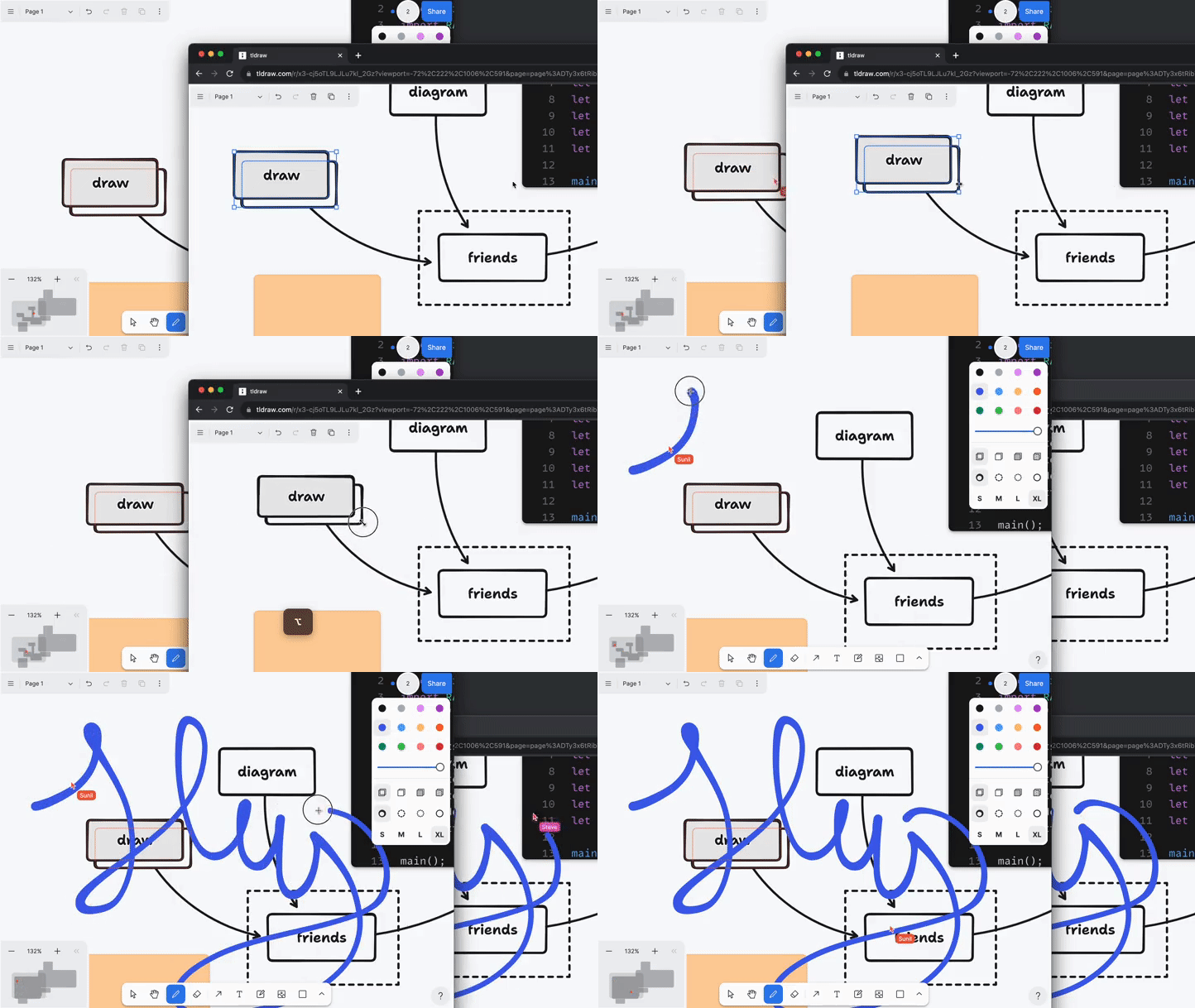
PartyKit in action: Tldraw synchronised in multiple windows Image Credits: PartyKit
In addition to facilitating real-time collaboration between humans, perhaps as part of a digital whiteboard, game, or code-editing app, companies can integrate large language models (LLMs) from the likes of OpenAI or even their own in-house models, so that a human operator can work in conjunction with an AI agent, with PartyKit handling all the long running processes, holding memory, and context for the machine agent. And all with a few lines of code.
So, for example, a company could develop an AI helper for some product design software, with the helper proactively stepping in to help with suggestions while they’re designing a website or app. Or perhaps a journalist writing an article could receive fact-checking and similar guidance on tone and structure though a little agent embedded inside their CMS.
“Building applications like this demands real-time infrastructure that push data and actions to its users,” Pai said. “LLMs now mean that humans don’t just collaborate with humans, but also little AI entities with different purposes. There’s a massive hole in the platforms that can enable developers to build these kinds of applications. That’s why I built PartyKit.”
Under the hood, the PartyKit platform is actually built on Cloudflare, a nod to the technology’s genesis from when Pai worked at the cloud infrastructure giant for more than a year. And before that, Pai also worked on multiplayer apps at Meta’s Oculus division (low-latency and real-time are pivotal to the collaborative VR experience).
“In each situation [role], I was surprised at how much investment and effort happened on the infrastructure side to be able to enable collaborative experiences,” Pai said. “While the rest of the application stack has become super accessible to developers over the last 20 years — I remember back when one had to be a database expert to put up a blog on the internet — the same level of commodification and accessibility hasn’t reached multiplayer infrastructure. It’s not a coincidence that it takes a multi-billion dollar company to build a Google Docs, Figma, or triple-A game.”
PartyKit has been in open beta since July, with the company announcing its first hires a few weeks back. So today effectively signals the company revealing its funding and launching its platform into general availability. It’s also preparing to introduce premium enterprise-focused features and services, including support for teams, analytics, compliance, and more. Pai also confirmed that PartyKit would cater to both on-premise and cloud hosting for those that need it, a level of flexibility that will prove particularly important for enterprises that face tough regulatory scrutiny in terms of how they store and process confidential data.
“The idea is to bring real-time, multiplayer development to millions of developers across the world, and the only way to do that is by selling it as infrastructure,” Pai said.


