

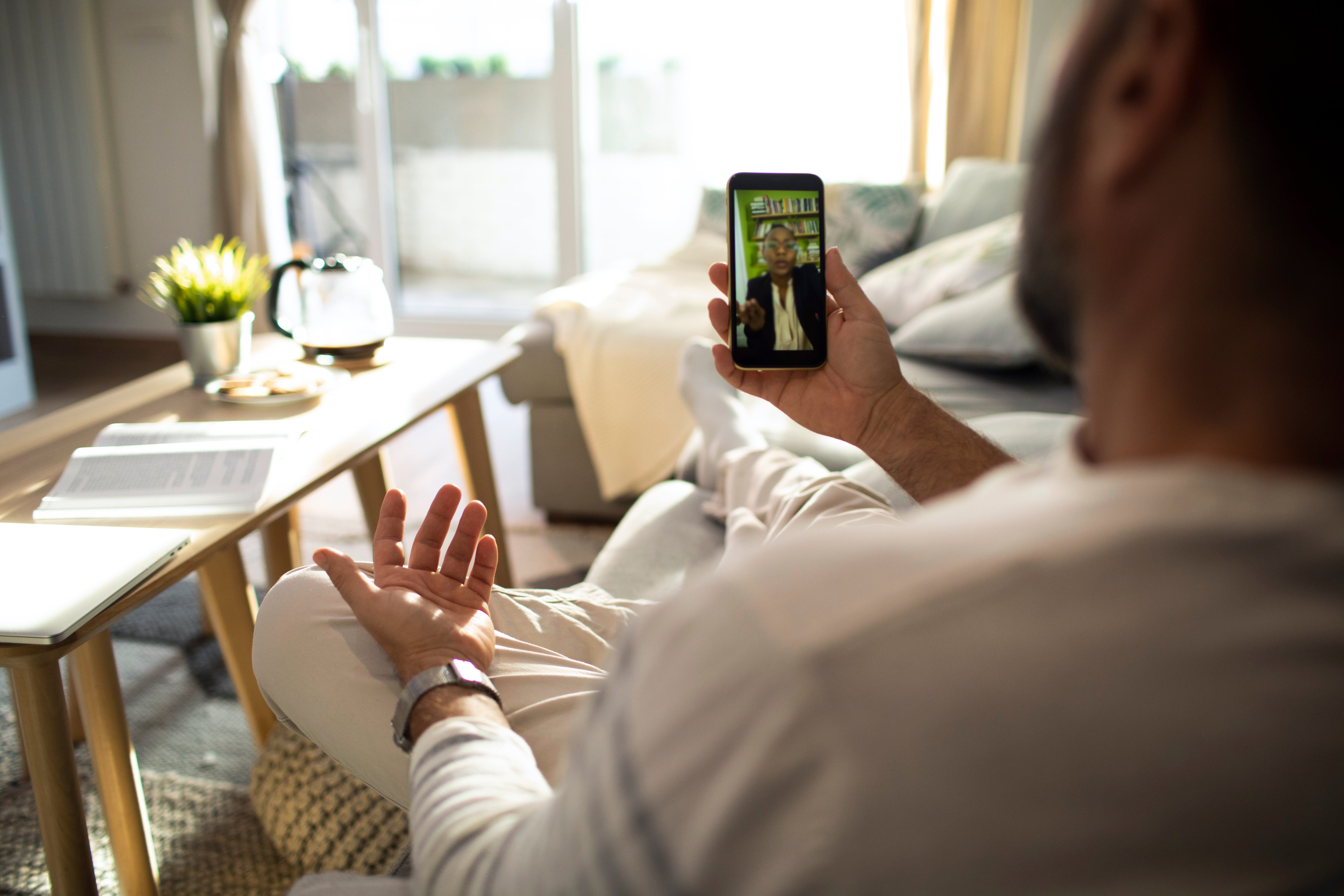
Talking to your therapist over Zoom is as helpful for anxiety and depression as going to in-person therapy. The virtual session, moreover, can be delivered at a lower cost, according to a large new study conducted in the U.K.
Online therapy has become more and more prevalent since the COVID pandemic, when lockdowns forced lots of therapists online. The new study suggests that one of the biggest benefits of virtual therapy may be that it can allow people to get treatment faster, which increases their quality of life and reduces the amount of additional medical care they require—and thus cuts costs overall.
“The actual cost of mental health care doesn’t come from treating these conditions but from not treating them,” says study co-author Ana Catarino, director of clinical science at ieso Digital Health, a U.K. company that contracts with the country’s National Health Service (NHS) to provide virtual treatments.
Cognitive-behavioral therapy (CBT) is a well-established method for treating a variety of disorders that is based on the premise that maladaptive patterns related to thoughts, feelings and behaviors are learned and can be unlearned. “There have been numerous studies that have shown that virtual CBT can be just as effective as in-person CBT for various mental health conditions, including depression and anxiety,” says Kathryn Boger, a psychologist at Harvard Medical School and Mass General Brigham’s McLean Hospital, who specializes in CBT for anxiety and mood disorders.
Questions persist about how best to deliver mental health interventions online, though, says David Barlow, an emeritus professor of psychology and psychiatry at Boston University, who developed an influential CBT-based protocol for treating emotional disorders. The advantage of the new study, published today in the journal Nature Mental Health, is that it analyzed the outcomes of more than 27,500 patients. And because the NHS is a single health care system that tracks patient outcomes very closely, Barlow says, the team had the ability to tease out cost-effectiveness in a way that would be impossible in a fragmented health system such as that of the U.S.
Catarino and her team compared ieso’s Internet-delivered CBT, which has a therapist working one-on-one with patients through a text chat, with the other services for anxiety and depression offered by the NHS, which covered a variety of therapies and delivery methods.
The findings showed that online therapy was more cost-effective than the other forms of care, Catarino says. What was most interesting was why, however: the researchers found that patients who were offered the therapist-guided CBT program got treatment faster. As a result, their quality of life improved more quickly, and they used fewer other medical services. “The longer patients wait, the more likely they are to see their problems become more severe and to have a poorer response as a result of that wait,” Catarino says.
The paper is likely to “make a big splash,” Barlow says, because the authors showed that the success of the NHS virtual CBT program was linked to the fact that it provided patients with a therapist’s guidance every step of the way. Some Internet-delivered CBT just gives patients modules to work through on their own, but the new study showed that having a therapist work with the patient online is more effective, he says. “That seems to be where we get the best results, and that’s so extraordinarily important, given the rapidity with which the behavioral-health-care-delivery system is converting to digital applications,” Barlow adds.
It’s not surprising that virtual therapy works as well as in-person therapy, says Haim Weinberg, a licensed psychologist and a group psychotherapist in private practice in Sacramento, Calif., who has written two books about online therapy. Studies outside the U.K. have found the same, he says. But there is still some bias against virtual therapy as somehow second-best, and there are not yet many established training programs to get mental health professionals comfortable with providing care online, Weinberg adds.
Nevertheless, the practice is growing. Mental health treatment is a particularly fruitful area for telemedicine, says Jeanine Turner, a communication researcher at Georgetown University, who has studied virtual medical treatment. People dealing with anxiety or depression may find the logistics of getting to a clinic overwhelming, Turner says, and the ability to talk to a professional from the comfort of home can help overcome that barrier. Virtual therapy can also expand access to people in rural areas, where mental health professionals are sparse.
Improving polices around virtual mental health care could go a long way toward making such sessions more common in the U.S., Boger says. PSYPACT, an effort to allow psychologists to use their licenses to practice teletherapy across state lines, is in effect in 37 states, Washington, D.C., and the Commonwealth of the Northern Mariana Islands.
Virtual care won’t be right for every person, Catarino says, but the new study’s results suggest the need to expand access so that patients aren’t left waiting for help. “These findings really speak to the importance of developing clinical interventions that are proven to be effective and that can be deployed at scale to match the demand we know exists,” she says. “Digital health interventions can play a big role in that.”


