By monitoring the calls of spider monkeys, researchers have shown what level of human activity they will tolerate, helping guide conservation.


The study, led by Imperial College London researchers, showed that Geoffroy’s spider monkeys in Costa Rica are not found in areas with less than 80% forest cover and within one kilometer of a paved main road.
Published in Proceedings of the Royal Society B, the research shows how ‘passive acoustic monitoring’ can speed up the study of threatened species, determining what their needs are in order to guide conservation decisions.
Lead author Dr. Jenna Lawson, from the Department of Life Sciences (Silwood Park) and the Grantham Institute at Imperial, said, “Identifying thresholds, or ‘tipping points’ below which threatened species may decline, is essential in the design of strategies to prevent local extinctions.”
“Our results highlight the dangers of forest loss and paving roads through important habitat, and provide tools and knowledge for setting targets and developing conservation strategies for the protection of Geoffroy’s spider monkey and other species that inhabit tropical forest ecosystems.”
Acoustic monitoring
Threatened species can be hard to study over large areas and over extended time periods, since they can be very spread out and be active only at certain times. Passive acoustic monitoring (PAM)—placing audio detectors across the habitat and recording when a target species calls to other members—has been suggested as a more effective method.
However, to be effective, the detector needs to work well and there needs to be a good automatic method for sorting through the many thousands of hours of recordings for the right species calls. The team used an AI model to sift the data, and then checked all ‘positive’ signals manually.
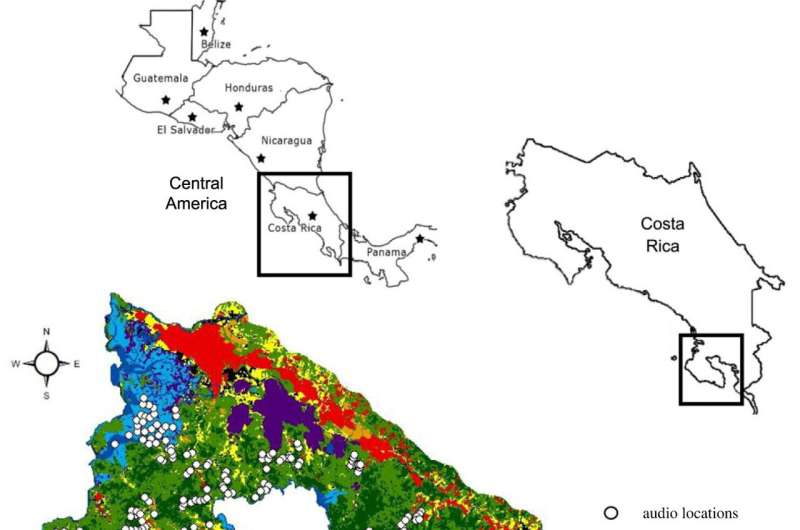
They gathered 35,805 hours of audio across 341 sites, which they managed to analyze in eight weeks—a significant improvement compared to having to listen to all the audio manually, which could have taken up to 20 years to listen to. Overall, they found 2,977 calls across 64 of the sites.
Human disturbance
This allowed them to conclude that the monkeys were not found where there was less than 80% forest cover, suggesting this is a threshold for them. This figure is important since previous monitoring of the same species in different countries has shown different forest cover needs, for example down to 50% in Mexico, showing that the local context is important when creating conservation policies.
The monkeys in Costa Rica however were equally tolerant of both primary and secondary (re-grown after clearing) forests, as long as there was at least 80% cover. This may be because in Costa Rica secondary forests are generally older than in other regions, allowing the trees and their fruit to mature enough for the monkey’s specialist diet.
While the monkeys did not seem to be disturbed by secondary gravel roads, they were not found with one kilometer of primary paved roads that bisect their forest territories. This means that even where there is good forest cover overall, the presence of a road can significantly affect how monkeys can move around this habitat.
Lead researcher Dr. Cristina Banks-Leite, from the Department of Life Sciences (Silwood Park), said, “The effect of primary paved roads could only be seen in a study like ours, where a sufficient area can be covered over time. While secondary roads were not so much of an issue, our results did show the monkeys were only found where roads and building in general were limited, suggesting they are very sensitive to human disturbance.”
More information:
Jenna Lawson et al, Automated acoustic detection of Geoffroy’s spider monkey highlights tipping points of human disturbance, Proceedings of the Royal Society B: Biological Sciences (2023). DOI: 10.1098/rspb.2022.2473
Provided by
Imperial College London
Citation:
AI-enhanced audio monitoring shows where monkeys won’t go (2023, August 25)
retrieved 25 August 2023
from https://phys.org/news/2023-08-ai-enhanced-audio-monkeys-wont.html
This document is subject to copyright. Apart from any fair dealing for the purpose of private study or research, no
part may be reproduced without the written permission. The content is provided for information purposes only.