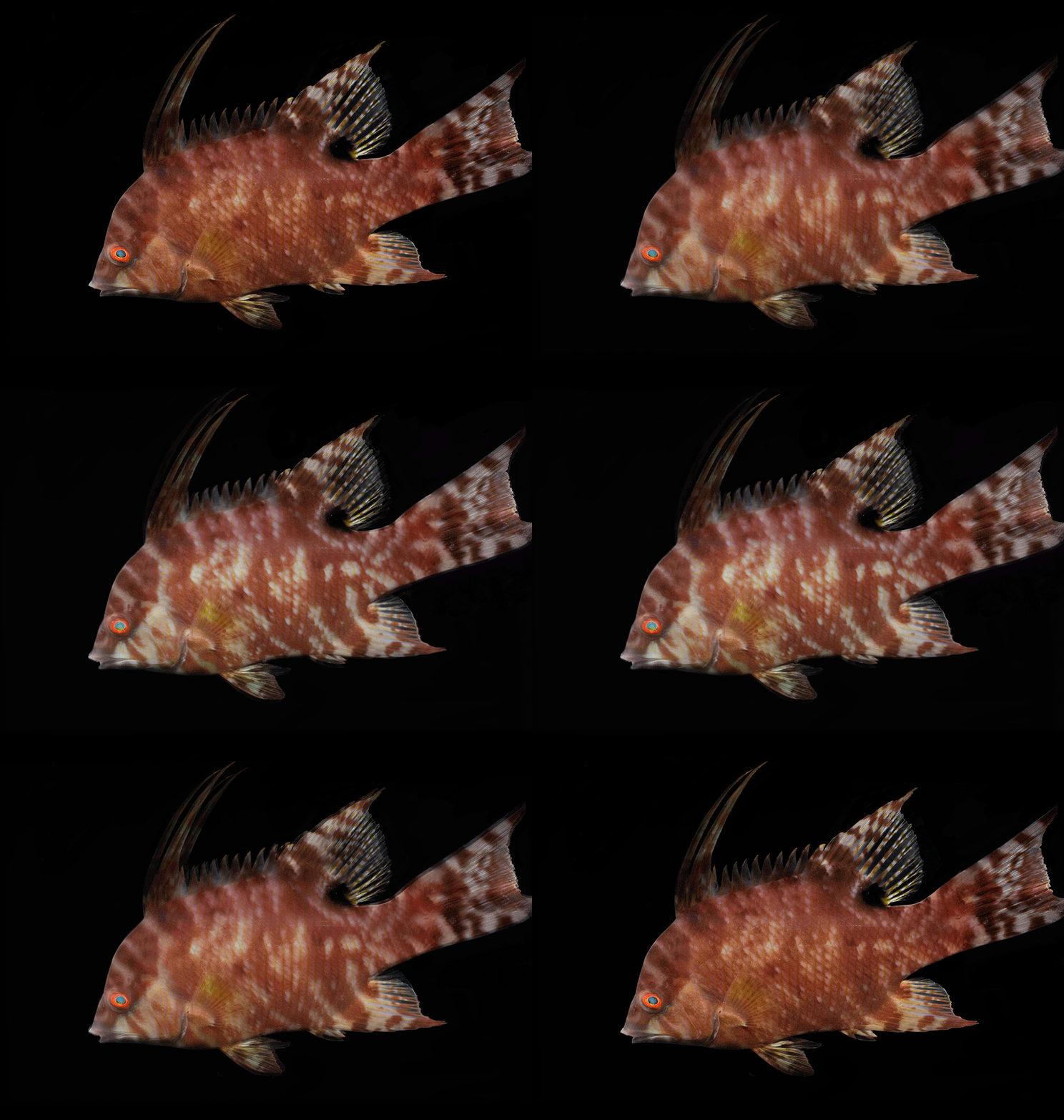
Lorian Schweikert was fishing in the Florida Keys when she hooked a hogfish—a type of tasty wrasse that’s known for its ability to change colors to match its coral reef environment. Schweikert dropped the animal on the boat deck and went back to casting her line. When she later went to retrieve the hogfish, she was startled to find that it had changed color to perfectly match the white deck—complete with little black circles that mimicked the textured floor.
Schweikert is a marine biologist at the University of North Carolina Wilmington. Seeing the fish’s impressively on-point camouflage made her suspect that the species could help answer a long-standing scientific question: How do color-changing animals actually know that they’re changing into the right color?
“Imagine you had to get dressed in the morning but didn’t have a mirror,” Schweikert says. While this would be an inconvenience for humans, “for a fish, that’s life or death.”
Hogfish changing color as it is approached by a diver in Miami, Fla. Credit: Brandon Kohn
Now Schweikert and her colleagues may have pinpointed the natural detection system hogfish use to make sure they match their environment. As the researchers report in Nature Communications, specialized light-sensing cells located underneath a layer of color-changing cells seem to allow the fish to monitor the status of their scaly wardrobe, likely with the goal of responding with necessary adjustments—an ability the species depends on for both camouflage and for finding mates. Because hogfish do not seem to be able to see their own skin, the newly discovered cells are probably the only tool they have for assessing their skin’s performance.
“This is the first study to look at the structure of where light detection is in the skin of a vertebrate animal,” Schweikert says. “This study only applies for hogfish, but it might be that this is a system that’s bigger than hogfish.”
A range of species are capable of rapidly changing the color of their skin, including some reptiles, amphibians, fish and cephalopods. This ability has evolved multiple times in the animal kingdom and is made possible by chromatophores, specialized cells that contain pigment that can be moved around to take on certain colors or patterns.
Based on previous studies, Schweikert and her colleagues knew that hogfish skin contains a blue-light-sensitive protein called SWS1. But no one knew where, exactly, SWS1 occurs in the skin. The researchers used a biochemical technique called immunolabeling to pinpoint the protein’s location in hogfish skin samples and found that it was concentrated in a specific area right below the chromatophores.
Next they used electron microscopy to find out what was actually keeping the SWS1 in place—specifically, what cell it might be part of. They discovered that the protein is contained in cells that could be photoreceptors in the skin, Schweikert says. In experiments, she and her colleagues passed light through skin samples and found that the chromatophores’ pigment, depending on its location in the cell, either turns on or turns off the underlying photoreceptorlike cells by blocking light. The researchers found that the light-sensing cells occur at a 1:1 ratio with the color-changing ones, meaning each individual cell does not seem to be able to make color comparisons. Any detection of changing skin color would come from “the collective sensing of all these photoreceptors, which is cool but untested,” Schweikert says. How or whether the light-detecting cells communicate skin color changes to the brain is also still unknown.
Schweikert and her colleagues are now conducting further research to better understand what, exactly, the light-detecting skin cells are and how the fish perceive them. “Are they photoreceptors?” Schweikert says. If so, “that would be the first example of such a cell outside the nervous system of a vertebrate.”
Already the new findings represent “a really exciting and considerable step towards answering the long-standing question ‘How can these animals tell what color they are?’” says Lauren Sumner-Rooney, an evolutionary biologist at the Museum of Natural History in Berlin, who was not involved in the study.
The hogfish “seems like a great model” to explore further questions, Sumner-Rooney adds, such as just how precisely hogfish can monitor their color changes and whether “this simple-but-effective approach is common to other fishes and beyond.”