In a recent article published in Nutrients, researchers pursued evidence of a possible improvement in psoriasis (Ps) through nutritional strategies, highlighting the regulatory effects of nutrients and food in Ps.
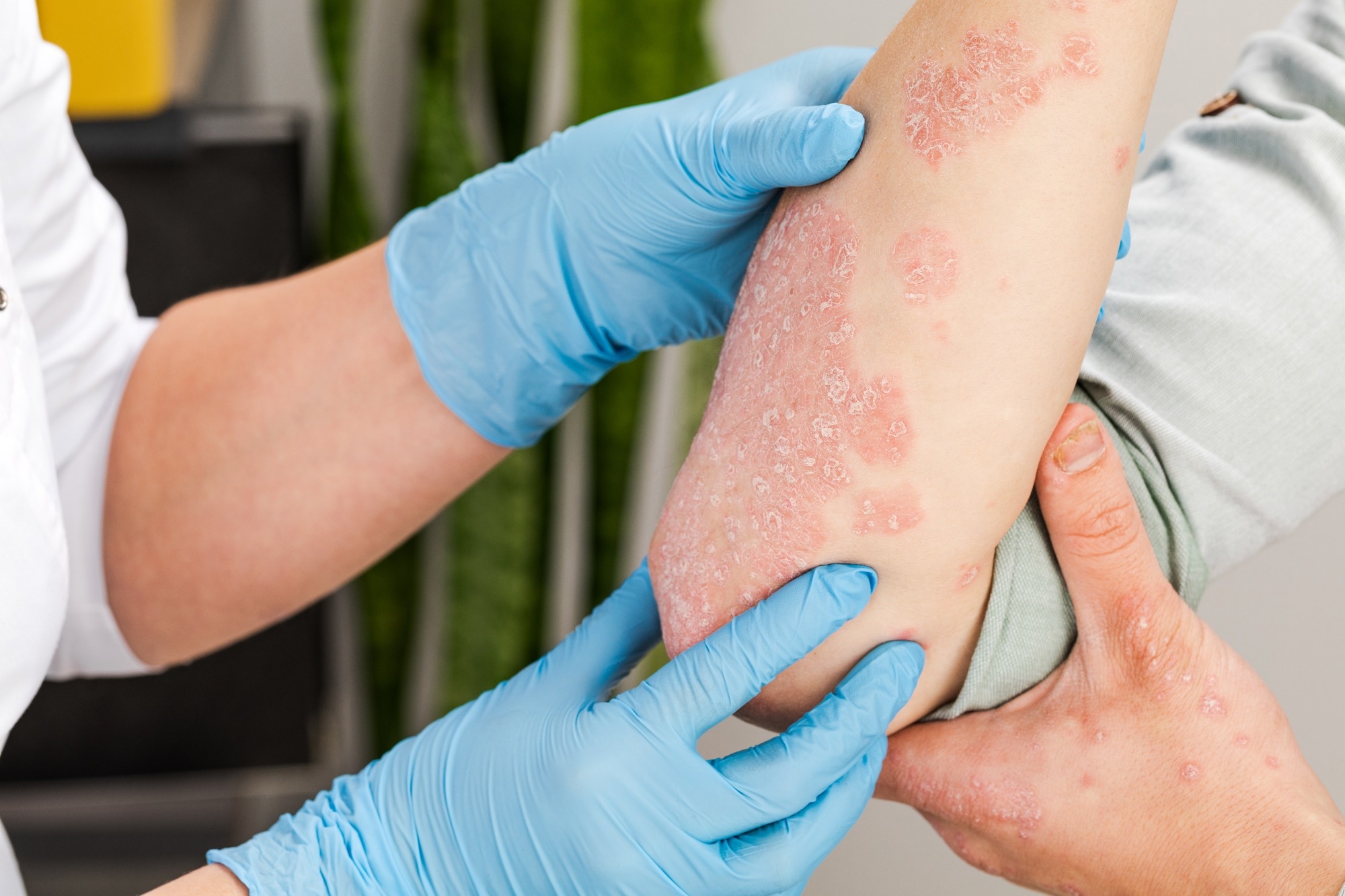 Study: Insights into Nutritional Strategies in Psoriasis. Image Credit: Fuss Sergey/Shutterstock.com
Background
Psoriasis is a multi-etiological autoimmune disease manifesting as a chronic inflammatory skin condition and a profound inflammatory pattern. The incidence of psoriasis has increased up to 4% in the general population worldwide, affecting mainly adults.
Some recent studies have implicated obesity as a factor worsening psoriatic events and comorbidities, such as diabetes, psoriatic arthritis, and gut microbiota dysbiosis, as both conditions share immune-mediated mechanisms. As is well-recognized, white adipose tissue is an endocrine organ that secretes immune, inflammatory, and metabolic factors.
These studies also demonstrated how fatty tissue overwhelmed the homeostasis of multiple organ systems via the induction of pro-inflammatory cytokines, such as tumor necrosis factor-alpha (TNF-α) and interleukins (IL-23/21/17/8/6).
So, the researchers evaluated clinical parameters associated with the inflammatory state of psoriasis patients on various diet regimens. They found that low-calorie and ketogenic diets improved all the tested clinical parameters of Ps and uplifted the psoriatic status of the patients.
About the study
Thus, in this study, researchers reviewed and summarized all recent studies discussing a connection between Ps and obesity to help find nutritional interventions that complement therapies for Ps disease.
Additionally, they described an animal model of Ps and obesity to highlight molecular mechanisms, such as the gut microbiota dysregulation pattern, that induce obesity and autoimmune diseases like Ps.
Effect of obesity on Ps and vice versa
There are two age peaks of Ps onset, i.e., between 20 and 30 years and 50 and 60 years. It is also the time when metabolic dysregulations commonly occur, including obesity. Thus, the
authors of this study favored both arguments- obesity triggers Ps, and Ps trigger obesity.
Accordingly, the Ps incidence in obese individuals is high, and its patients can gain weight rapidly. So, weight loss or management is a key tool to normalize Ps, whether done through dietary interventions or positively impacting or improving the efficacy of classical Ps medications.
All interventions that reduce chronic inflammation improve Ps outcomes by positively affecting gut dysbiosis.
The skin–gut–microbiota link
The skin is the largest human organ and houses many types of bacteria. Earlier animal models of psoriasis fetched contradictory results about the skin microbiota.
However, a recent study identified significant deregulations in alpha- and beta-types of skin bacteria among imiquimod (IMQ)-induced Ps mice. Moreover, this study showed a correlation between some microbes residing in the intestine and the skin, sustaining the skin–gut–microbiota link.
Gut dysbiosis negatively impacts skin integrity and function and disturbs overall skin homeostasis; vice versa also occurs. Some microbes disrupt the intestinal barrier and skin homeostasis by interfering with mucosal immunity components and signaling pathways that regulate epidermal differentiation.
For example, Clostridioides difficile, a gut-inhabiting bacteria, synthesizes two metabolites, p-cresol, and phenol, that enter the blood circulation and accumulate on the skin, causing dryness, hindering epidermal differentiation, and affecting keratinization. Dysbiosis in Ps also deregulates T cell function and differentiation.
Effect of nutritional interventions in Ps
Of all the dietary regimens tested in this study, a low-calorie diet induced the most benefits in severe Ps by reducing systemic inflammation, obesity, and dysbiosis regulation. In this diet regimen, people ate food comprising 60% carbohydrate, 15% protein, and 25% fat which provided 500 kcal below their calculated dietary requirement.
After 24 weeks, many people on this diet attained Ps lesion area and severity index (PASI) scores of 75 and 50. Caloric restriction due to four weeks of dieting led to a regression in the Ps lesions.
Moreover, a dermatologist found significantly reduced (~50%) PASI scores and the standard parameters, including dermatology life quality index (DLQI) and visual analog scale (VAS) for pruritus measurement in patients with chronic disease symptoms.
This diet also improved many other parameters consistently deregulated in Ps, such as folic acid, vitamin B12, and calcium levels. The low-calorie diet increased an antioxidant metabolite, bilirubin, and cortisol, both associated with an improved psoriatic condition.
Conclusions
To summarize, over 60% of patients diagnosed with moderate to severe psoriasis have a poor quality of life. The researchers found a connection between obesity, the gut microbiome, and the pathogenesis of Ps, primarily occurring through the deregulated epithelial barrier that triggered systemic inflammation.
The composition and diversity of the gut microbiome influence the symptom severity in Ps patients; thus, diet and supplements that actively modulate the gut–skin axis functionality could improve Ps symptomatology and a patient’s quality of life.