


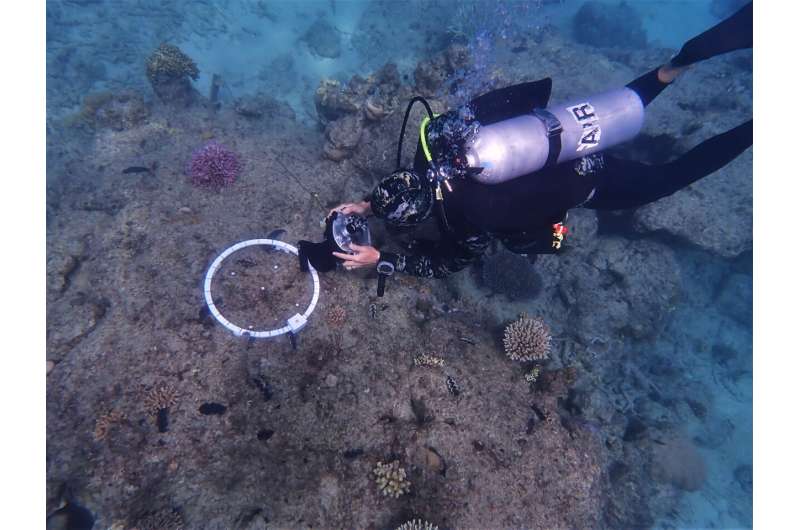
Keeping a watchful eye on newly settled corals at submillimeter scale on the Great Barrier Reef is now much easier, with Southern Cross University and CSIRO successfully using underwater macrophotogrammetry for the first time.
In a paper published today in the journal Methods in Ecology and Evolution, a team of scientists from Southern Cross University and CSIRO demonstrates how advanced imaging techniques can offer new opportunities to monitor and study the recruitment of corals, and other sessile (attached) organisms, at an astonishingly fine scale directly on the reef.
This new method is particularly useful to monitor the recruitment success of newly settled corals following coral larval restoration interventions: when microscopic larvae raised in floating coral nursery pools are released en masse on reefs damaged by the impacts of climate change to kickstart their recovery.
“Coral recruitment occurs at a scale invisible to the human eye (less than 1mm), and up until now, required the use of artificial plates attached to the reef to later be examined under microscopes to quantify newly settled corals,” said Dr. Marine Gouezo, the lead author and Post-Doctoral Researcher at Southern Cross University.
“With this new method, observations of the recruitment of organisms 0.5 millimeter in size, such as two-month-old corals, can be documented and tracked through time in their natural habitat: the reef.”
The study demonstrates the application of underwater macrophotogrammetry: a combination of macrophotography (the art of taking close-up photographs at very high resolution to see tiny organisms typically smaller than 1-mm in size) and photogrammetry (a technique that “stitches” these photos together to re-create three-dimensional models of small portions of the reef).
Unlike traditional methods for observations in the field that rely on artificial devices (like tiles), this innovative approach allows scientists to directly monitor larval settlement and recruitment on a reef, making it valuable for assessing the success of coral larval restoration interventions.
“While reef scale photogrammetry is commonly used in ecological surveys underwater, especially during monitoring programs to document changes through time, such as coral cover, it lacks the resolution to spot baby corals. This macrophotogrammetry technique can complement reef scale photogrammetry by magnifying small portions of the reefs to monitor the reef at submillimetre scale, which is the scale at which recruitment occurs for corals,” Dr. Gouezo said.
For large scale projects like Coral Larval Restoration on the Great Barrier Reef, the macrophotogrammetry technique is cost-effective and avoids the need for equipment installation on the reef or access to laboratory microscopes. It provides a permanent three-dimensional (3D) record of small reef areas, characterizing reef associated organisms in their natural environment.
Advancements in modern photography combined with the capacity for cameras to operate underwater, along with software for 3D model reconstruction, have revolutionized coral reef research. Digitizing this monitoring step opens doors to opportunities for automated processing and machine learning techniques.
“The macrophotogrammetry method provides researchers with a monitoring approach to understand the hidden dynamics of marine life at unprecedented detail. I am excited about its potential to drive marine ecological research and restoration efforts forward,” said Dr. Gouezo.
Dr. Gouezo is a senior member of Southern Cross University’s Coral Larval Restoration team led by Distinguished Professor Peter Harrison, who also authored the paper. Dr. Christopher Doropoulos, a Senior Research Scientist at CSIRO Environment, is a co-author.
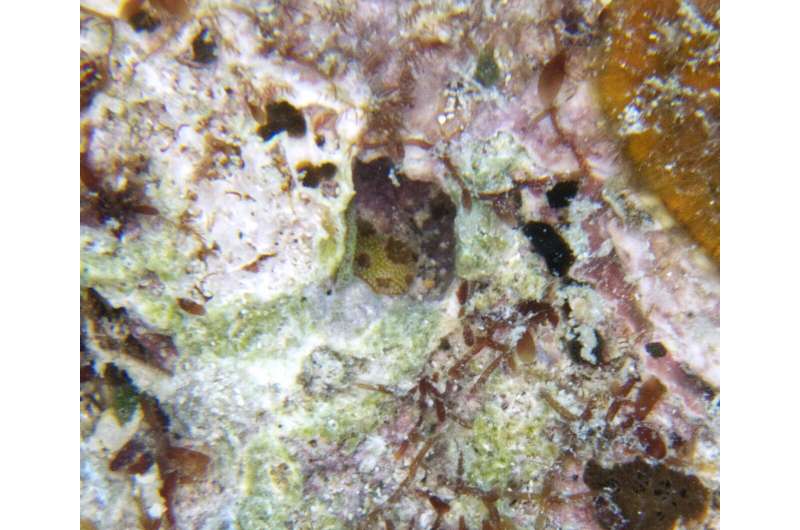
“This macrophotogrammetry technique enables us to examine the earliest stages of coral recruitment in field settings on the reef for the first time, rather than using proxies such as settlement tiles,” said Dr. Doropoulos.
“It will deepen our ecological understandings of what limits and what promotes successful larval settlement and early survival for optimizing the application and scale of on reef larval-based coral restoration operations.”
“Photogrammetry methods like these, are being developed across the RRAP and help us to close critical knowledge gaps in reef recovery,” said RRAP Executive Director Cedric Robillot of the Great Barrier Reef Foundation.
“It’s an important step on the journey to develop and test novel scientific solutions and make those available to managers to help the Great Barrier Reef and other coral reefs survive the effects of climate change in the decades ahead.”
More information:
Underwater macrophotogrammetry to monitor in situ benthic communities at submillimetre scale, Methods in Ecology and Evolution (2023). DOI: 10.1111/2041-210X.14175
Provided by
Southern Cross University
Citation:
Advanced imaging technology helps monitor baby corals on Great Barrier Reef (2023, July 26)
retrieved 26 July 2023
from https://phys.org/news/2023-07-advanced-imaging-technology-baby-corals.html
This document is subject to copyright. Apart from any fair dealing for the purpose of private study or research, no
part may be reproduced without the written permission. The content is provided for information purposes only.


