


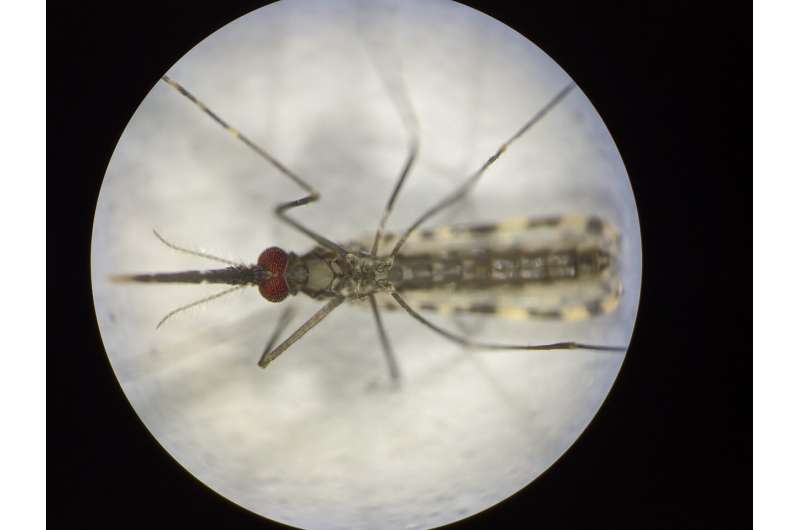
Research led by the Department of Microbiology & Molecular Genetics, University of California at Irvine, Irvine, has developed a gene drive solution for mitigating malaria transmission from mosquitoes.
In their paper, “Dual effector population modification gene-drive strains of the African malaria mosquitoes, Anopheles gambiae and Anopheles coluzzii,” published in Proceedings of the National Academy of Sciences, the team present a proposed gene drive approach to reducing human malaria cases by introducing genes into vector mosquitoes that hinder the transmission of the malaria parasite.
The study demonstrates the potential of using Cas9 guide RNA–based gene drive systems coupled with dual anti-parasite effector genes to rapidly spread through mosquito populations and reduce the load of Plasmodium falciparum, the parasite that causes malaria in humans.
Gene drives operate by taking advantage of genetic systems that link highly conserved or advantageous traits to chromosomes or other genetic elements with a positive transmission bias so that it will be inherited at rates much higher than 50%. In this way, a new gene can be introduced into a rapidly reproducing population with a small number of modified individuals and quickly spread to become dominant within the population.
Previous considerations of using gene drive modifications to eradicate mosquitoes have been met with great concern for the potential unintended effects of removing a species from the environment, even one as universally despised as mosquitoes.
Mosquitoes are food for many creatures, including several birds, bats, turtles, fish and frogs, spiders and snakes, dragonflies and damselflies. While they may have a taste for blood, mosquitoes primarily feed on nectar from small flowers, making them important pollinators.
The current study takes a much more holistic approach, essentially using the gene drive to vaccinate generations of mosquito populations against the parasite that causes malaria without harming the mosquitos or jeopardizing their important role in the ecosystem.
Researchers added the designed gene drive effector gene to a small population of mosquitoes under laboratory conditions. Trials were conducted using two strains of mosquitoes, Anopheles gambiae and Anopheles coluzzii. The genes were inherited by offspring at nearly 100%, and researchers observed the complete spread of the gene drive augmentation to captive wild-type populations within a few months.
The effector genes spread by the gene drive produce monoclonal antibodies that target specific stages of the parasite’s life cycle within the mosquitoes, significantly reducing P. falciparum prevalence and their potential subsequent infection intensity.
Transmission modeling predicts that, with a series of releases, the genetically modified mosquito strains could have swift and meaningful epidemiological impacts by reducing malaria incidence by 50% to 90% within just a few months.
The competitiveness of the augmented Anopheles gambiae males was observed to be significantly less. While the reason for this is unclear, it could affect the robustness of the species in the wild, though likely not more so than other considerable mitigation efforts like pesticides.
The authors suggest that the tested mosquito strains are promising candidates for future field trials in malaria-endemic regions, pending further validation and testing.
No small problem
According to the World Health Organization, in their World malaria report 2022, there were an estimated 247 million cases and 619,000 deaths from malaria. Yearly global investment in malaria intervention and control programs exceeds $16 billion.
While the current efforts, ranging from mosquito nets and pesticides to the development of vaccines, have saved millions of lives, they require constant costly investment. Heavy pesticide use in concentrated areas of malaria infections could also have uncalculated long-term negative effects on local ecosystems.
A gene drive solution like the one proposed and tested in the current study could be an integral solution to the persistent malaria problem. A solution that greatly reduces financial costs, environmental tolls, and the loss of human life.
More information:
Rebeca Carballar-Lejarazú et al, Dual effector population modification gene-drive strains of the African malaria mosquitoes, Anopheles gambiae and Anopheles coluzzii, Proceedings of the National Academy of Sciences (2023). DOI: 10.1073/pnas.2221118120
© 2023 Science X Network
Citation:
Mosquito-friendly gene drive may lead to a malaria-free future (2023, July 19)
retrieved 22 July 2023
from https://phys.org/news/2023-07-mosquito-friendly-gene-malaria-free-future.html
This document is subject to copyright. Apart from any fair dealing for the purpose of private study or research, no
part may be reproduced without the written permission. The content is provided for information purposes only.


