

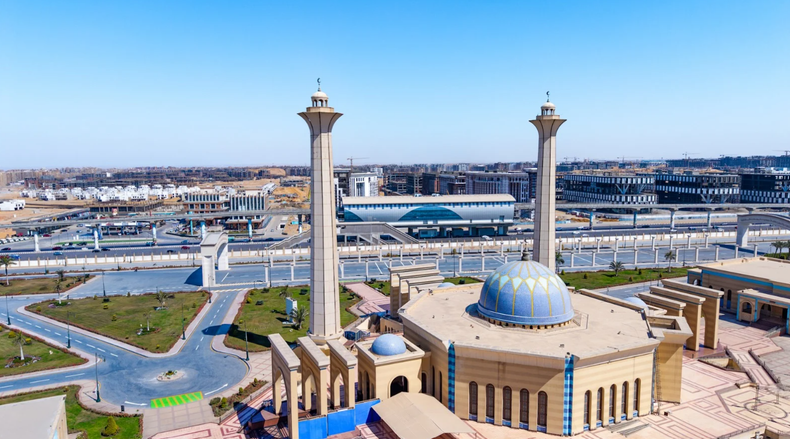
President Abdel Fattah al-Sisi inaugurated the driverless system on Friday, unveiling a high-capacity transit link connecting Cairo’s Nasr City to the New Administrative Capital.
Following the inauguration, Sisi, alongside families of fallen Egyptian soldiers, rode the monorail from the Al-Fattah Al-Alim Mosque station to the Financial District, passing through key residential zones.
Transport Minister Kamel al-Wazir described the project as a “civilizational leap,” noting that it aligns with government efforts to deploy eco-friendly transport systems that reduce fuel consumption and road congestion.
The rubber-tyred, fully automated system consumes about 30% less energy than conventional electric rail and operates on elevated tracks, minimizing disruption to existing road networks.
Africa’s longest line vs Africa’s largest system
The East Nile monorail is now the longest single monorail line in Africa at 56.5 km. However, it is part of a broader network—the Cairo monorail system—which includes a second line linking 6th of October City.
When both lines are combined, the network stretches to about 96 km, making it Africa’s largest monorail system overall. In simple terms, the East Nile route holds the record for a single line, while the full Cairo network holds the continental record for total system size.
Built by a consortium including Alstom, Orascom Construction, and Arab Contractors, the project features 40 trains capable of reaching speeds of up to 80 km/h, with intervals as short as 90 seconds.
The system integrates with Cairo’s Metro Line 3 and the Light Rail Transit (LRT), with future links planned to Metro Lines 4 and 6.
Equipped with platform screen doors, LED displays, and accessibility features, the monorail is expected to play a central role in reshaping Cairo’s urban mobility and supporting the shift toward sustainable transport.


