

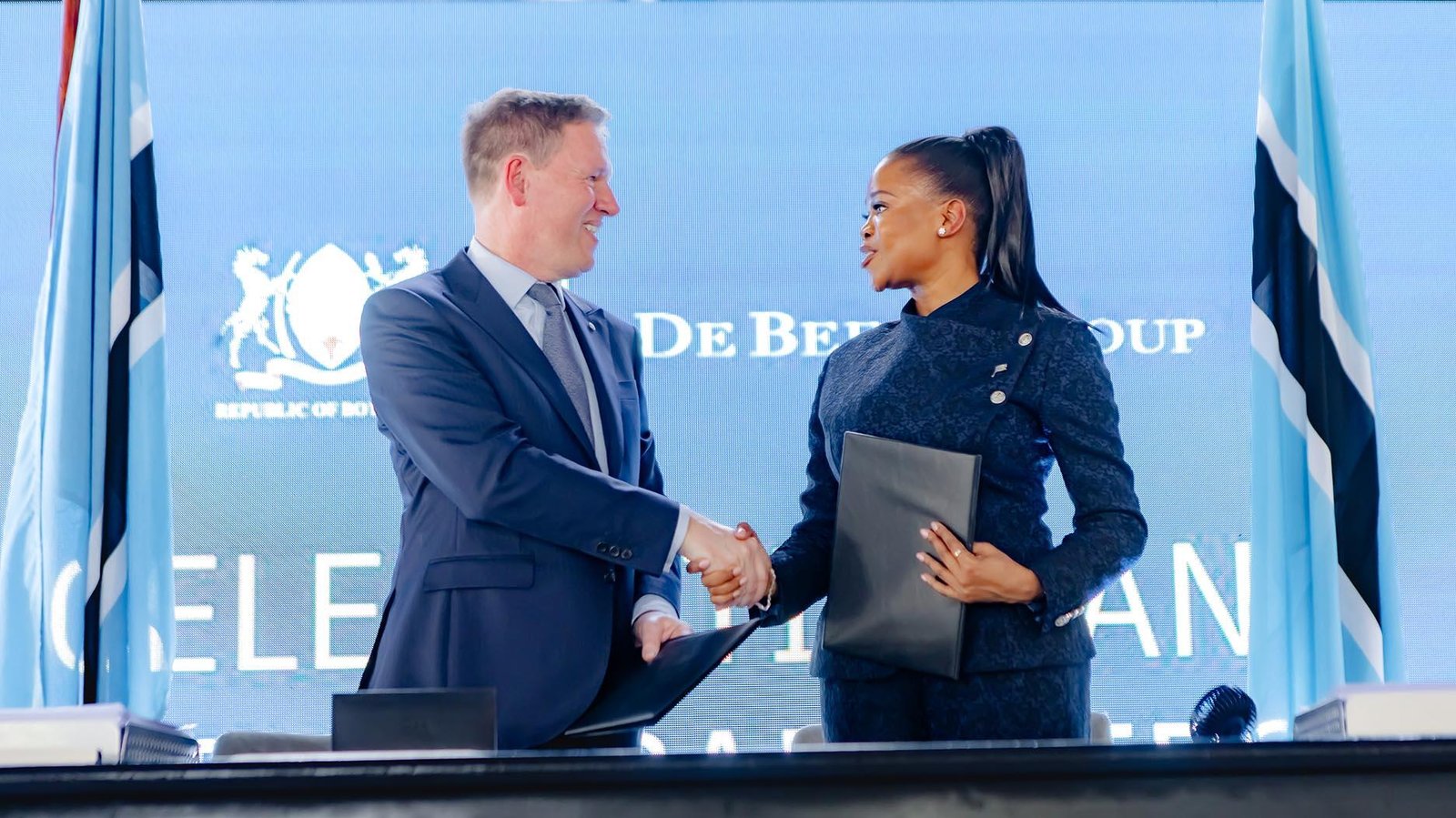
Botswana has implemented a transformative diamond revenue framework that reduces De Beers’ stake in their joint venture from 75% to 60%, marking the most significant shift in Southern African resource governance since the end of apartheid. The new arrangement, effective March 2026, restructures the Debswana partnership that has generated over $4.2 billion annually for the past five years.
Revenue Mechanics Under New Framework
The revised structure allocates 60% of Debswana profits to De Beers and 40% to the Botswana government, reversing the previous 75-25 split that had favored the Anglo American subsidiary since 1969. This change affects revenues from the Jwaneng, Orapa, Letlhakane, and Damtshaa mines, which collectively produce approximately 20 million carats annually roughly 20% of global rough diamond supply.
Under the new framework, Botswana projects annual revenue increases of $840 million based on current production levels. The government has structured the deal to include technology transfer requirements, with De Beers committing to establish a $200 million diamond processing facility in Gaborone by 2028.
Ownership vs. Royalty Structure
Unlike traditional royalty-based mining agreements, Botswana maintains direct ownership through equity participation rather than percentage-based extraction fees. The government receives dividends as a shareholder while also collecting a 10% royalty on gross diamond sales—a dual revenue stream that generated $520 million in 2025.
This hybrid model differs from neighboring countries: South Africa operates on a 7% royalty basis without equity participation, while Angola uses production-sharing agreements capping foreign ownership at 51%. Botswana’s approach provides greater revenue predictability during price volatility, as demonstrated during the 2022-2023 diamond market correction when equity returns cushioned royalty losses.
Implementation Timeline and Governance Changes
The new framework phases in over 18 months, with immediate changes to profit distribution beginning April 2026. Botswana has established a Diamond Revenue Management Board, chaired by Bank of Botswana Governor Moses Pelaelo, to oversee compliance and revenue allocation.
Key governance mechanisms include quarterly auditing by PricewaterhouseCoopers, mandatory disclosure of sales contracts above $10 million, and government representation on Debswana’s executive committee. The framework also requires De Beers to maintain rough diamond sales through Botswana’s Okavango Diamond Company, ensuring local value addition.
Regional Competitive Positioning
The restructuring positions Botswana more competitively against emerging producers. Russia’s Alrosa, which operates under state ownership, generated $3.8 billion in 2025 revenue with higher government capture rates. Similarly, Australia’s Rio Tinto diamond operations contribute 47% of profits to federal and state governments through combined royalties and corporate taxation.
Industry analysts at Wood Mackenzie project the new framework could influence contract renegotiations across Africa, particularly in Tanzania and Sierra Leone where existing agreements favor foreign operators with minimal local participation.
Market Response and Investment Implications
De Beers’ parent company Anglo American saw share prices decline 8% following the announcement, while Botswana’s sovereign bond yields tightened by 45 basis points as investors priced in improved fiscal dynamics. The London-listed Gem Diamonds, which operates the Letšeng mine in Lesotho, faces pressure to renegotiate similar terms.
Credit rating agency Moody’s upgraded Botswana’s outlook from stable to positive, citing improved revenue diversification and fiscal sustainability. The agency noted that diamond revenues now represent 31% of government income, down from 45% in 2019, indicating successful economic diversification efforts.
Technological Transfer Requirements
The agreement mandates De Beers transfer cutting and polishing technology to local operators within three years. This requirement addresses long-standing criticism that Botswana exports rough diamonds while importing finished jewelry a pattern common across African mineral producers.
The processing facility will employ approximately 2,400 workers and target annual production of 500,000 polished carats, potentially adding $340 million to local GDP by 2030 according to government projections.
Forward-Looking Implications
For institutional investors, the restructuring signals a broader trend toward resource nationalism in stable African jurisdictions. Portfolio managers should monitor similar negotiations in copper-rich Zambia and gold-producing Ghana, where governments face comparable pressure to capture greater mining revenues.
The success of Botswana’s model combining equity participation with technology transfer may become a template for other commodity-dependent economies seeking sustainable development financing. However, execution risks remain significant, particularly regarding local processing capabilities and global market access for finished products.


