

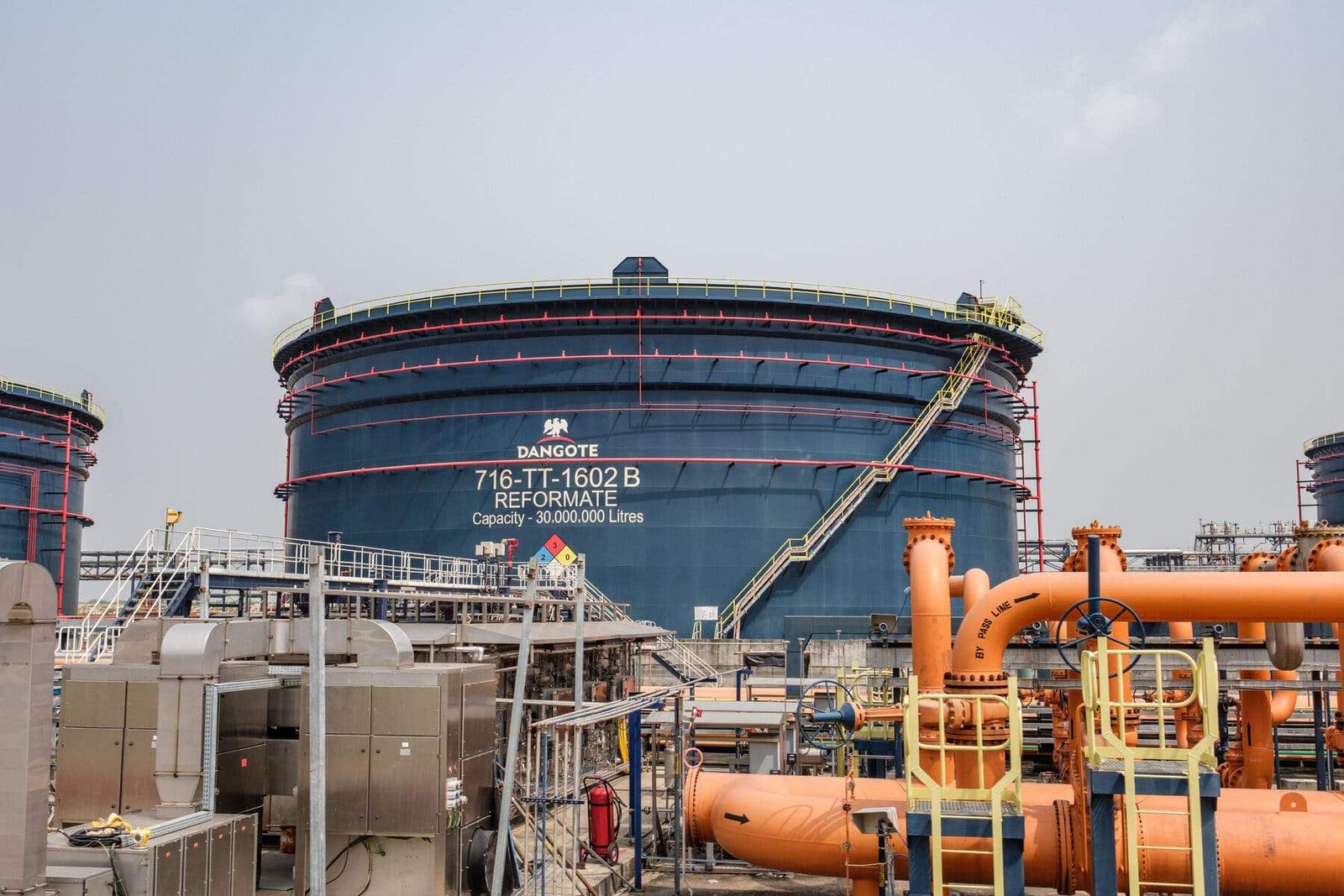
Several African countries are increasingly turning to petroleum supplies from Nigeria’s Dangote refinery as disruptions linked to the ongoing Iran war tighten global fuel supply chains.
According to a report by Bloomberg on Friday, the refinery owned by Nigerian businessman Aliko Dangote has been approached by several countries, including South Africa, Ghana and Kenya, as governments move to secure alternative supply sources.
A company executive, quoted by Bloomberg, said South Africa and several other countries have reached out to the refinery for supply.
Sources with knowledge of the discussions said South Africa is seeking a standard supply contract with Nigeria expected to run for about 12 months, although the talks remain private.
Dependence on Middle East supply exposes vulnerabilities
The scramble for supplies comes as the conflict involving Iran continues to affect global energy markets, exposing vulnerabilities in countries that rely heavily on imports for refined petroleum products.
Data from energy consultancy CITAC show that about 75 per cent of refined fuel imports in East and Southern Africa come from the Middle East.
Elitsa Georgieva, executive director at CITAC, said the dependence leaves countries in the region exposed when supply from that corridor is disrupted.
The South African government said on Wednesday it is “actively coordinating with industry stakeholders to secure both crude oil and refined petroleum products from a diversified range of sources.”
It added that “a comprehensive plan is in place to manage potential supply risks.”
People familiar with the matter also said Ghana and Kenya have also made enquiries to the Dangote refinery as part of efforts to secure fuel supply.
The Dangote refinery, with a capacity of 650,000 barrels per day, is expected to supply both the domestic market and export to other countries.
About 75 per cent of its output is reserved for Nigeria, while the remainder is available for export.
Speaking in an interview with The Economist, Dangote said supply availability has become the immediate concern in the market.
“Right now it is not about pricing, it’s about availability,” he said, adding that the situation could persist for some time.
Countries adopt measures to manage shortages
Across the continent, governments are taking steps to manage supply pressures. South Africa said it has enough fuel for the “coming weeks,” while Kenya requires oil marketing companies to maintain at least three weeks of stock, with officials saying there is no immediate concern over shortages.
In Ethiopia, authorities have directed fuel stations to prioritise public transport providers and urged citizens to use fuel sparingly.
In Somalia’s capital, fuel prices have nearly doubled amid tightening supply.
The International Energy Agency recommends that countries hold at least 90 days of net oil imports as a buffer, but no African country currently meets that benchmark.
South Africa holds about eight million barrels of strategic crude oil stocks through its state-owned Central Energy Fund, but has little in the way of dedicated refined fuel reserves, according to officials.
Jacob Mbele, director-general at South Africa’s Department of Mineral Resources, said fuel marketers maintain some stock as a distribution buffer, while the government is considering building strategic reserves, although the process is still at an early stage.
Businesses adjust to supply uncertainty
Moreover, businesses are also adjusting to the situation. Exxaro Resources Ltd., one of South Africa’s major coal producers, said demand for coal has risen as companies seek alternatives.
Chief Executive Officer Ben Magara said prices have increased by about 20 per cent to around $112 per ton.
“Making sure we have enough fuel inventories for a crisis like this is also quite important,” Magara said.
“So we are putting a lot of business continuity management plans in place because you just, you never know.”
The disruption has renewed focus on Africa’s refining capacity.
The continent has lost a portion of its refining output in recent years due to ageing infrastructure and underinvestment, increasing reliance on imported fuel.


