

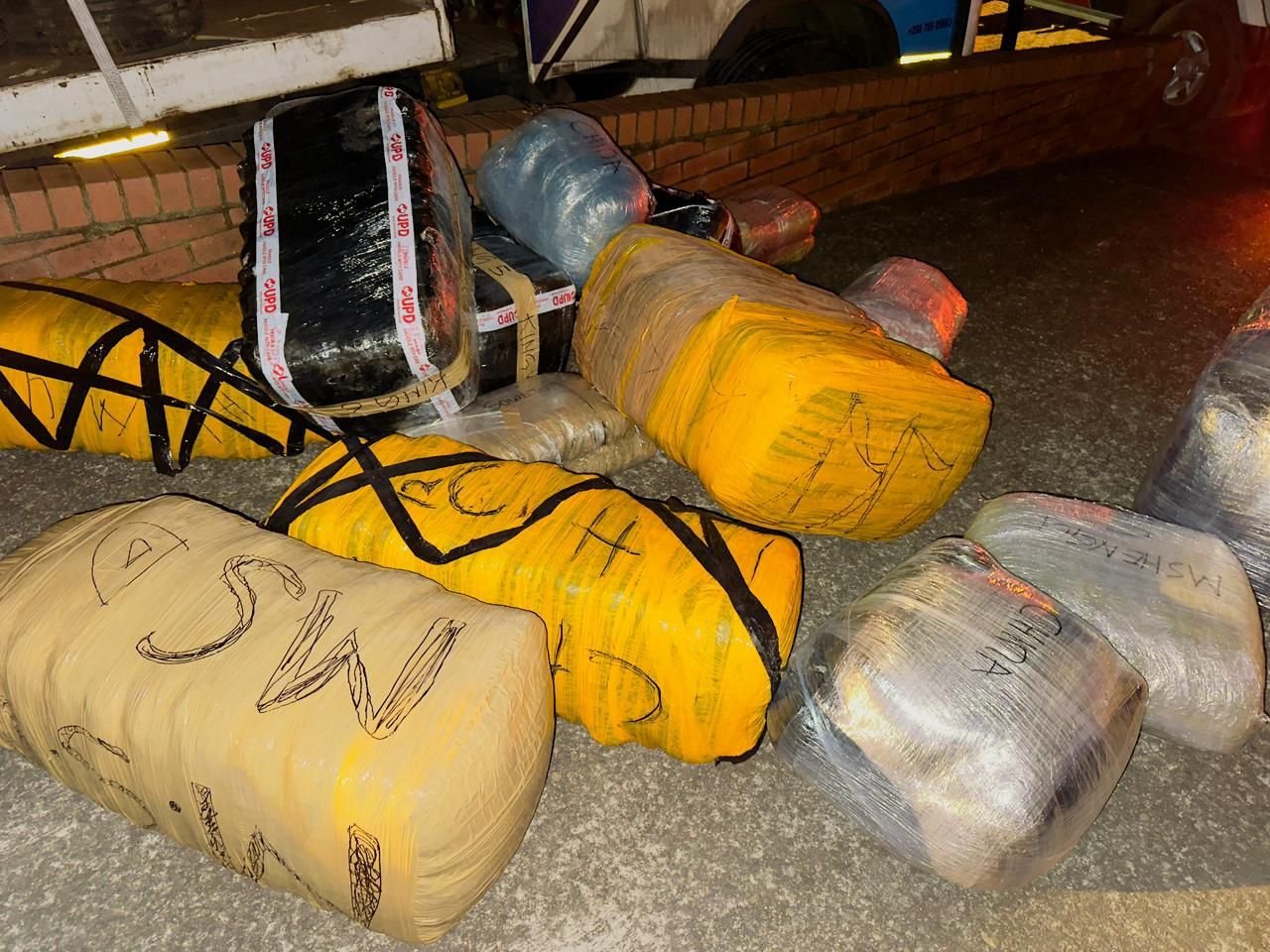

A three-pronged operation at the Oshoek port of entry (PoE) linking Eswatini and South Africa saw over 670 kg of dagga confiscated.
On Monday, 16 March, Border Management Authority (BMA) personnel working with police and SA Revenue Service (SARS) staff “intercepted”, as per a BMA statement, an apparently Eswatini registered truck. In addition to the hundreds of kilogrammes of dagga valued at R2.8 million, the truck was carrying “916 illicit tyres”, with no value given.
The truck driver fled the scene while the vehicle search was underway and is still at large with a law enforcement hunt underway.
The dagga and tyres were handed to police and registered as evidence with the vehicle impounded as part of an ongoing investigation into a criminal case.
BMA Commissioner Michael Masiapato has reiterated the Port Management Committee’s commitment to strengthening border security and preventing the cross-border movement of illicit goods. He further emphasised the importance of inter-agency collaboration in disrupting criminal networks and safeguarding the country’s borders.
The BMA said it will continue to work closely with its partners to intensify operations and ensure that those involved in criminal activities are brought to justice.
In Cape Town Home Affairs Minister Leon Schreiber told a Parliamentary questioner the BMA and its National Border Targeting Centre (NBTC) is now rating drugs smuggling a priority in its overall counter cross-border smuggling portfolio. This, MKP (uMkhonto we Sizwe Party) Parliamentarian Nokwethemba Mtshweni was informed, will see collaboration between SARS Customs, SAPS (SA Police Service) CI (Crime Intelligence), SANDF (SA National Defence Force) DI (Defence Intelligence) as well as the State Security Agency (SSA) and the Financial Intelligence Centre (FIC). “Information and intelligence” will be shared to up the drugs targeting ability of law enforcement along South African borders.
Mtshweni was further informed the BMA has and will further strengthen its border inspection and surveillance capabilities.
This, to date, includes bio-security X-ray scanners “significantly improving” detection of concealed narcotics, illicit substances and other contraband in luggage; video scope inspection kits enabling BMA and other border personnel to inspect difficult to access compartments in vehicles and cargo containers, among others, as well as infrared telescopic cameras. These support long range monitoring in low visibility environments, allowing identification of suspicious movement and cross border activity.


