

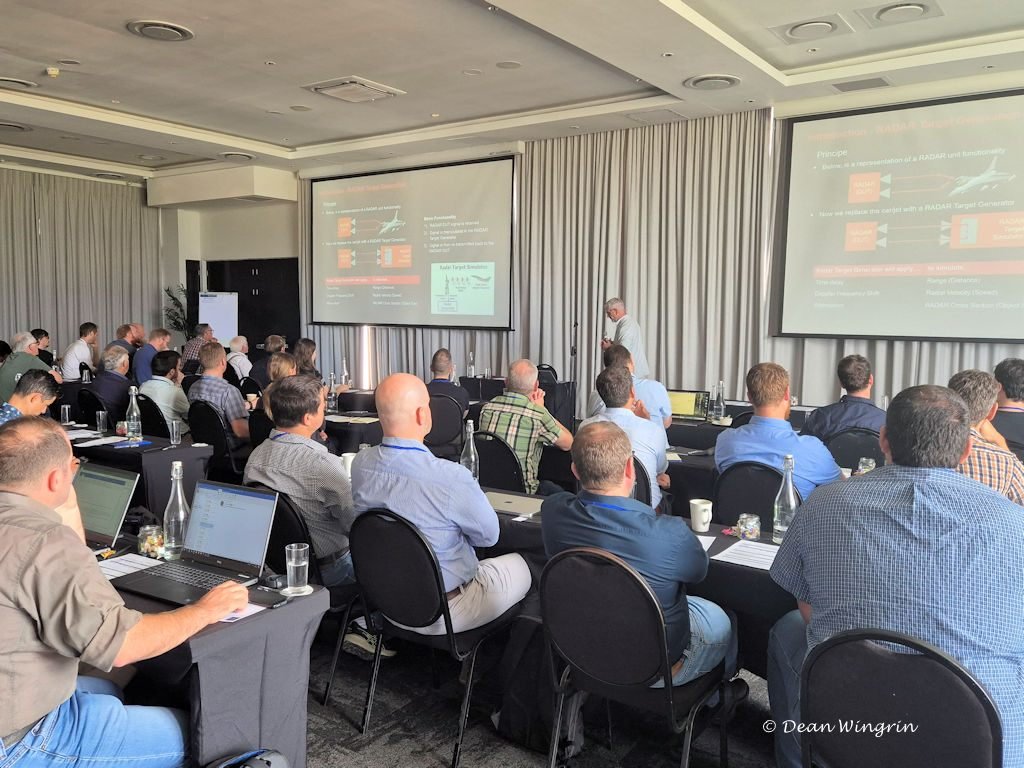
A well-attended Aerospace and Defence seminar, presented jointly by Keysight Technologies and South African based Concilium Technologies, drew local defence industry engineers and executives to Cape Town and Pretoria in February. The event showcased a detailed overview of the Keysight portfolio, solutions available and case studies.
The partnership behind the seminar runs deeper than most. Both Concilium and Keysight share a common heritage tracing back to Hewlett-Packard, making the collaboration a natural extension of a long-standing relationship. Concilium identified an opportunity to bring global insight directly to the local market and the attendees were highly appreciative.
Whilst the product presentations were highly technical in nature, Richard Soden, Director of Space and Satellite Solutions at Keysight, provided an overview of the global space market. He traced the industry’s evolution from the governmental era of Sputnik and Apollo, through the commercialisation of GPS and satellite television, into what he described as today’s entrepreneurial era, driven by dramatically lower launch costs and an explosion of new business cases.
“The space and satellite industry is a $415 billion industry,” Soden told delegates. He noted that launch costs had fallen from $40 000 per kilogram to as low as $1 500 per kilogram, fundamentally lowering the barriers to entry.
Addressing the issue of sovereign satellite infrastructure, he said that satellites have become critical to everything from financial market timing to telecommunications synchronisation and national security.
“Nation states are saying we don’t want to be in a position where we’re having to negotiate for our ability to maintain our GDP,” he said. “We need to be independent, or we need to make sure that we have the ability to have our independence.”
Whilst the space market is rapidly evolving to become a key infrastructure for all, space is hard and failures can be costly, with new opportunities for the industry bringing new operational challenges.
Investment, he noted, is flowing into mega constellations, non-terrestrial 5G and 6G networks, intelligence, surveillance and reconnaissance (ISR) satellites, and cybersecurity for space systems – all areas in which South African companies are increasingly active.
James Kerr of Orion Consulting provided a snapshot of the local industry, noting that despite having one of the world’s smallest defence budgets for a country with a fully established multi-sector industry, South Africa remains a formidable global player. The South African Defence Industry (SADI) currently ranks 21st globally for international defence exports, with over 80% of its trade destined for the international market.

Photo: Dean Wingrin
Kerr noted that the country’s capabilities are far more extensive than most people realise.
“When I present this to our defence attachés and executives, their eyes just get big,” Kerr said. “Are we really that big as a defence industry?”
The numbers are striking. South Africa has approximately 600 companies supplying products and services to the defence sector, supports around 20 000 direct jobs, and ranks 21st globally on the SIPRI list of defence exporters, despite having one of the smallest defence budgets of any country with a full-spectrum defence industrial capability. The country supplies to more than 35 African nations and over 70 countries worldwide.
Kerr described South Africa as an “apex industry,” one in which design and development capability creates a waterfall effect of technology transfer across other sectors. He referenced the claim, attributed to a former Deputy Minister of Trade and Industry, that approximately 20 percent of satellites currently in low Earth orbit carry a South African component.
He also introduced the Innovate: Aerospace and Defence publication, a project-first showcase of current South African defence innovations, developed in partnership with the South African Aerospace, Maritime and Defence Export Council (SAAMDEC), aimed at international buyers, defence attachés and procurement teams.
Andrew Cole, MD of Concilium, summed up his company’s unique position in the local market: “Concilium is uniquely well-placed to serve the local aerospace and defence industry. As the only facility in Southern Africa capable of calibrating equipment up to 50GHz through its SANAS accredited laboratory, and holding ISO9001 certification, Concilium offers a level of technical capability and quality assurance that the sector demands.”
Concilium specialises in servicing the Broadcast, Telecom, and Test & Measurement sectors and is the authorised distributor for Keysight Technologies in southern Africa. Keysight Technologies, headquartered in California, manufactures hardware and software for engineering workflows across design, test, and emulation.
The seminar left little doubt that Keysight Technologies is a leader in design and measurement solutions and that Concilium is well-placed to serve the local aerospace and defence industry. South African engineers and companies are better positioned to seize the moment than many of them realise.


