

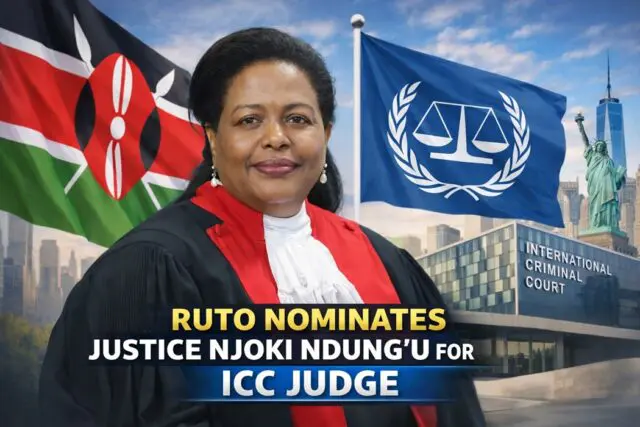
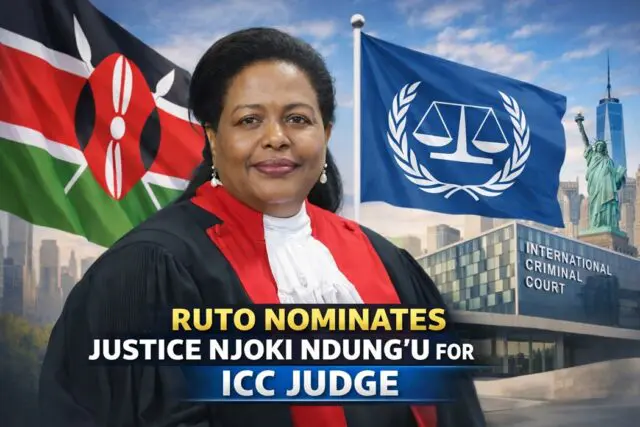
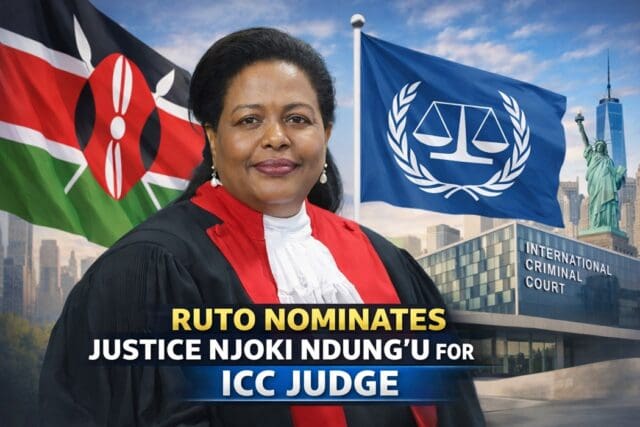
NAIROBI, Kenya — President William Samoei Ruto has officially nominated Njoki Ndung’u as Kenya’s candidate for election to the bench of the International Criminal Court (ICC), positioning the veteran jurist to compete for one of the court’s prestigious judicial seats.
The election will take place during the 25th session of the Assembly of States Parties, scheduled for December 7–17, 2026, in New York, where member states will vote to fill vacancies on the ICC bench.
If elected, Justice Ndung’u would join the world’s highest criminal court responsible for prosecuting individuals accused of genocide, crimes against humanity, war crimes, and the crime of aggression.
Kenya’s Candidate for a Global Judicial Role
Justice Njoki Ndung’u has served as a judge of the Supreme Court of Kenya since 2011, making her one of the country’s most experienced jurists. Over the past two decades, she has built a reputation as a leading voice in constitutional law, human rights, and gender justice.
– Advertisement –
Before joining the judiciary, Ndung’u was also a legislator and played a major role in advancing laws protecting women and vulnerable groups in Kenya.
Her nomination places her among seven candidates from different regions, including nominees from:
- Tanzania
- Uganda
- Ghana
- Switzerland
- Japan
- Colombia
Justice Ndung’u is competing under the African States category, which ensures geographic representation within the ICC’s judicial structure.
Potential Impact on Kenya’s Supreme Court
Legal analysts say the nomination could have significant implications for Kenya’s judiciary, particularly if Ndung’u wins the international post.
Her election to the ICC would create a vacancy at the Supreme Court of Kenya, forcing the government to initiate a new appointment process through the Judicial Service Commission (JSC).
Some political observers are already questioning whether the move could indirectly reshape the composition of the Supreme Court.
While the nomination has been widely praised as recognition of Ndung’u’s legal expertise, critics and analysts have raised questions about whether the decision could also open the door for new judicial appointments under President Ruto’s administration.
A Career Shaped by Constitutional Reform
Justice Njoki Ndung’u is widely recognized for her contributions to Kenya’s constitutional transformation and human rights advocacy.
Her legal career spans more than 20 years, during which she has served in several influential roles, including:
- Advocate of the High Court of Kenya
- Member of Parliament (2003–2007)
- Architect of landmark legislation on sexual offenses and gender rights
- Justice of the Supreme Court since 2011
Her jurisprudence has helped shape key constitutional decisions affecting governance, elections, and civil liberties in Kenya.
What Happens Next
The Assembly of States Parties to the ICC will review all nominated candidates ahead of the December elections.
Member states will then vote to select new judges who will serve nine-year terms at the court’s headquarters in The Hague, Netherlands.
If elected, Justice Njoki Ndung’u would join a small group of Kenyan legal professionals who have served at international judicial institutions, further elevating Kenya’s influence in global justice and international law.
Why This Matters to the Kenyan Diaspora
For Kenyans living abroad, especially those engaged in international law, governance, and global diplomacy, Ndung’u’s nomination represents a moment of national pride.
The appointment would place a Kenyan jurist at the heart of international justice, strengthening the country’s voice in global legal systems and human rights institutions.
It also highlights the growing role of African legal experts in shaping international criminal law and accountability mechanisms worldwide.


Ruto Nominates Justice Njoki Ndung’u for (ICC) Judge
Related
– Advertisement –


