

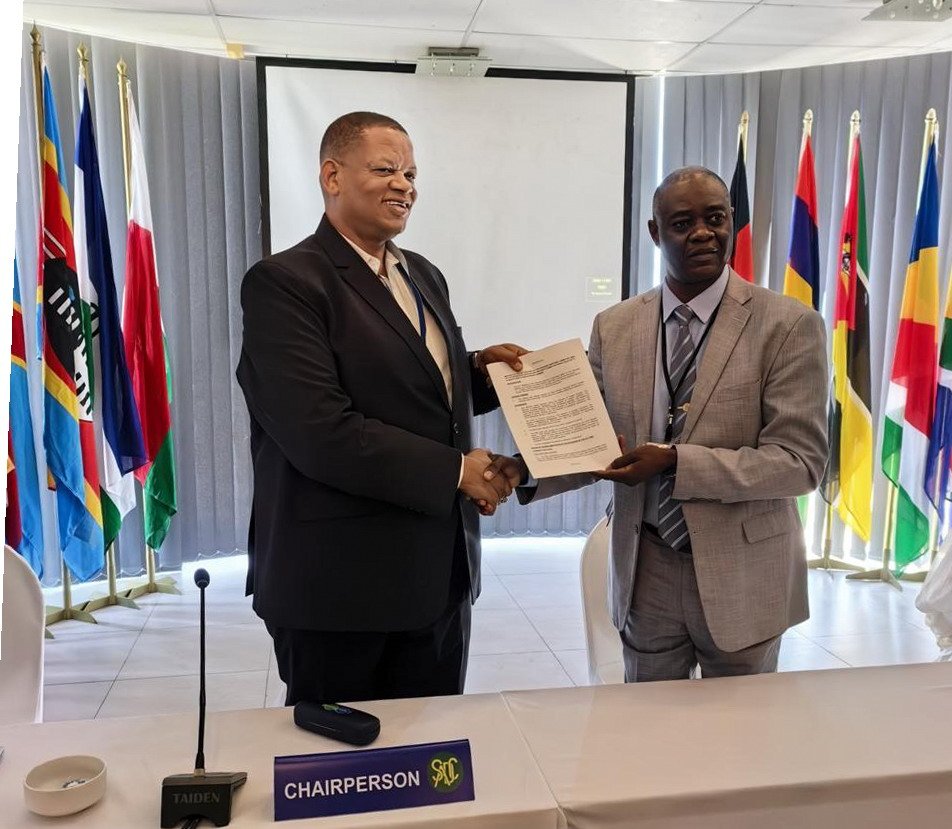
South Africa has assumed the chairmanship of the Southern African Development Community’s (SADC’s) Standing Maritime Committee (SMC), its main platform for SADC navies to coordinate maritime cooperation, operational readiness, training and strategic planning. This includes multiple naval exercises to be held in Namibia, Tanzania, and Zambia.
The Standing Maritime Committee was established following an SADC Interstate Defence and Security Committee (ISDSC) seminar held in Gaborone, Botswana, in March 1995 and formally inaugurated at its first meeting in July 1995.
South Africa assumed chairmanship following the 32nd SMC meeting held in Swakopmund, Namibia, last week. The meeting brought together maritime representatives from several SADC member states to review regional maritime cooperation and determine priorities for strengthening collective maritime security, the SA Navy said.

Through the committee, member states collectively address maritime threats affecting the region, including piracy, illegal fishing, trafficking and the protection of strategic sea lines of communication that support regional trade and economic stability.
During the meeting, members reviewed progress on key regional initiatives. Particular attention was given to preparations for the SADC Maritime Exercise (MAREX), a multinational exercise designed to enhance interoperability and operational readiness among regional navies.
“Due to security challenges affecting the host nation, the exercise originally planned for 2026 was postponed, with Namibia volunteering to host MAREX 2027. South Africa was tasked with leading the development of the exercise concept and coordinating preparatory engagements among member states,” the SA Navy said.
The committee also advanced plans for Exercise MIGEBUKA, a riverine and inland water exercise aimed at strengthening cooperation on inland waterways. Zambia and Tanzania agreed to co-host the exercise on Lake Tanganyika in 2027, with Malawi responsible for developing the operational concept.
Further discussions focused on Naval Coordination and Guidance of Shipping (NCAGS) training, with South Africa reporting that the regional curriculum is in its final stages of development. Member states were invited to nominate personnel for the training programme, which will improve coordination between naval forces and commercial shipping during periods of crisis or conflict.
In his remarks after assuming the chairmanship, Chief of the South African Navy, Vice Admiral Monde Lobese, emphasised the importance of regional unity and cooperation in addressing maritime security challenges. He noted that no nation can secure the maritime domain alone and called for greater commitment by SADC member states to participate actively in regional initiatives and exercises.
Lobese further highlighted that South Africa’s chairmanship will align with the Sisonke (Togetherness) concept he introduced during engagements in Ghana and which was accepted during the Sea Power for Africa Symposium (SPAS) 2024. The concept promotes African cooperation and solidarity in addressing shared maritime challenges, consistent with the broader ideals of the African Renaissance.
“In this regard, South Africa’s leadership of the SMC will support the implementation of SPAS resolutions aimed at strengthening cooperation and partnerships among African navies. Through the committee, the South African Navy intends to advance regional collaboration, enhance maritime domain awareness, and ensure that collective initiatives such as regional exercises and maritime information sharing are implemented effectively,” the SA Navy said.
South Africa will host the 33rd SMC meeting in Cape Town in March 2027, where member states will review progress on these initiatives and further strengthen the regional maritime security framework.
“Through this leadership role, the South African Navy continues to reinforce its commitment to building a secure and cooperative maritime environment that supports stability, economic development and shared security across the SADC region,” SA Navy Public Relations concluded.


