

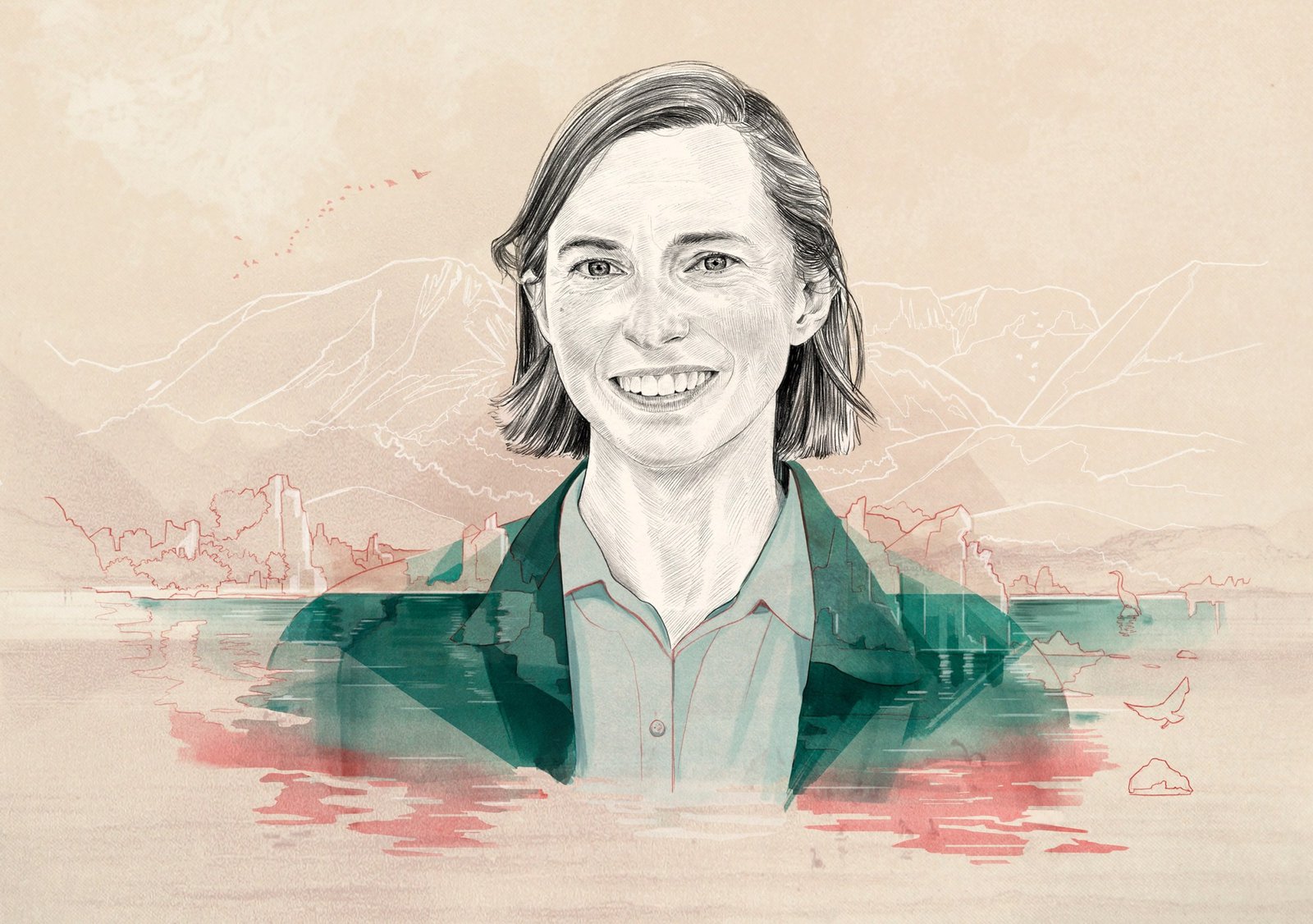
On Caroline Tracey’s inaugural visit to a salt lake, California’s Salton Sea, she heard something crunch underneath her feet. Looking down, she recoiled: She was standing on a bed of fish skeletons.
But once she ventured closer to the water, Tracey discovered that what had appeared to be a wasteland was, in fact, an avian oasis — home to scuttling sandpipers, plovers and snowy egrets.
“This was the first of salt lakes’ many lessons for me: places that seem ugly or desolate are vital and complex in ways that you don’t notice until you give them a chance,” she writes in her new book, Salt Lakes: An Unnatural History.
Tracey’s debut, which publishes March 17, is a celebration of these strange and embattled ecosystems. Working as a geographer and High Country News contributor, she learned that there are dozens of salt lakes around the world — glistening bodies of water hidden deep in desert valleys, teeming with pinkish algae and salt-tolerant shrimp. But agricultural consumption and climate change are causing nearly all of them to dry up, with dire consequences for biodiversity and human health.
Traveling all over the Great Basin, and to Kazakhstan, Mexico and Argentina, Tracey documents both the shrinking lakes and the varied communities working to protect them. The book doubles as a kind of aquatic autobiography: Interwoven with her reporting is the story of how Tracey came into queerness, learning to understand her own desires and values through her encounters with literature and landscape. Salt Lakes is personal, pragmatic and cautiously hopeful — a thoughtful meditation on what it means to inhabit a rapidly transforming world.
HCN recently spoke with Tracey about the challenges facing salt lakes, the solutions emerging to preserve them, and what queerness can teach us about confronting the losses of climate change.
The conversation has been edited for length and clarity.
High Country News: This book documents a full decade of your thinking and writing about salt lakes. Why do you think salt lakes so obsessed you?
Caroline Tracey: I was driving around the Great Basin and I saw these lakes, and they’re very striking. Because they have these minerals dissolved in the water, they actually reflect the sky better than fresh water. So I think the draw for me for a long time was just that there are these extraordinarily beautiful, odd bodies of water in the very dry landscape. Once I started doing more research, I became really fascinated by the different histories of water diversion that had affected the lakes; you can’t really write about salt lakes without getting deeply into the history of the Bureau of Reclamation and irrigation in the American West. And then, more recently, the different types of activism that people have tried to save the lakes — those tools just gave me a lot of optimism, which is something that’s hard to come by as an environmental reporter.
HCN: For a book about ecological damage, this one is surprisingly hopeful. You write that salt lakes’ decline is actually a very solvable problem in comparison to other ecological restoration issues. What makes you optimistic?
CT: The basic geology of salt lakes is that they form in closed basins. When enough water isn’t reaching them, they just start to evaporate. Historically, the issue has mainly been water diversion — irrigation for things like alfalfa or cotton. So, the simple idea is, if we reduce the amount of alfalfa that we are growing in the Southwest, much more water will reach the Great Salt Lake Basin. At the same time, climate change has really accelerated (salt lakes’) decline because of diminished snowpack, so we’re facing a situation that isn’t quite so easy because there’s just less water available.
There are a handful of tools being (used) at salt lakes that are really exciting. One is the Clean Air Act. Drying-up salt lakes create a ton of dust; for instance, at the Salton Sea in California, the communities around the lake have experienced really severe respiratory issues. So that’s holding the entities that are responsible for drying the lakes up accountable.

Another is the Public Trust Doctrine, which is the idea that the government is responsible for (maintaining) the bodies of water within its borders. In California there was a successful lawsuit where a group of residents said the state needs to uphold this doctrine and protect these salt lakes. Just the very idea that there is a shared value among the people of the state over what the state is responsible for, I think, is powerful.
In the case of the Zuni Salt Lake in New Mexico, there was actually a successful LandBack case, which I think is pretty inspiring, not only for salt lakes but for many different types of land and water around the country. There’s also a small but mighty number of environmental humanities scholars of Mormon scripture, and they’re directly involved in the Great Salt Lake fight. I think that taking these religious concepts of the sacred allows you to deepen your relationship to place in a way that just thinking about nature as beautiful, or the importance of saving the environment, doesn’t quite get you.
HCN: As you’re tracing the challenges facing salt lakes and efforts to save them, you’re also telling the story of your own coming into queer adulthood in the West. Was it always clear that those things were related?
CT: I always had a sense that I wanted to have the book (involve) a degree of coming of age and critical thinking about womanhood. And as I continued to research salt lakes, I discovered that salt lakes are just hotbeds of queer ecology. Brine shrimp can reproduce in, like, three different ways. And the phalaropes have a mating cycle that is reversed with regard to most birds. The females are bigger and showier, and the males are actually the ones that stay and tend the nest.
Ecology teaches that biodiversity is a good thing, right? That we want as much complexity in the landscape as we can have. And I think that’s also the lesson of queer theory: that diverse ways of living are a good thing, and we want as much diversity and complexity in our society as we can have.
HCN: How has your experience of queerness changed the way you think about climate change, and loss or recovery?
CT: I think queerness and being a writer are very compatible, because both put you at a slight distance from society, in this kind of observer role. And so the benefit of queerness for thinking about the environment is (understanding) there are actually many other ways of life that are possible. We don’t need to consume at the rate that we’ve been consuming, that our parents have consumed.
A lot of conservation historically has been very focused on pristine landscapes, making sure that we keep intact landscapes from being destroyed. Queer ecology has an intervention, which is to say that highly altered landscapes also have a lot of value in terms of biodiversity and ecology.
Some salt lakes, like the Great Salt Lake, exist all year round. And then there are other lakes that are mainly dry. So if you drive by them, most of the time, you’ll just see a salt flat. But then, with big storms or snowmelt in the late spring, they’ll fill. Those are called “ephemeral” lakes. One of the most powerful experiences for me in writing the book was shifting away from thinking about the efforts to save these perennial lakes and thinking: What can the concept of the ephemeral teach us, especially in a moment of climate change? As we’re facing this very likely possibility that a lot of these permanent lakes become ephemeral lakes, what does it mean to embrace and live with the ephemeral?
We welcome reader letters. Email High Country News at editor@hcn.org or submit a letter to the editor. See our letters to the editor policy.
This article appeared in the March 2026 print edition of the magazine with the headline “A very unusual ecosystem.”



