

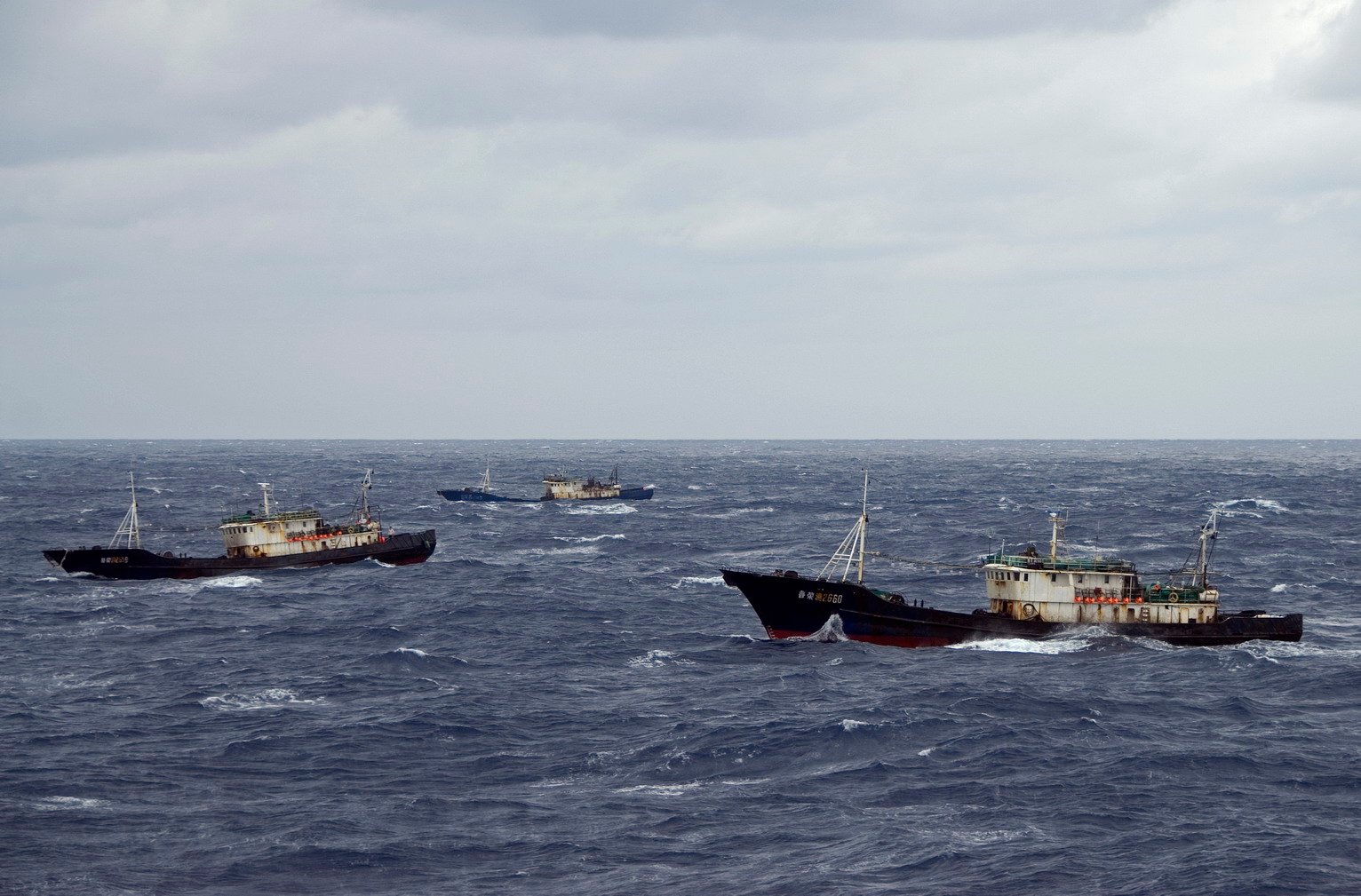

Four Chinese-flagged fishing vessels that entered South Africa’s Exclusive Economic Zone (EEZ) and territorial waters without the required authorisation have been intercepted and fined.
This is according to Department of Forestry, Fisheries and the Environment (DFFE), which said the vessels initially requested permission on 23 February 2026 to pass through South Africa’s EEZ under “innocent passage”, indicating they would exit by 3 March. On 27 February, the South African Maritime Safety Authority (SAMSA) reported that the vessels had also applied for Off-Port Limits (OPL) authorisation without the required justification or documentation, and the request was rejected.
“Further investigations by DFFE revealed that the vessels had already entered South African territorial waters while the OPL request was under consideration. They were detected within 12 nautical miles of the KwaZulu-Natal coast and later tracked along the Eastern Cape coastline,” the DFFE said on 12 March.
During this time, the vessels repeatedly switched their Automatic Identification System (AIS) on and off. “This is a violation of South African regulations requiring foreign vessels to keep AIS active while transiting national waters. AIS is a critical safety system used to ensure navigational awareness and prevent collisions at sea,” the DFFE noted.
The vessels – Zhong Yang 231, Zhong Yang 232, Zhong Yang 233, and Zhong Yang 239 – were placed under guard by South African Police Service (SAPS) Tactical Team members and Fishery Control Officers at the Port of Cape Town anchorage while compliance processes were finalised between DFFE and the vessel owner, Shenzhen Shuiwan Pelagic Fisheries Co. Ltd.
Based on the available evidence, there were reasonable grounds to suspect non-compliance with the Marine Living Resources Act 18 of 1998, the DFFE said. The Masters of the vessels were charged and an administrative penalty of R400 000 was imposed. The vessel owner subsequently paid the fine, after which the vessels were released and have departed South African waters.
The Minister of Forestry, Fisheries and the Environment, Willie Aucamp, welcomed the swift and coordinated action by the Fisheries Branch of the DFFE, working with the South African Police Service Tactical Team, to intercept the Chinese-flagged fishing vessels.
“South Africa will not tolerate the unlawful use of its maritime zones,” said Aucamp. “We remain resolute in safeguarding our marine resources and ensuring that our ports are not perceived as ports of convenience. Compliance with our laws is non-negotiable.”
South Africa remains committed to safeguarding its maritime zones, protecting marine resources, and strengthening international cooperation in combating illegal, unreported and unregulated Fishing, the DFFE concluded.
Andrew de Blocq, Democratic Alliance (DA) Spokesperson for Forestry, Fisheries and the Environment, welcomes the interception and fining of the vessels. “For years, concerns have been raised that foreign fishing fleets may be operating illegally in South African waters by switching off AIS transponders while inside the EEZ. Although illegal fishing could not be proven in this instance, the behaviour observed in this case underscores the importance of vigilant maritime monitoring and enforcement,” he said.
“Illegal, unreported and unregulated fishing remains one of the most serious threats to the sustainability of South Africa’s marine resources. It undermines fisheries management, threatens marine ecosystems, and jeopardises the livelihoods of South Africans who depend on the ocean economy for jobs, food security, and cultural heritage,” Blocq said in a statement.
“This successful interception demonstrates the importance of strong enforcement and coordinated maritime monitoring. South Africa must increase its investment in its maritime surveillance and compliance capacity to ensure that foreign fleets respect our laws and that our marine resources are protected for future generations.”
Defence analyst Dean Wingrin said the interception is good news, but “if we had a maritime surveillance aircraft capability and regular sea patrols of our territorial sea and EEZ (DFFE and Navy), imagine what we would find. Despite Operation Phakisa (which seems to have stagnated), our sea economy is being neglected.”
Africa loses an estimated $11.2 billion in annual revenue to illegal, unreported and unregulated (IUU) fishing. The challenge is particularly acute in West Africa, which loses up to $9.4 billion to the scourge.
China, which commands the world’s largest distant-water fishing fleet, has the world’s worst illegal fishing record, according to the IUU Fishing Risk Index. Of the top 10 companies engaged in illegal fishing globally, eight are from China. Beijing’s trawlers can catch five times as many fish in a day as a small village fleet can in a year.


