

(Bloomberg) — Anthony Sandford knew it was time to jump back into the energy sector when US warplanes first cast shadows over Tehran in late February.
A week later, the Minneapolis-based day trader bought June call options on the XLE — an exchange-traded fund that tracks oil stocks — a position that has since doubled in value. Sandford won’t sell until the ETF reaches $60, roughly $2.50 above the current price.
He’s among the legions of investors piling into retail products to capitalize on Iran war-driven prices swings, even as the same volatility brings institutional trading to a near halt. That trend has helped exacerbate oil’s historic rally amid an effective closure of the Strait of Hormuz chokepoint through which a fifth of global oil typically flows.
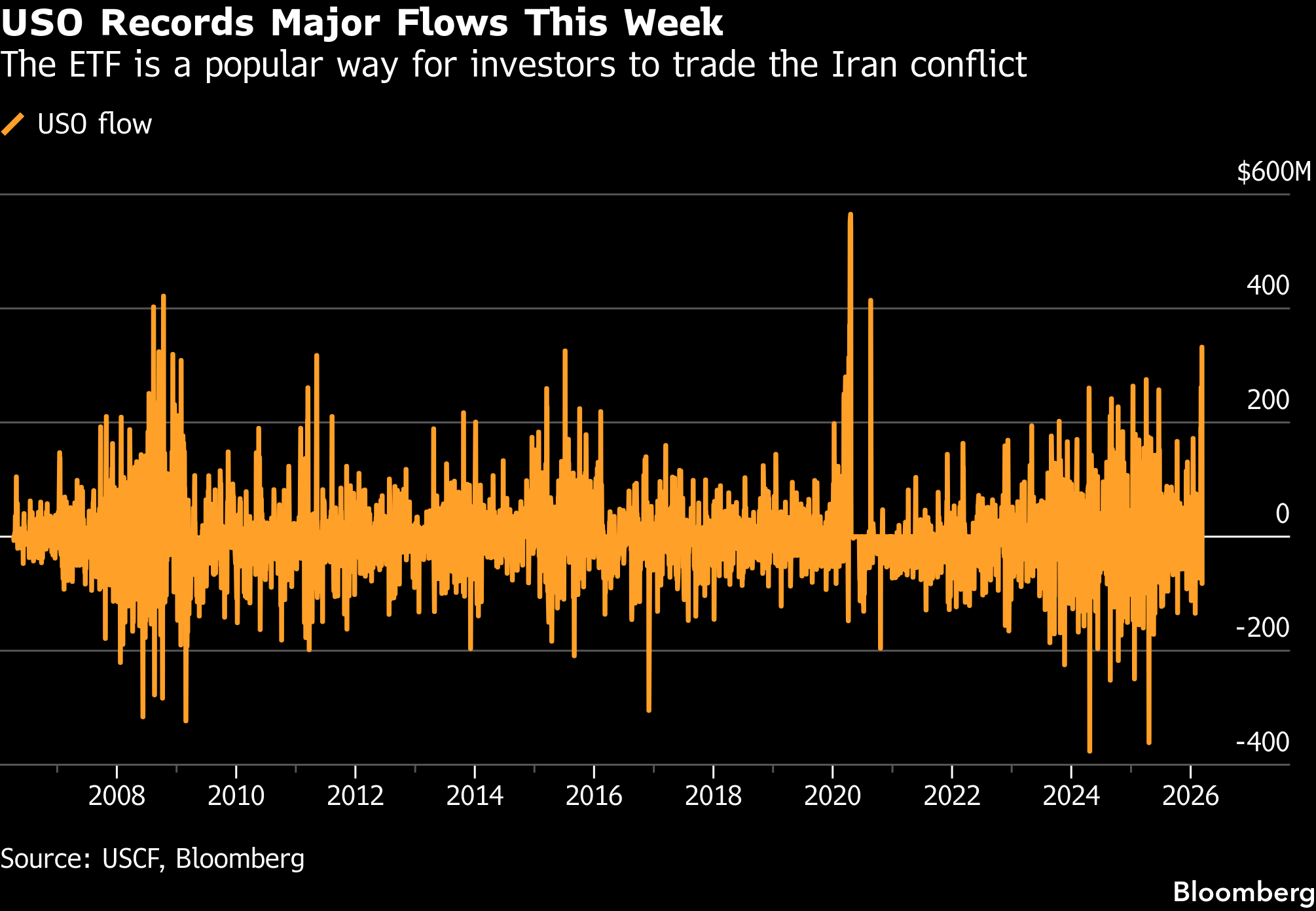
The United States Oil Fund, with the ticker USO, is an investor favorite these days, recording more than $330 million of inflows Thursday for its largest one-day cash intake since August 2020. The surge pushed the ETF’s total assets to $2.5 billion. USO ranked among the five most-traded ETFs on eToro in the first week of March and was the trading platform’s single most-traded asset on March 9.
The 10 largest bullish oil ETFs posted their biggest combined daily inflows since 2023 last week and their steepest combined outflow since May on March 10, according to data compiled by Bloomberg.
Meanwhile, the ProShares UltraShort Bloomberg Crude Oil Fund, an exchange-traded product designed to deliver twice the inverse of the daily performance of its underlying index, attracted nearly $222 million on March 11. That was the fund’s largest-ever inflow and signals that traders are betting on price declines as aggressively as they are on gains.
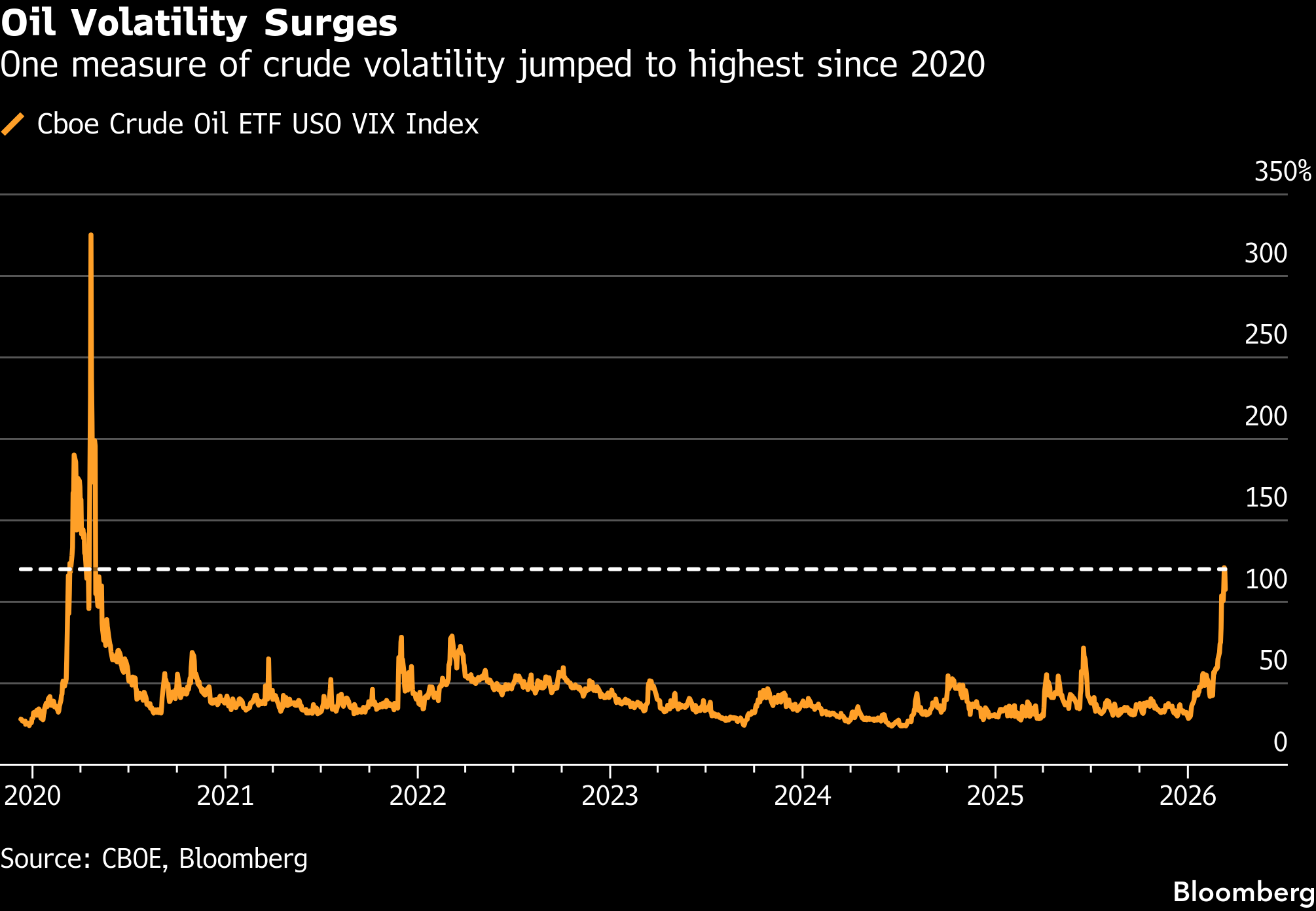
Several other energy-linked products have recently experienced inflow and outflow rates at levels not seen in years as crude volatility surged.
Jamie Ahmed, a financial operations engineer who invests as an after-hours passion, hasn’t been interested in increasing his exposure to oil futures since the Covid-19 pandemic, when he bought some USO. Now he’s back.
“Trump signaling that high oil prices are good for the US may be a sign that he doesn’t plan to TACO as quickly as we’ve seen in the past,” said Ahmed, employing a pejorative acronym for “Trump always chickens out.”
On Thursday, the US president posted on his Truth Social network that an Iran bereft of nuclear weapons is “of far greater interest and importance to me” than oil prices. The shift in tone contrasted with his earlier assurances that the conflict wouldn’t swell crude prices for a meaningful period of time.
Brent oil prices traded above $100 a barrel for a second straight day on Friday, the first time that’s happened in over three years.
That prompted Ahmed to consider adding to USO alongside his existing stakes in Chevron Corp. and Brazilian oil giant Petrobras, which he bought in the autumn and which have advanced since the conflict began.
Retail-trader interest isn’t limited to energy. Cross-commodity ETFs have also seen significant flows in recent weeks, as the Iran war fueled rallies across markets ranging from aluminum to grains. Invesco’s PDBC fund, the biggest cross-commodity ETF, posted its largest daily inflow in a year earlier this week.
“This was the wake up call for everyone,” Kathy Kriskey, head of alternative ETF strategy at Invesco, which oversees several exchange-traded funds in the commodities space.
This is a rare instance where market conditions that tend to benefit commodity-linked ETFs — inflation, geopolitical risks and the need for diversification — are converging, she added.
Kriskey describes opening a conference call with clients invested in cross-commodity products with a simple greeting: “Congratulations.”
“Our real-time gauge of commodity demand growth continues to point to significant hoarding of broad commodities in the immediate aftermath of the Iranian conflict,” Dan Ghali, a commodity strategist at TD Securities. “This behavior was also observed at the onset of the Russia-Ukraine war, and only ebbed after the first significant downside momentum shock.”
The frenetic demand among retail traders stands in stark contrast to the frozen market confronting institutional investors. With several volatility gauges at multi-year highs, dealers have been forced to scale back risk exposure, curbing liquidity and widening the gap between bids and offers. Discretionary traders have largely pulled back in response, while many funds are already heavily long with little room to add positions.
Open interest in oil futures has fallen back to late-January levels, before the Iran war began, after briefly climbing to the highest since early 2022.
This environment spurred losses at some of the world’s largest hedge funds historically known for steady returns, including Balyasny Asset Management, Millennium Management and Coatue Management.
Sandford describes himself as an unemotional investor, whose focus is rarely broken by anything other than his King Charles Spaniel trotting into the room. Even so, he admits feeling uneasy, knowing his trades could unravel at the whim of a weekend post from the administration.
“I always tell people that’s the most volatile sector of the market,” Sandford said, referring to commodities. “You have to be very careful.”
©2026 Bloomberg L.P.


