

The U.S.-Israel war against Iran has already disrupted global commodity markets, tightening supply in energy, chemicals and several metals while raising the risk of longer-term price volatility.
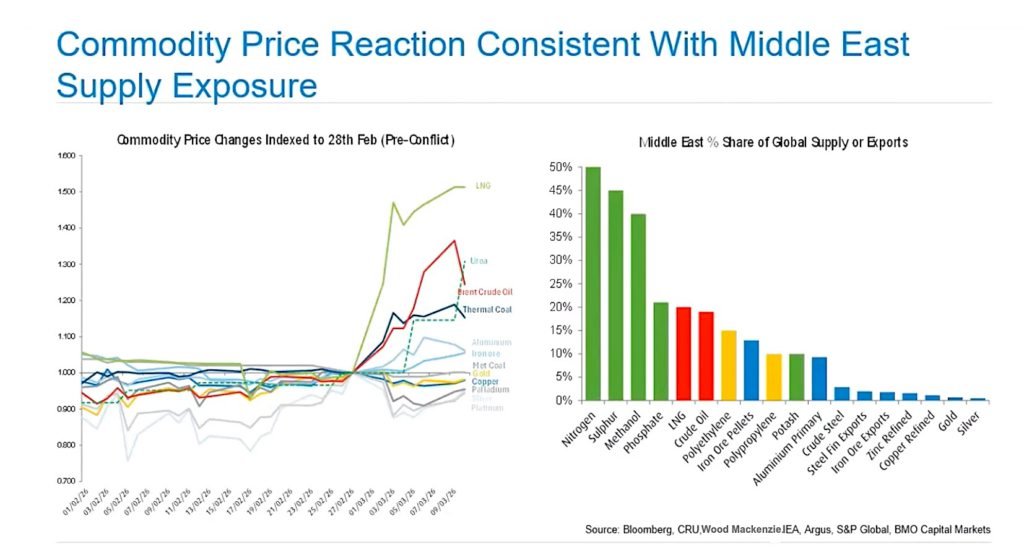
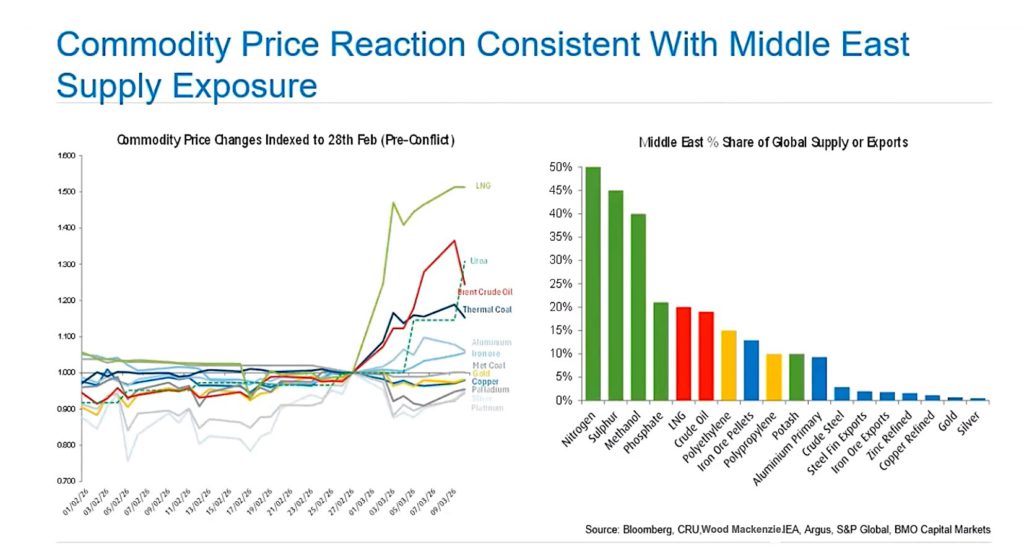
Analysts at BMO Capital Markets said the evolving conflict has triggered sharp moves across commodities tied to the region, where supply chains for oil, fertilizers, chemicals and metals remain highly concentrated. Early price reactions largely reflect how exposed each commodity is to Middle East supply, with oil and fertilizers showing the most immediate impact.
Oil markets face the most significant disruption, according to BMO oil and gas analyst Randy Ollenberger, who said the conflict represents the biggest shock to the oil market in decades. Prices briefly surged toward $120 per barrel before retreating into the $90 range, but he argued the market is underestimating the scale of the supply risk.
Even if hostilities ended quickly, the conflict has already reshaped oil market fundamentals, eliminating expectations of oversupply and tightening global inventories. Tankers have struggled to move through the Strait of Hormuz, where traffic has dropped dramatically from the typical 80 ships a day to only a handful, while storage constraints and refinery outages are adding pressure across petroleum supply chains.
“The longer this conflict goes, the tighter the market is going to get,” Ollenberger said, adding that the risk to oil prices remains skewed to the upside as long as the threat of broader regional disruptions persists.
Credit: BMO Global Commodities Research
Fertilizers & chemicals
Chemicals markets are also tightening as supply from the Middle East becomes constrained. BMO chemicals analyst John McNulty said the region accounts for roughly 15% of global polyethylene production, meaning disruptions could push industry utilization rates above 90% and potentially toward full capacity.
The sudden supply squeeze has already triggered price increases in the United States and Europe, with polyethylene producers announcing successive price hikes as the industry shifts from oversupply toward tight conditions. McNulty said the shift could boost margins for major producers such as Dow, Lyondell and Westlake, while higher prices for sulphur and other feedstocks may also benefit titanium dioxide producers including Tronox (NYSE: TROX) and Chemours (NYSE: CC).
Fertilizer markets are experiencing similar pressure. BMO analyst Joel Jackson said nitrogen prices have climbed about 30% since the conflict began, reflecting the Middle East’s dominant role in global fertilizer exports. Countries across the region account for nearly half of global urea exports, while Russia and Middle Eastern producers dominate nitrogen supply.
Rising European gas prices and disruptions to Middle East output have widened the cost advantage for North American fertilizer producers, particularly companies such as CF Industries (NYSE: CF) and Nutrien (TSX, NYSE: NTR). While potash markets remain relatively stable, sulphur shortages could eventually push phosphate prices higher as input costs rise.
Metals markets have responded unevenly depending on supply exposure and macroeconomic pressures. Aluminum has outperformed because roughly 9% of global supply comes from the Middle East, and as much as 5 million tonnes of the region’s production may already face disruption, BMO metals and mining analyst Helen Amos said.
Iron ore prices have also gained some support due to the region’s role in pellet supply, while thermal coal has risen alongside higher natural gas prices. In contrast, metals such as copper and nickel have lagged amid broader risk-off sentiment tied to inflation concerns and a stronger US dollar. Copper prices briefly dipped about 1% to $5.83 per lb. in the early hours of Thursday, before rebounding to $5.88. Nickel almost mirrored copper, falling to about $7.79 per lb. before recovering to $7.88 on Thursday morning.
Amos said the conflict could ultimately reinforce longer-term trends favouring electrification and metals demand. Rising energy security concerns may accelerate global efforts to reduce dependence on fossil fuels while boosting strategic stockpiling of key industrial metals.
Battery metals face a more complex outlook. Lithium production is less immediately exposed to higher sulphur costs, but prolonged supply disruptions could affect refining activity in China, the world’s largest lithium processor, BMO analyst George Heppel said. Nickel production may face greater risk because the metal’s extraction is highly sulphur intensive, particularly in Indonesia where high-pressure acid leach operations rely heavily on sulphuric acid.
Beyond battery metals, analysts said the conflict could increase demand for critical minerals tied to defence supply chains. Modern warfare consumes large volumes of metals used in drones, missiles and other advanced weapons systems, potentially boosting demand for materials such as tungsten, rare earth elements and antimony.
With the duration and escalation of the conflict still uncertain, analysts said commodity markets remain highly sensitive to developments in the region. Even if shipping routes reopen quickly, the disruption has already altered supply dynamics across several key sectors of the global resources industry.


