

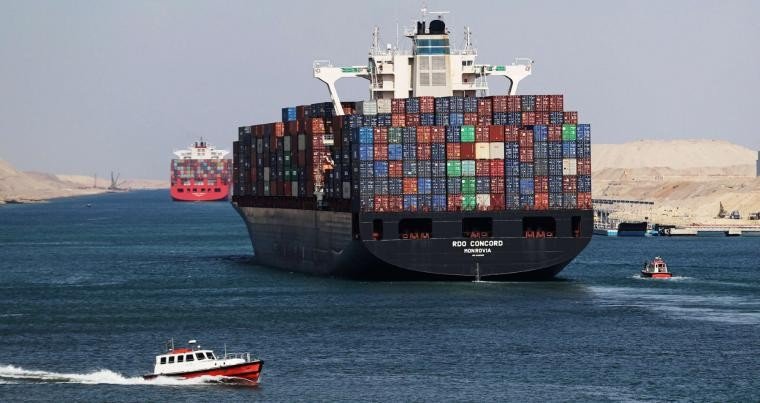
If you’ve ever wondered how goods, oil, and gas make their way across Africa, or between Africa and the rest of the world, it all comes down to a handful of critical shipping routes. The Suez Canal in Egypt, for example, is a lifeline for global trade.
But these routes are far from foolproof. Geopolitical tensions, regional conflicts, and even piracy can quickly throw shipping schedules and entire supply chains into chaos. The ongoing Iran conflict, for instance, has already prompted some vessels to skip the Strait of Hormuz and sail around the Cape of Good Hope instead, adding thousands of kilometres to their journeys.
Below are Africa’s most important shipping routes shaping global trade:


1. Suez Canal
The Suez Canal is one of the most important maritime routes in the world and a critical artery for global trade. Located in Egypt, the canal connects the Mediterranean Sea to the Red Sea, allowing ships to travel directly between Europe and Asia without having to sail around Africa. Opened in 1869, it dramatically shortened global shipping times and transformed international trade routes.
Today, thousands of vessels carrying crude oil, liquefied natural gas, manufactured goods, and containerised cargo pass through the canal each year. It is estimated that roughly 10–12% of global trade moves through this narrow waterway. The canal is also a vital source of foreign revenue for Egypt through transit fees.
2. Bab el-Mandeb Strait (Red Sea – Gulf of Aden)
The Bab el-Mandeb Strait is a narrow but strategically vital maritime chokepoint linking the Red Sea with the Gulf of Aden and the Indian Ocean. Located between Djibouti and Yemen, the strait is a critical gateway for ships travelling between Europe, the Middle East, and Asia via the Suez Canal. Large volumes of crude oil, liquefied natural gas, and container cargo pass through the strait daily.
Because it is only about 30 kilometres wide at its narrowest point, it is particularly vulnerable to geopolitical tensions, piracy, or military conflicts. Any disruption in this corridor can force vessels to reroute around the Cape of Good Hope, adding significant time and cost to global shipping. For East African nations such as Kenya and Ethiopia, the strait plays an essential role in securing energy supplies and maintaining steady trade flows.
3. Cape of Good Hope
The Cape of Good Hope, located at the southern tip of South Africa, is one of the world’s most historic and strategic maritime routes. Before the opening of the Suez Canal in the 19th century, it served as the primary sea route linking Europe with Asia.
Even today, the route remains a crucial alternative path for ships when disruptions occur in the Red Sea or Suez Canal.
The Iran conflict has prompted some vessels to divert around Africa’s southern tip and sail via the Cape of Good Hope to reach their destinations rather than risk routes closer to the conflict.
While travelling around the Cape adds several thousand kilometres to shipping journeys, it can provide a safer and sometimes more reliable option during periods of geopolitical tension.
4. Gulf of Guinea
The Gulf of Guinea is a major maritime corridor along West Africa’s coastline and one of the world’s most significant oil-exporting regions. Stretching from Nigeria to Angola, the region is home to some of Africa’s largest oil producers and offshore energy projects.
Ports such as Lagos, Port Harcourt, Tema in Ghana, and Luanda in Angola serve as key export hubs for crude oil, refined petroleum, and liquefied natural gas.
In addition to energy exports, the Gulf supports significant container shipping and regional trade. However, the region has also faced challenges, including piracy, illegal fishing, and maritime crime, which have occasionally threatened shipping security.
5. Mozambique Channel (East Africa)
The Mozambique Channel lies between Madagascar and Mozambique and serves as a major shipping corridor connecting the Indian Ocean to Southern African ports. This route has grown increasingly important with the development of large offshore natural gas fields in Mozambique and Tanzania.
Energy exports, including liquefied natural gas (LNG), are expected to pass through this channel in greater volumes in the coming years. In addition to energy shipments, the channel supports container shipping, bulk cargo transport, and regional maritime trade.
Because of its deep waters and proximity to major sea lanes linking Asia, the Middle East, and Africa, the Mozambique Channel plays a key role in global maritime logistics.
6. Nile River & Port of Alexandria (Egypt)
The Nile River and the Port of Alexandria form a crucial maritime and inland trade network in northern Africa. The Nile, flowing through Egypt from south to north, has served as a transportation artery for thousands of years. It connects agricultural regions in the interior with major Mediterranean ports, allowing bulk commodities such as grains, fertilisers, and construction materials to move efficiently.
Alexandria, located on Egypt’s Mediterranean coast, is the country’s largest seaport and a key gateway for imports and exports. Together, the river and the port facilitate the movement of goods between domestic markets and international shipping routes.



