




By John Kourkoutas
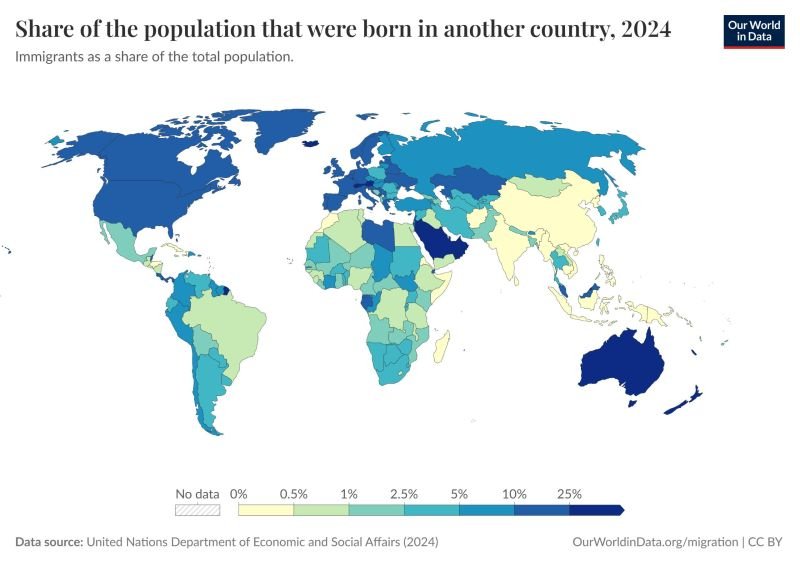
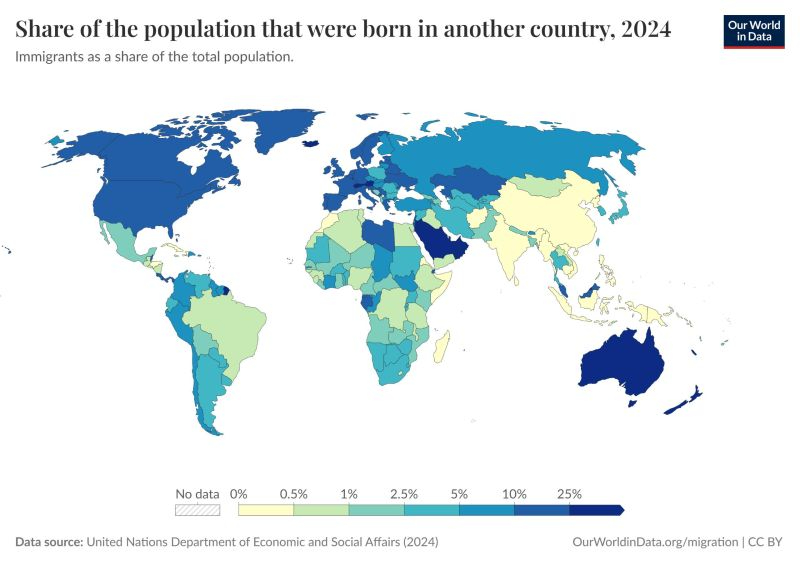
Look at a map of the world’s foreign-born populations below, and a pattern emerges that confounds the conventional narrative. The Gulf States are deep blue – in some cases, migrants account for more than 80 percent of the resident population.
Australia and Canada are similarly saturated with arrivals from abroad. Swaths of Western Europe tell the same story. Then your eye travels to Africa.
Pale. Almost entirely pale.
Across the majority of African nations, fewer than 2.5 percent of the population was born in another country. That figure is not merely low by comparison – it is low in absolute terms, and it represents a structural economic disadvantage that receives almost no serious attention in mainstream policy debates.
The Narrative Gets It Backwards
The default story told about African migration focuses on outflows: young Africans crossing the Mediterranean, skilled professionals departing for Europe and North America, the so-called brain drain hollowing out universities and hospitals. It is a story with real human stakes, and it deserves serious coverage.
But it is only half the picture – and arguably the less instructive half.
Most African migration is, in fact, intra-African. Zambians move to South Africa. Zimbabweans cross into Botswana. Congolese professionals settle in Tanzania. Ethiopians relocate to Kenya.
The great majority of African movement stays on the continent, redistributing skills and labor across borders rather than draining them entirely from the region. This story rarely makes headlines, because it does not fit the familiar framing of a continent in flight from itself.
The more consequential story – and the one almost entirely absent from the discourse – is the flip side of that pale map: almost nobody is migrating to most African countries. And that is a problem with profound economic consequences.
The countries that figure out how to attract global talent – not just export it – will lead Africa’s next chapter.
What Low Immigration Actually Costs
Immigration is, at its core, a mechanism for knowledge transfer. When an Indian engineer relocates to Germany, or a Brazilian entrepreneur moves to the United States, they bring with them skills, professional networks, capital connections, and ways of solving problems that did not previously exist in their destination economy.
The receiving country does not merely gain a worker – it gains a node in a global network.
African economies, by and large, are being excluded from this process. Low inward migration means fewer international professionals importing global best practices.
It means local markets developing in relative isolation from the talent flows that have turbocharged economies elsewhere. It means a scarcity of the cross-cultural business relationships that tend to precede serious foreign direct investment.
The comparison with the Gulf States is instructive. Dubai did not discover oil and simply wait for prosperity to follow. It made a deliberate, decades-long bet on openness – building infrastructure, crafting investor-friendly regulation, and constructing an entire economy around the premise that if you make a place genuinely attractive to global talent, the capital and growth will follow.
Singapore made the same calculation in Southeast Asia. Both are now among the world’s most economically dynamic cities.
These are not accidental success stories. They are the results of a specific policy orientation: the understanding that in a globalized economy, attracting human capital is as important as extracting natural resources.
The Structural Barriers Are Real – and Mostly Self-Imposed
After a decade of working across Sub-Saharan Africa, the sources of this gap are not mysterious. They are, in many cases, entirely within the control of African governments.
European multinationals frequently hesitate to post staff to African markets – not because of the markets themselves, which are often genuinely exciting, but because of the bureaucratic friction involved. Visa regimes across the continent remain punishing, even for intra-African movement.
A Kenyan professional seeking to work in Nigeria, or a Ghanaian entrepreneur trying to set up operations in Côte d’Ivoire (Ivory Coast), faces a labyrinth of work-permit requirements, residency restrictions, and administrative delays that would strike most observers as self-defeating.
The African Continental Free Trade Area (AfCFTA) was conceived, in part, to address exactly this dysfunction. By harmonizing trade rules and, eventually, the movement of people across the continent, it promises to unlock the kind of integrated labor market that has made the European Union so economically coherent.
But implementation has been painfully slow, and the political will to genuinely open borders – even to fellow Africans – remains inconsistent.
The Countries Getting It Right
The good news is that the model for success already exists on the continent. Rwanda has spent the better part of two decades building a reputation as Africa’s most business-friendly destination – streamlining work-permit processes, investing in digital infrastructure, and positioning Kigali as a legitimate hub for regional headquarters.
Kenya has pursued a similar trajectory, with Nairobi increasingly functioning as the continent’s tech capital. Zambia has taken meaningful steps toward investor-friendly frameworks and special economic zones designed to attract foreign expertise.
None of these countries have solved the problem entirely. But they have demonstrated that the underlying dynamic is not fixed – that African nations can, with deliberate policy choices, begin to reverse the talent flows that the map currently depicts.
The continent that welcomes the world will be the one that wins the century.
A Different Kind of Ambition
The debate about African migration tends to be conducted entirely in defensive terms – how to manage outflows, how to leverage diaspora remittances, how to prevent brain drain. These are legitimate concerns. But they reflect a fundamentally reactive posture toward a challenge that deserves a proactive one.
The question worth asking is not only how to keep Africans in Africa, but how to make African countries the kind of places that people from everywhere else want to come to. Talent follows opportunity, and opportunity follows openness.
The pale spaces on the map are not a natural condition – they are a policy outcome, and policy outcomes can be changed.
Africa contains six of the world’s ten fastest-growing economies. It has the world’s youngest population and a middle class that is expanding faster than on any other continent.
The raw material for an economic renaissance is present. What is missing, in many cases, is the global connectivity that turns local dynamism into compounding growth.
That connectivity begins with people. The continent that figures out how to welcome the world will be the one that defines the century. The map, right now, suggests that most of Africa has yet to make that bet. The data, and the examples of those that have, suggest there is everything to gain from making it.
John Kourkoutas is business development expert that specializes in helping companies, export teams, and business leaders succeed in Africa’s dynamic and emerging markets.



