
Defence industry association AMD has welcomed the increase in funding for security and defence announced in South Africa’s 2026 budget speech, but political parties and experts are not happy with the trajectory of defence spending.
Finance Minister Enoch Godongwana on 25 February announced that spending on peace and security will increase from R268.2 billion in 2025/26 to R291.2 billion in 2028/29, with the majority going to the South African Police Service (SAPS): the SAPS has been allocated R133 billion in 2025/26 and defence and state security R60 billion, with law courts and prisons R58 billion, and Home Affairs R16 billion.
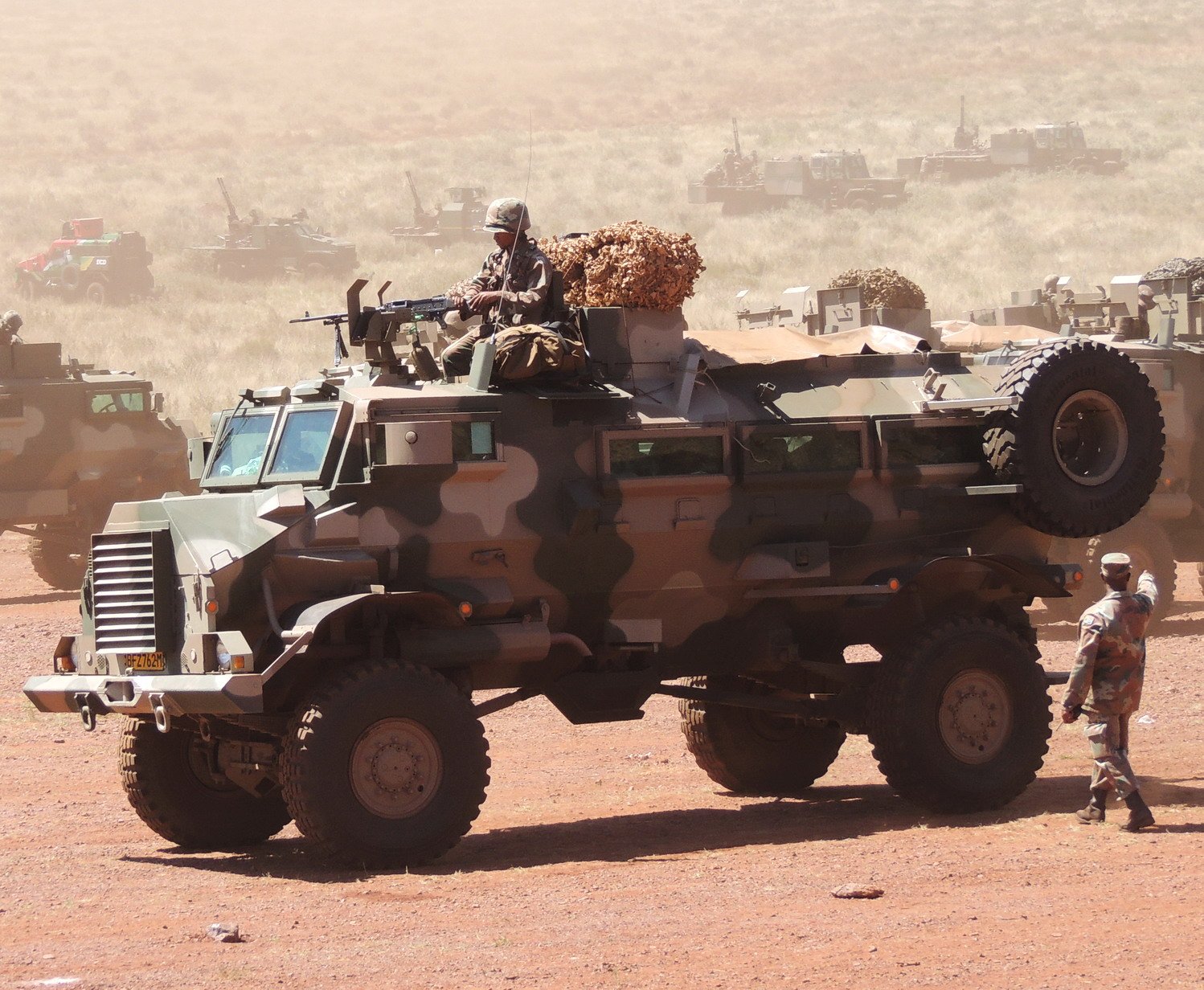
The 2025/26 defence budget (Vote 23) stands at R59 billion, up from R57.9 billion the year before, but will drop down to R57.6 billion in 2026/27 before increasing slightly to R59.8 billion in 2027/28, and R61.7 billion in 2028/29. This represents a 1.5% average growth rate, which is well below inflation and represents a decrease in real terms.
The Aerospace, Maritime and Defence Industries Association of South Africa (AMD) said it welcomed the overall increase in national funding for security and defence. AMD CEO Sandile Ndlovu said the allocations reflect a growing recognition that safety and security are foundational to economic growth and social stability. Ndlovu noted that the strengthened allocation represents a critical investment in safeguarding South Africa’s sovereignty, supporting regional stability, and enabling the country’s defence industry to continue contributing advanced capabilities to national and continental security priorities.
Government will allocate R1 billion to the South African Police Service and another R1 billion to the South African National Defence Force (SANDF) from the Criminal Assets Recovery Account (CARA) to bolster the fight against organised crime.
“The increased investment in defence and security is a welcome and necessary step toward strengthening South Africa’s ability to protect its people, its borders, and its sovereignty,” he said.
Ndlovu added that the increased funding comes at a crucial time, as South Africa is emerging from a period marked by sustained defence budget cuts.
“AMD extends its appreciation to the Minister of Finance, the Minister of Defence and Military Veterans Angie Motshekga and President Cyril Ramaphosa for recognising the strategic importance of reversing the downward defence spending trajectory,” he said.
He emphasised that while the 2026 Budget is a positive and encouraging step, the long‑term objective remains to raise defence spending closer to 2% of GDP, in line with international benchmarks.
Ndlovu reiterated that although the road ahead is long, the South African defence industry stands ready to work alongside government, industry partners, and all relevant stakeholders to strengthen national security and advance a safer and more resilient South Africa.
He added that this shift presents an opportunity to deepen collaboration between government and the local defence industry to ensure that national operations are supported by modern, locally developed and internationally sort after capabilities.
“As a strategic partner to the defence force, the South African defence industry stands ready to support government in equipping and sustaining the SANDF with locally developed and internationally recognised technology and equipment.”
Ndlovu also highlighted that while South Africa produces world‑class defence and security technologies, most of these capabilities are exported. This presents a significant opportunity for increased local adoption to strengthen domestic operations.
According to Ndlovu, industry leaders remain firmly committed to supporting government in building a secure, stable, and resilient South Africa. Ndlovu added that AMD’s long‑term national security vision focuses on strengthening partnerships across government, the defence industry, and local communities.
Through sustained investment, increased public awareness, and deeper collaboration, AMD and its members aim to enhance national security and contribute to a safer and more resilient society for all South Africans.
“A safe nation is the foundation of economic growth. Sustained and predictable investment in defence and security drives innovation, supports advanced manufacturing, and creates skilled jobs,” Ndlovu said.
“The commitments announced in this Budget represent important progress, and maintaining this investment trajectory will be critical to long‑term public safety, resilient institutions, and sustainable economic growth,” Ndlovu concluded.
Defence budget shows government ‘not serious’ about defence
Defence analyst Dean Wingrin said the latest defence budget figures reflect a meagre increase in nominal terms, that falls short of what is actually required. The additional R2.7 billion added to defence spending over the next three years to improve operations, including maintain the SA Air Force’s fighter capability, is primarily for repair and sustainment.
“The R2.7 billion, which should be included in the budget anyway, slows decline, it doesn’t expand capability. It helps keep existing aircraft flying/ships sailing. It does not represent a net increase in South Africa’s combat capacity.”
Wingrin pointed out the budget “once again shows that the Government and Treasury are not serious about Defence, despite recent utterances by the President and Defence Minister.” He noted the annual increase of 1.5% over the medium term (through 2028/29) is a reduction in real terms of 5% when factoring inflation in – an “absolute disaster for the SANDF”.
Defence spending equates to 0.79% of GDP, “considered very low for military spending relative to international benchmarks. This can still be viewed as a disaster for the SANDF and its abilities to carry out its missions. The Minister and Deputy Minister constantly state it will be increased to 1.5%!” Wingrin emphasised.
Carl Niehaus, the Economic Freedom Fighter’s (EFF’s) permanent representative on the Portfolio Committee on Defence and Military Veterans and the Joint Standing Committee on Defence, said the latest defence budget is a “betrayal” of the defence force.
“This budget does not merely underfund the SANDF; it condemns it to oblivion, representing a real-term decline in resources that mocks the President’s hollow commitments and accelerates the force’s spiral into decay and irrelevance,” he said.
“Defence spending languishes at approximately 0.8% of GDP, a betrayal of President Cyril Ramaphosa’s earlier solemn pledge to elevate it to 1.5%. This is not investment; it is deliberate starvation, ensuring that by the decade’s end, the SANDF will be little more than a shadow of its former self, incapable of safeguarding our borders or projecting power on the continent,” Niehaus stated.
He said his oversight visits back up the decline of the SANDF. “I recall a visit to the South African Air Force’s base in Hoedspruit, where rows of fighter jets—once symbols of our aerial prowess — sat grounded, their engines cannibalized for parts due to chronic underfunding. Pilots, highly trained and eager to serve, confided in me about flying hours reduced to a pitiful 6 210 in 2024/25, far below the targeted 12 000.
“Similarly, at the Naval Base and Armscor Dockyard in Simon’s Town, I inspected vessels that were non-serviceable, their hulls corroded and electronics outdated, achieving only 3 717 sea hours against the budget’s aspirational 8 000. The R1.6 billion earmarked for vessel maintenance is a drop in the ocean, insufficient to combat piracy in the Mozambique Channel or stem the tide of illegal fishing, smuggling, and migration that erodes our maritime sovereignty.”
The EFF said it rejected the defence budget, with Niehaus calling for an immediate review to align defence spending with the promised 1.5% of GDP, the restoration of procurement integrity, modernisation of equipment, and rebuilding of morale.