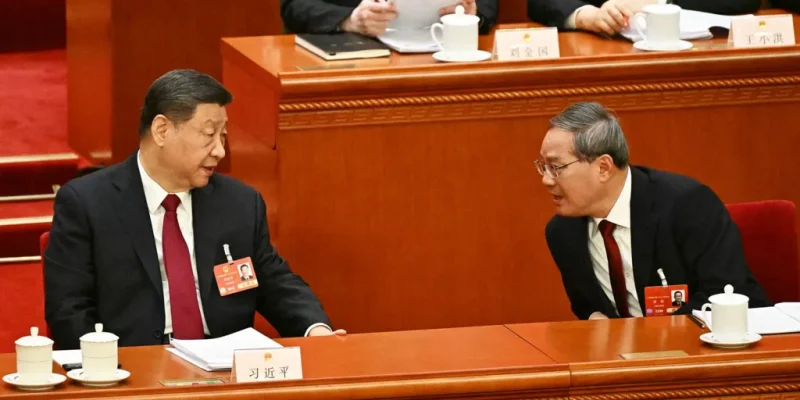

Chinese President Xi Jinping and Premier Li Qiang on 5 March. Photo Courtesy

Advertisement

China Sets Lowest Economic Growth Target Since 1991
China has lowered its annual economic growth target to between 4.5% and 5%, marking the slowest expansion goal since 1991.
The government last adjusted the target in 2023 when it set growth at “around 5%.” Authorities did not announce a target in 2020 because of the pandemic.
China now faces several economic pressures. These include weak domestic consumption, a shrinking population, a prolonged property crisis, global trade tensions and rising energy costs linked to the Iran conflict.
Key Announcements From the “Two Sessions”
Chinese leaders announced the new target during the country’s largest annual political gathering, widely known as the “Two Sessions.”
During the meeting, officials also revealed early details of the 15th Five-Year Plan, which will guide economic policy in the world’s second-largest economy.
According to analysts, the lower growth target allows the government to manage the economy more carefully.
Jason Bedford from the East Asian Institute said the flexible target gives China more room to manage the economy without making huge financial commitments.
He added that China used similar flexible targets during the pandemic, although such an approach is not common.
The Two Sessions began on Wednesday and usually runs for about a week. The event brings together top leaders for several policy discussions and legislative meetings.
New Economic Strategy and Investments
Premier Li Qiang presented the new economic plans in a 46-page government report.
The report outlines China’s development strategy through 2030. Lawmakers will vote on the full plan during the final day of the meeting.
The government plans to invest heavily in innovation, high-tech industries, scientific research and consumer spending initiatives.
Officials hope these investments will strengthen domestic demand. At the same time, they want to reduce China’s heavy reliance on exports.

Chinese President Xi Jinping and Premier Li Qiang on 5 March. Photo Courtesy
Major Infrastructure and Technology Plans
The government also plans to launch more than 100 major projects over the next five years.
These projects will expand China’s industrial capacity in several sectors including science and technology, transportation and energy infrastructure.
In addition, Beijing wants to strengthen its position as a global technology powerhouse. Authorities plan to expand the use of artificial intelligence across key industries.
China will also continue pushing its green energy transition. The government aims to reduce carbon emissions while improving environmental protection.
Demographic Challenges Threaten Growth
China also faces serious demographic challenges.
The government plans to build what officials describe as a “childbirth-friendly society.” Policies will focus on employment, education and healthcare support for families.
These efforts come as China struggles with an ageing population and falling birth rates, both of which threaten long-term economic growth.
Slowing Economic Momentum
Earlier this year, official figures showed that China met its 5% economic growth target for 2025.
However, growth slowed to 4.5% in the final quarter of the year. Weak domestic spending and the prolonged property crisis contributed to the slowdown.
Many regional governments have already adjusted their expectations. More than two-thirds of China’s provinces have lowered their growth targets or shifted their language to aim for growth around a specific level.
Policy analyst Zhou Zheng from China Macro Group said the new national target shows Beijing is taking a realistic approach to complex domestic challenges and a difficult global trade environment.